

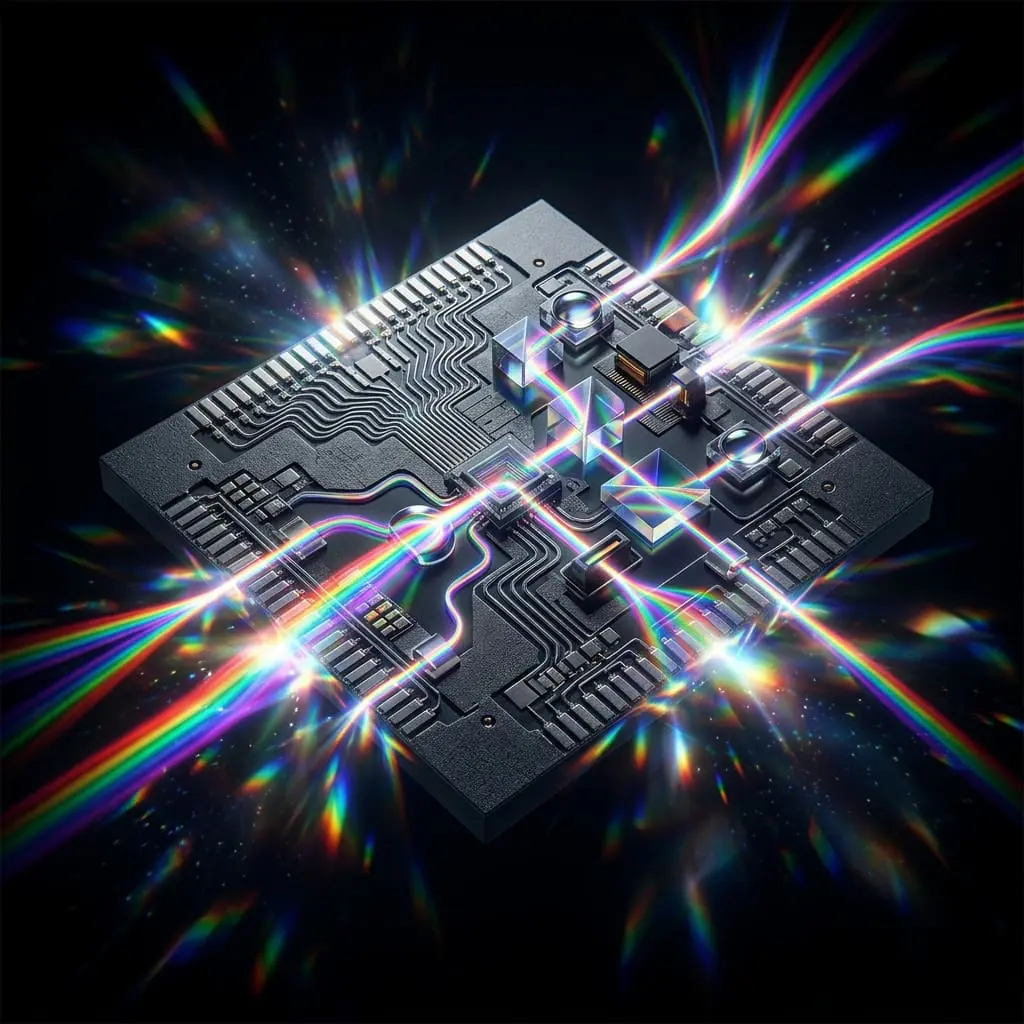
Shu Yang and colleagues at The University of Hong Kong and 1Department of Physics and HK Institute of Quantum Science and Technology demonstrate a programmable photonic mesh lattice capable of simulating the dynamics of open quantum systems, which lose phase coherence through environmental interactions. The lattice enables continuous transition between coherent and incoherent quantum walks, revealing how directional transport changes under varying levels of dephasing and non-Hermitian drive. By using non-Hermitian skin dynamics as a measurement tool, the team quantify the crossover between coherence-enhanced and decoherence-enhanced transport, confirming their findings with quantum-channel simulations and establishing a flexible platform for exploring open quantum systems.
The team engineered a programmable photonic mesh lattice to simulate open quantum systems, key for bridging the gap between idealised quantum physics and realistic, dissipative environments. The lattice functions as a platform where light particles mimic the behaviour of quantum particles, allowing precise control of the system’s properties; specifically, they introduced controlled ‘phase noise’, deliberate disturbances to the light’s wave properties, to simulate environmental interactions that cause decoherence. This setup allows continuous adjustment between coherent and incoherent quantum walks, probing how directional transport changes under these conditions, with the team focusing on a one-dimensional lattice with sites supporting two internal states. The underlying principle relies on the Liouvillian framework, a mathematical formalism extending the standard Schrödinger equation to describe the evolution of density matrices, which are necessary to represent mixed quantum states, those lacking perfect phase coherence, accurately. This is crucial because real-world quantum systems are invariably subject to environmental influences, leading to decoherence and the loss of quantum information.
Enhanced centre-of-mass drift velocity enables observation of the Liouvillian regime in photonic
A centre-of-mass drift velocity exceeding 0.7 lattice spacings per cycle was achieved, representing a threefold increase compared with previous coherent systems that limited themselves to a maximum of 0.2. This significant enhancement in velocity facilitated careful optimisation of the lattice geometry and the control parameters governing the photonic quantum walk. The increased speed allowed for the observation of the Liouvillian regime, previously unobservable due to the inability to resolve dynamics between fully coherent and incoherent behaviours. The Liouvillian regime describes the system’s evolution under the influence of both coherent and incoherent processes, where the density matrix evolves according to the Liouville-von Neumann equation. This equation accounts for both unitary (coherent) and non-unitary (dissipative) dynamics. Controlled phase noise within a photonic mesh lattice bridged the gap between ideal quantum simulations and realistic, dissipative environments, allowing continuous interpolation between predictable quantum walks and random classical walks. Spatial and temporal interfaces programmed themselves to observe interface accumulation, revealing a long-time drift governed by the instantaneous channel characteristics. The accumulation at interfaces provides a sensitive probe of the non-Hermitian dynamics and the interplay between coherence and decoherence.
While these results establish a controllable photonic platform for simulating open quantum dynamics, current numbers do not yet demonstrate scalability to complex systems or address the significant engineering challenges required for practical quantum technologies. The observation of the Liouvillian regime enabled this advancement, a state previously inaccessible due to limitations in resolving dynamics between fully coherent and incoherent behaviours. Adjustable dephasing created itself by introducing controlled phase noise, effectively transitioning the system from predictable quantum walks to random classical walks, and allowing exploration of how the system’s behaviour changes with varying levels of disturbance. The ability to tune the degree of dephasing is critical, as it allows researchers to investigate the transition between quantum and classical behaviour and to understand how environmental noise affects quantum information processing. This offers insights into realistic quantum processes and potentially improves quantum technologies. Specifically, understanding how to mitigate decoherence is paramount for building robust quantum computers and communication networks.
Controlling partially maintained quantum states through Liouvillian dynamics
The University of Hong Kong and the HK Institute of Quantum Science and Technology researchers have demonstrated a new level of control over open quantum systems, bridging the gap between idealised simulations and the messy reality of environmental interactions. The team’s photonic mesh lattice provides a novel means of examining open quantum systems, moving beyond simulations limited to either fully coherent or incoherent conditions. A gradual transition between predictable quantum behaviour and random classical movement was observed by precisely controlling disturbances, or ‘noise’, within this lattice, accessing the previously elusive Liouvillian regime. The photonic lattice allows for the precise manipulation of single photons, encoding quantum information in their polarisation or other degrees of freedom, and guiding their propagation through the lattice structure.
Simulating genuinely open quantum systems, those interacting with unpredictable environments, remains exceptionally challenging, making this achievement significant as it establishes a highly controllable platform for studying these complex interactions. Previous demonstrations often existed at extremes, with either perfectly isolated, ‘coherent’ quantum states, or fully disrupted, ‘classical’ behaviours. Instead, this work explores the important middle ground where quantum characteristics persist despite environmental influence, offering insights into realistic quantum processes and potentially improving quantum technologies. The ability to explore this intermediate regime is crucial for understanding the fundamental limits of quantum computation and communication. The researchers employed non-Hermitian skin dynamics as a diagnostic tool, allowing them to quantify the crossover between coherence-enhanced and decoherence-enhanced transport. This technique relies on the observation of an accumulation of probability at the edges of the system, which is characteristic of non-Hermitian physics and provides a sensitive measure of the system’s openness. The findings are further corroborated by quantum-channel simulations, providing independent verification of the experimental results and strengthening the validity of the approach. This work paves the way for more sophisticated investigations into open quantum systems and their potential applications in quantum technologies.
The researchers successfully demonstrated a tunable open-system quantum walk using a photonic mesh lattice, allowing a gradual transition between coherent and incoherent behaviours. This is important because it provides a controllable platform to study how quantum systems interact with realistic, unpredictable environments, moving beyond simulations limited to perfect or fully disrupted conditions. By precisely controlling disturbances within the lattice, they observed a crossover from coherence-enhanced to decoherence-enhanced transport, confirmed by quantum-channel simulations. The authors programmed spatial and temporal interfaces to further demonstrate interface accumulation and long-time drift governed by the instantaneous channel.
👉 More information
🗞 Observation of Non-Hermitian Skin Dynamics in the Liouvillian Regime
✍️ Shu Yang, Yeyang Sun, Lingrui Hong and Yi Yang
🧠 ArXiv: https://arxiv.org/abs/2606.27043
See today’s quantum computing news on Quantum Zeitgeist for the latest breakthroughs in qubits, hardware, algorithms, and industry deals.



