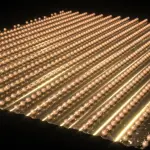
Wenxue He, Chen Wang, Fan Yang, and Hechen Ren of Tianjin University have experimentally demonstrated a new quantum phase within a square-octagon RLC circuit initially functioning as a gapped trivial insulator. The researchers introduced on-site loss to the circuit using patterned grounding resistors, maintaining fixed conservative couplings to induce a quadrupole topological transition. Impedance spectroscopy and spatial maps then revealed corner-localized responses consistent with the predicted phase, connecting dissipation-driven topology to observable boundary behavior in RLC circuits. These results offer a new way to control topology through dissipation.
Loss-Induced Quadrupole Topology in RLC Circuits
A square-octagon circuit, constructed from standard electronic components, has demonstrated a loss-induced quadrupole topology, starting from a configuration known as a gapped trivial insulator. The design frequency of the circuit was established at approximately 0.777 MHz, using capacitors of 100 nanofarads and 10 nanofarads, combined with 200 nanohenry inductors, to achieve a specific hopping ratio of 0.1, characteristic of the initial quadrupole phase. Measurements of the circuit without intentional resistive grounding served as a baseline for comparison with the loss-induced experiments.
Further experiments shifted the circuit’s parameters to a gapped trivial insulator, a state where the ideal Hermitian model predicts no topological behavior, by setting the hopping ratio to 10. Patterned grounding resistors, each with a measured mean resistance of 6.61 milliohms, were then connected to specific sublattices within the circuit. This precise application of resistance induced the topological transition, and the resulting changes were observed through both band spectra and spatial impedance maps.
The band spectra revealed a closure and reopening of the real line gap, a hallmark of the topological transition driven by the introduced loss. These maps, however, do not represent a static voltage field but rather capture the spatial distribution of the circuit’s response. The team observed that increasing the strength of the patterned loss enhanced the contrast of these corner responses within the same predicted phase, indicating a stronger localization of energy at the circuit’s corners.
Comparing two finite-loss configurations, the researchers found that stronger patterned loss resulted in enhanced corner contrast, further validating the predicted behavior. Simulations with a resistance of 10 milliohms showed that even with loss, corner enhancement persisted; at a loss level of 10 percent, the mean impedance magnitude at the four corner nodes was 12.007 times greater than the mean impedance magnitude at all non-corner nodes. These findings connect dissipation-driven topology to observable boundary responses in RLC circuits, offering a new avenue for controlling topological states through engineered energy loss.
The work builds on previous theoretical studies identifying finite-disorder regimes of corner localization in both Hermitian and non-Hermitian quadrupole insulators, and extends these findings to an experimentally realized system. “Studies of disorder effects on localization and boundary transport, as well as loss-induced delocalization, highlight this distinction between topology and response,” the authors write, emphasizing the importance of understanding how loss affects the fundamental properties of topological materials.
Square-Octagon Lattice Defines Phase Diagram & Loss Parameters
The square-octagon RLC circuit, designed as a gapped trivial insulator, served as the platform for experimentally observing a transition into a loss-induced quadrupole topological phase, a state where charge concentrates at the corners of the lattice. This realization hinged on the precise introduction of on-site loss through patterned grounding resistors, a method deliberately chosen to maintain fixed conservative couplings within the circuit. This careful control allowed researchers to isolate the effect of dissipation on the topological properties, differentiating it from changes caused by alterations in the fundamental circuit connections.
This transition was confirmed using biorthogonal nested Wilson loops, a mathematical tool for identifying topological invariants, and directly visualized through impedance spectroscopy and spatial maps. These maps revealed the predicted corner-localized responses, demonstrating that the circuit’s behavior aligned with theoretical predictions for the quadrupole phase.
The phase diagram itself, depicted in the study, shows the quadrupole index, a measure of the topological charge, varying with both the hopping ratio and the strength of the applied loss. Further investigation involved comparing two circuit configurations with differing levels of patterned loss, both operating within the established quadrupole phase. Measurements showed enhanced corner contrast at the higher loss configuration, indicating a stronger concentration of charge at the corners.
This enhancement, quantified by comparing impedance values, demonstrated that the visibility of the corner states increased with the strength of the dissipation, even while remaining within the same predicted topological phase. Specifically, the impedance at the corners was 1.452 and 3.870, respectively, when compared to noncorner nodes without intentional grounding loss, confirming the increased visibility. The design of the circuit itself is notable, using capacitors and inductors to implement hopping between sites and grounding resistors to independently control on-site loss.
This approach allows for a tunable system where the topological properties can be manipulated through dissipation, rather than solely through changes in the circuit’s geometry or material properties. The impedance of the circuit is directly linked to the inverse admittance matrix and its modal weights, providing a pathway to connect the predicted topological state to observable responses at the circuit’s corners. This connection is important for verifying the theoretical predictions and demonstrating the practical implications of loss-induced topology.
The study’s findings build on a growing body of work exploring the interplay between disorder, localization and dissipation in topological systems. Previous research has often treated dissipation as a detrimental effect, leading to attenuation and resonance broadening, but this work demonstrates its potential as a control parameter for manipulating topology.
This approach offers a new avenue for designing electronic devices with tailored boundary responses and opens up possibilities for exploring novel quantum phenomena. The persistence of corner enhancement even under simulated variations in capacitance and inductance further strengthens the robustness of the observed topological phase. The team’s work extends beyond simply demonstrating the existence of loss-induced quadrupole topology. It also provides a detailed characterization of the phase diagram and the factors influencing the visibility of the corner states.
The combination of theoretical modeling, circuit design, and experimental measurements provides a comprehensive understanding of this phenomenon and lays the groundwork for future investigations into the control and manipulation of topological states through dissipation. The ability to tune topology with loss, they suggest, could lead to the development of new types of electronic components and devices with unique functionalities.
Impedance Spectroscopy Reveals Corner-Localized Responses
Impedance spectroscopy confirmed the emergence of localized electromagnetic responses at the corners of a specially designed circuit, revealing a new quantum phase of matter. The square-octagon RLC circuit, initially a “gapped trivial insulator,” exhibited distinct behavior when subjected to carefully controlled energy loss, a departure from traditional approaches that often treat dissipation as a hindrance.
The team’s methodology hinged on a precise manipulation of the circuit’s properties; the patterned grounding resistors created on-site loss without altering the conservative couplings, a critical aspect of the experimental design. Band spectra and biorthogonal nested Wilson loops identified a transition driven by this loss, marked by the closure and subsequent reopening of a gap in the circuit’s response at specific frequencies.
This transition signaled a shift in the circuit’s topological state, a change that was then visually confirmed through spatial mapping of impedance. The measurements revealed that the corner-localized responses aligned with predictions for the newly established quadrupole phase, demonstrating a direct link between dissipation and observable boundary behavior. This finding suggests that the degree of corner localization can be actively tuned by controlling the amount of energy dissipation within the circuit.
Measurements of local impedance magnitudes at various frequencies, 0.241 MHz, 0.552 MHz, 0.839 MHz and 0.272 MHz, showed a progression from edge-dominated responses to a distinctly corner-dominated response at 0.839 MHz. The fabricated circuit itself comprised 4×4 unit cells, each containing capacitors with a value of 100 nF and 10 nF, alongside 200 nH inductors.
These component values yielded a hopping ratio of 0.1, falling below the critical threshold for the observed topological phase. The nominal design frequency of the circuit was approximately 0.777 MHz, placing the ideal model within the quadrupole phase. Further analysis revealed that the sample retained residual component losses, a factor accounted for in the data analysis. Simulations indicated that a ratio of at least 1.1 at a frequency matching the design frequency, ω = , signified a visible corner response.
This operational criterion focused on response visibility rather than the underlying bulk topological invariant. The observed behavior is a consequence of the circuit’s geometry and a direct result of the interplay between topology and energy loss. The researchers state in their published work.
Fixed Couplings Enable Loss-Driven Phase Change
This approach contrasts with previous methods that relied on modifying the inherent connections within the system to induce topological transitions. The team’s methodology extended beyond simply identifying a phase change; they quantified the resulting topological behavior through impedance spectroscopy and spatial mapping. This observation demonstrates that the strength of the loss can further refine the observable characteristics of the topological state, even without transitioning to a different phase.
The ability to tune corner contrast within a single phase is a novel aspect of this work, suggesting potential for fine-grained control over boundary responses. Simulations were then employed to assess the robustness of these corner enhancements, testing the circuit’s response under variations in both capacitance and inductance. These simulations indicated that the observed corner enhancement persisted even with moderate variations in these key circuit parameters, suggesting a degree of resilience against real-world imperfections.
The model underpinning the experiment, a square-octagon lattice with a π-flux pattern, was designed to facilitate the anticommutation of reflection operators, a critical ingredient for realizing the quadrupole construction. The normalized phase index, , served as a key indicator, transitioning from 0 in the trivial regime to 1 in the quadrupole phase as loss increased beyond a threshold value of ≃ 19.8 at a coupling ratio of λ = 10.
These losses, while unavoidable in any physical circuit, were accounted for in the analysis to ensure accurate interpretation of the observed topological behavior. “We have experimentally realized loss-induced quadrupole topology in a square-octagon RLC circuit whose ideal Hermitian limit is a gapped trivial insulator,” they state in their published work. The precise control over loss, combined with the preservation of conservative couplings, provides a unique pathway for manipulating topological states and engineering specific boundary behaviors.
The team’s work demonstrates that the visibility of these boundary responses depends not only on the bulk topological phase but also on the contributions of individual modes within the circuit. This understanding is important for optimizing the performance of future devices based on loss-driven topological principles.
👉 More information
🗞 Experimental realization of loss-induced quadrupole topology from a gapped trivial insulator in RLC circuits
✍️ Wenxue He, Chen Wang, Fan Yang and Hechen Ren (Center for Joint Quantum Studies and Tianjin Key Laboratory of Low Dimensional Materials Physics and Preparing Technology, Department of Physics, School of Science, Tianjin University, Tianjin 300350, China)
🧠 ArXiv: https://arxiv.org/html/2611.02435v1

See today’s quantum computing news on Quantum Zeitgeist for the latest breakthroughs in qubits, hardware, algorithms, and industry deals.