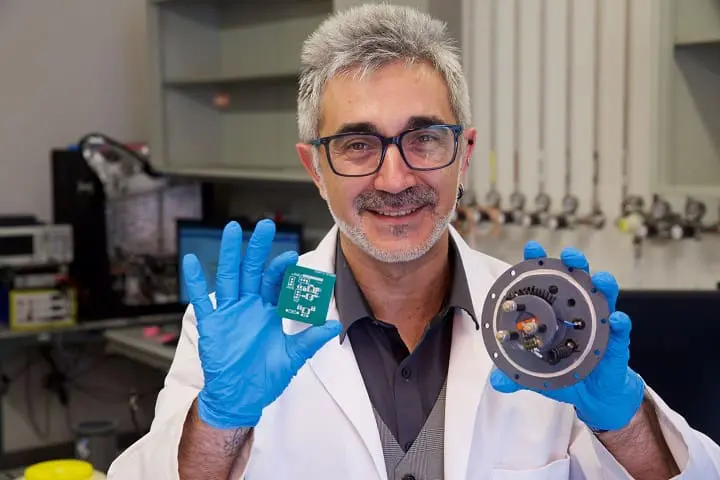
Researchers at the University of Alicante have, for the first time, identified gold structures measuring just three atoms thick and published their findings in Physical Review Materials. The team’s work details a new method for measuring distances at the nanometer scale, accomplished at room temperature, potentially impacting the future of molecular electronics research. While gold is known to form atomic chains at −269 °C when stretched, these structures help calibrate experiments in molecular electronics.
Room-Temperature Measurement via Mechanically Controllable Break Junctions
The UA team, based at the Quantum Transport Laboratory (QT-Lab), built upon their prior work demonstrating one- and two-atom-thick gold contacts, confirming that stable three-atom configurations can also exist under ambient conditions. The research hinges on mechanically controllable break junctions (MCBJ), a technique employed in fewer than a dozen centers globally, allowing for the precise stretching and breaking of metallic wires to create nanogaps. Carlos Sabater, a physics researcher at the UA and lead author of the study, explained, “Using advanced experimental techniques that allow extremely thin metallic wires to be stretched and broken in a controlled manner, together with simulations and first-principles calculations, we have unravelled the structure and geometry of gold atomic wires.” This precise control, combined with computational modeling, enabled visualization of the three-atom-thick gold structures, providing direct evidence of their existence.
Sabater emphasizes the practical implications of this room-temperature calibration system, noting that calibrating nanometric systems is extremely difficult without equipment costing millions of euros or cryogenic temperatures. The UA team’s innovation not only advances fundamental understanding of electronic transport at the atomic level but also addresses a critical bottleneck in the field by enabling research without relying on prohibitively expensive infrastructure. The QT-Lab has become a leading center in Spain for condensed matter and molecular electronics research by specializing in the development of its own experimental tools, including those fabricated via low-cost 3D printing, as commercially available equipment is often inaccessible or too expensive for many research groups.
Three-Atom Gold Nanocontacts Advance Electronic Transport Understanding
This discovery, detailed in the journal Physical Review Materials, builds upon the UA team’s earlier work identifying gold contacts one and two atoms thick and significantly refines understanding of how electrons move through these incredibly constricted pathways. The ability to reliably create and study these three-atom structures opens possibilities for designing more efficient and precise electronic components at the nanoscale. The UA team’s work isn’t solely focused on material discovery; they’ve also developed a new calibration system for nanometric devices that operates without the need for expensive equipment or cryogenic cooling. This calibration system has already been successfully tested in laboratories across the Netherlands, Belgium, and Germany, suggesting its broad utility and impact on the field.
According to Sabater, this emphasis on self-reliance is crucial for fostering innovation, particularly in specialized fields. The published findings, titled “Electronic transport in three-atom-thick gold nanocontacts: Revealing atomic geometries and applications,” and accessible via DOI /3z2q-cm7x, suggest a new course for future electronics, according to Sabater.



See today’s quantum computing news on Quantum Zeitgeist for the latest breakthroughs in qubits, hardware, algorithms, and industry deals.