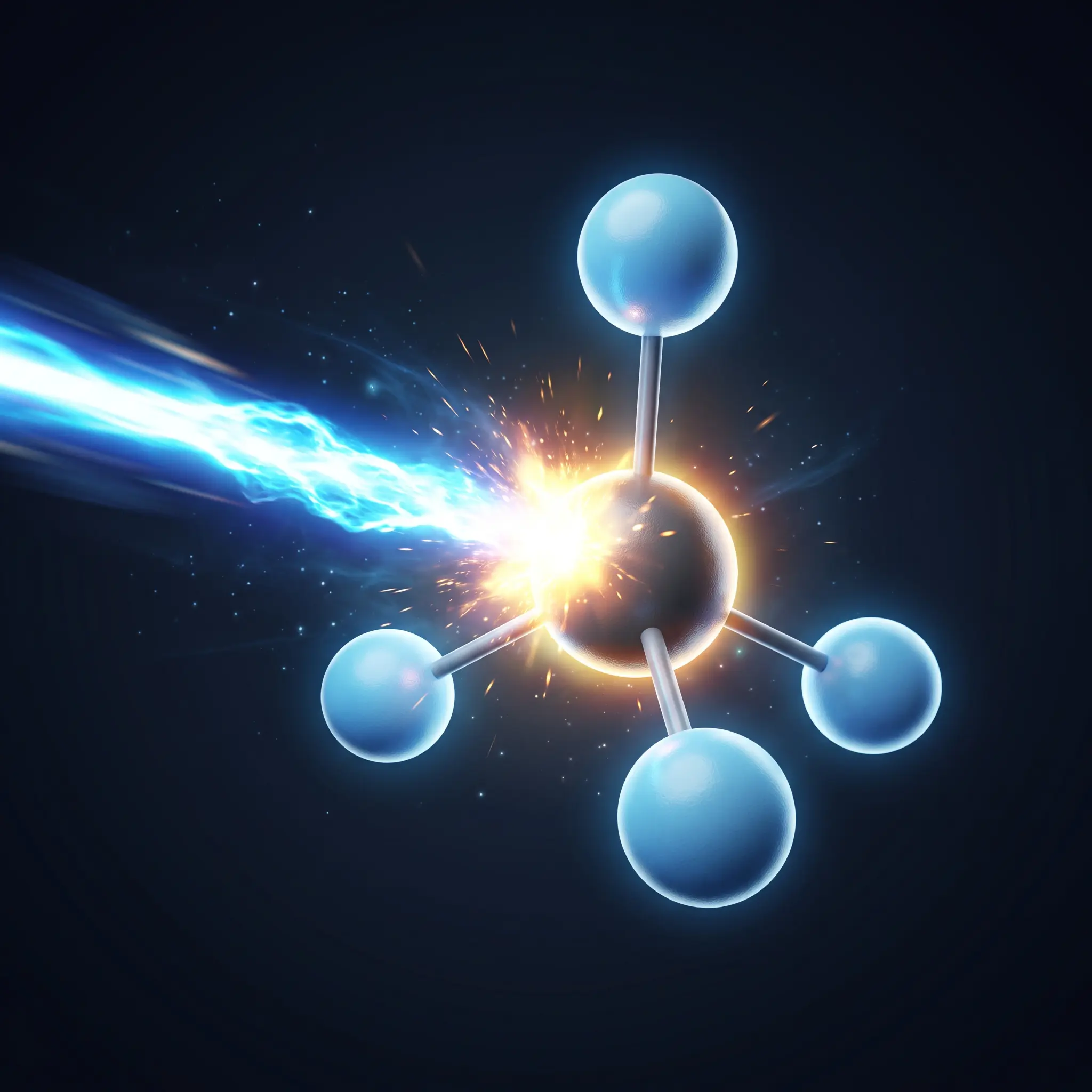
Researchers at Texas A&M University have developed a laser technique that directly measures the quantum forces shaping proteins, a feat previously impossible for scientists working without this capability for decades. Called Thermostable Raman Interaction Profiling (TRIP), the method offers a real-time view of the atomic forces that govern protein interactions and pharmaceutical drug efficacy. When the team tested TRIP on a key coronavirus protein, the results were significant; the technique not only revealed structural changes but also accurately predicted how effectively antiviral drugs would bind to and work against it. “For the first time, we can directly measure molecular forces at their most fundamental level,” said Dr. Narangerel Altangerel, assistant research scientist in the Department of Electrical and Computer Engineering and lead researcher of the project.
TRIP Technique Directly Measures Quantum Forces in Proteins
Visualizing the subtle quantum interactions within proteins has long been a goal for researchers, and a team at Texas A&M University has now developed a method to do just that. This innovation addresses a longstanding challenge in biophysics; for decades, scientists acknowledged the influence of these quantum forces but lacked the tools to quantify them within complex biological systems. The core of TRIP lies in its ability to detect pi-pi stacking, a subtle geometric interaction between ring-shaped molecules crucial to protein structure and function. “Pi-pi interactions are a cornerstone of biology, materials science and drug design. They hold the 3D structuring of molecules like DNA and proteins in living systems and play a major role in how medications work,” explains Dr. Philip Hemmer, professor of electrical and computer engineering at the Texas A&M University College of Engineering.
Traditional methods like X-ray crystallography and mass spectroscopy provide structural information, but rely on interpretation rather than direct measurement of these forces. TRIP, however, utilizes a Raman-based approach, firing a laser at a sample and analyzing the resulting vibrational signals to reveal the subtle shifts indicative of pi-pi stacking. The team focused on the main protease (Mpro) of the SARS-CoV-2 virus as a proving ground for their technique, recognizing its dependence on pi-pi stacking for activation. They were able to uncover how the virus’ protein physically rearranged itself and predict how effectively antiviral drugs would bind to and work against it.
These changes were not random, but systematic and direct indicators of vibrational shifts. The researchers extended their investigation to assess the effectiveness of antiviral drugs against Mpro, using TRIP to monitor the interaction in real-time. A clear correlation emerged: stronger antiviral medications corresponded with more pronounced vibrational signatures, accurately predicting drug potency. “It was an exciting result,” Altangerel notes. “A quantum-scale interaction predicted real-world biological performance.” This predictive capability extends beyond virology; the team envisions applications in cancer research, where TRIP could evaluate drugs targeting protein networks, and in Alzheimer’s disease, where it could assess compounds stabilizing healthy brain proteins. “We can directly use these measurements as a predictive tool for drug development, extending far beyond a single virus or disease.” The team offers a real-time view of the atomic forces that shape proteins and introduces a powerful invention for drug discovery and development.
Pi-pi interactions are a cornerstone of biology, materials science and drug design. Think of them as biology’s Velcro. They hold the 3D structuring of molecules like DNA and proteins in living systems and play a major role in how medications work.
Dr. Philip Hemmer Professor of electrical and computer engineering Texas A&M University College of Engineering
Pi-Pi Stacking Reveals Hidden Molecular Interactions
The pursuit of understanding molecular interactions has long been hampered by the inability to directly observe the subtle forces governing protein behavior; for decades, researchers relied on indirect methods to infer these critical relationships. This advancement isn’t simply about observing these interactions, but offers a new technique for drug discovery and development. Think of them as biology’s Velcro. For years, scientists have recognized the importance of pi-pi stacking, but lacked the tools to quantify its influence directly, hindering efforts to harness its potential in therapeutic design. The team discovered that the vibration of the amino acid phenylalanine serves as a sensitive indicator of pi-pi stacking; as molecules stack, this vibration shifts, providing a measurable signal. “We turned molecular vibrations into a readable signal. This approach allows for a non-invasive assessment of molecular forces, potentially expediting the testing and pre-screening of pharmaceutical drugs.” By monitoring the vibrational signature of Mpro, they observed how the virus’ protein physically rearranged itself. Crucially, the team then tested the technique’s ability to predict how effectively antiviral medications would bind to and work against the protein, finding a clear correlation between drug potency and the vibrational changes. “It was an exciting result,” Altangerel states, highlighting the ability of a quantum-scale interaction to predict real-world biological performance.
We turned molecular vibrations into a readable signal. It’s like listening to the music of a molecule and hearing how its internal forces change in real time.
Altangerel
TRIP Validated by Predicting Coronavirus Protein Behavior
Researchers at Texas A&M University are developing a new approach to understanding protein behavior, moving beyond observation to predictive capability with a laser-based technique called Thermostable Raman Interaction Profiling, or TRIP. The innovation stems from a longstanding challenge in biophysics: directly measuring the subtle quantum forces governing protein interactions, a feat previously described as working “blindfolded” for decades. Unlike conventional methods, TRIP doesn’t rely on indirect inference but instead directly assesses these forces, offering a real-time view of the atomic interactions critical to biological function. The team, led by assistant research scientist Dr. Narangerel Altangerel, tested their new technique on a key coronavirus protein, and the results were significant. Not only did TRIP uncover how the virus’ protein physically rearranged itself, it accurately predicted how effectively antiviral drugs would bind to and work against it.
The project, published in Science Advances, offers a real-time view of the atomic forces that shape proteins and introduces a powerful invention for drug discovery and development. The true power of TRIP became apparent when the researchers exposed the viral protein to various antiviral medications. A clear correlation emerged: the stronger the drug’s antiviral potency, the more pronounced the vibrational signature detected by TRIP.
DFT is a quantum mechanical method that relies on using supercomputers to model and study phenomenon like pi-pi stacking.
Hemmer
Applications of Quantum Precision in Drug Development
The promise of tailored therapies, designed at the molecular level to maximize efficacy, is rapidly moving from aspiration to reality thanks to advances in quantum-based measurement techniques. Unlike traditional methods that rely on indirect inference, TRIP provides a real-time view of atomic forces, enabling scientists to design drugs that interact with them at a fundamental level. The implications extend far beyond a single disease; the forces TRIP captures are integral to the very architecture of life. “Proteins are one of the building blocks of life,” explains Dr. Hemmer. “What we are doing is shining a light, literally, on the mechanism that holds them together, which are fundamental to how pharmaceutical drugs work.” This capability opens doors to evaluating drug candidates for complex conditions like cancer, where disrupting protein networks is crucial, and Alzheimer’s disease, where stabilizing healthy proteins could slow neurodegeneration.
The ability to directly observe how drugs target viral protein machinery also promises to accelerate the identification of promising candidates before costly clinical trials begin. The team overcame this challenge by utilizing a Raman-based approach, analyzing the unique vibrational signals emitted when a laser interacts with a sample. Changes in this vibration, detected in real-time, provide a direct readout of the interaction’s strength. This predictive capability is a significant advancement. The research, published in Science Advances, offers a powerful invention for drug discovery and development. “By understanding these quantum interactions directly, we can start designing medicines with a level of precision that wasn’t possible before, applied to a spectrum of diseases,” Altangerel concludes.
By understanding these quantum interactions directly, we can start designing medicines with a level of precision that wasn’t possible before, applied for a spectrum of diseases.
Dr. Narangerel Altangerel Assistant Research Scientist, Department of Electrical and Computer Engineering Texas A&M University


See today’s quantum computing news on Quantum Zeitgeist for the latest breakthroughs in qubits, hardware, algorithms, and industry deals.