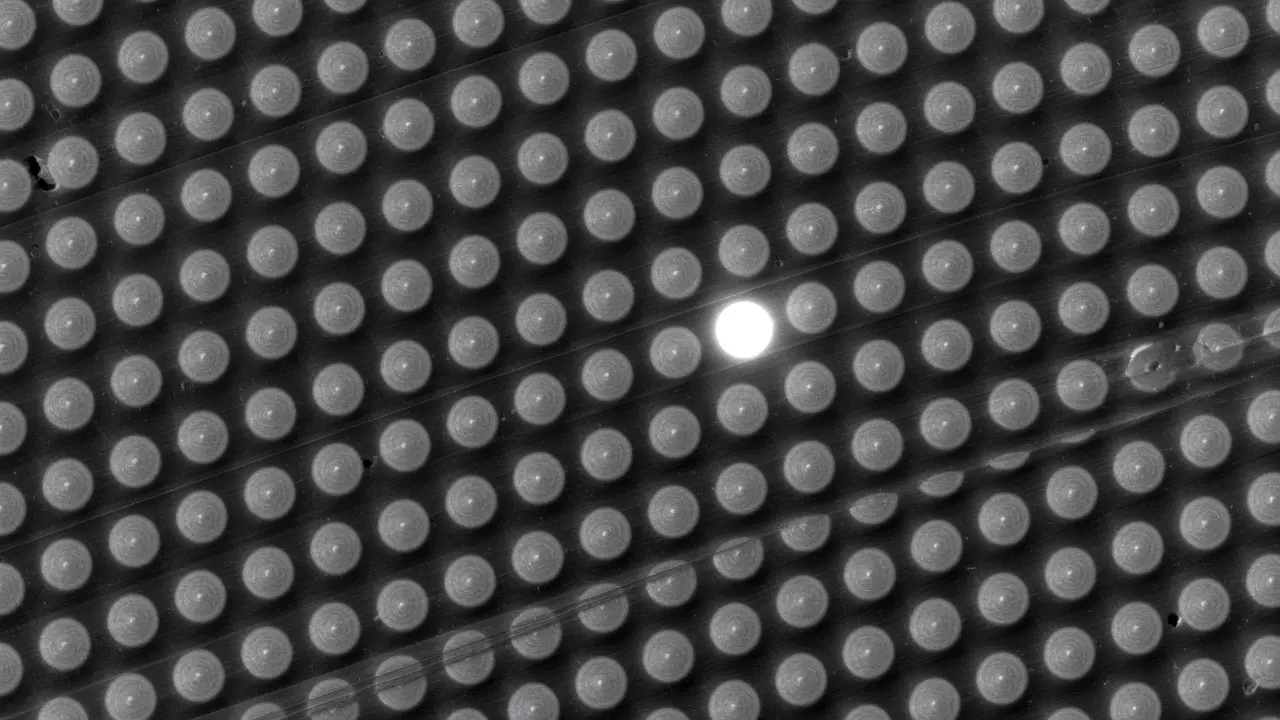
Silicon Quantum Computing has fabricated the first integrated circuit manufactured at the atomic scale, a feat achieved two years ahead of its projected timeline, SQC says. The Australian company used its new analogue quantum processor to accurately model a small polyacetylene molecule, validating the technology’s potential for simulating quantum systems.
Says SQC Founder and CEO Michelle Simmons, adding that the development will allow for the construction of quantum models for new materials, “whether they be pharmaceuticals, materials for batteries, or catalysts.” This achievement, stemming from two decades of research led by Simmons, positions Sydney, Australia as a key hub in advanced quantum computing manufacturing.
Atomic Precision: SQC’s Integrated Circuit Manufacturing Feats
This successful modeling, achieved with an analogue quantum processor, validates SQC’s approach to building quantum hardware focused on precision rather than sheer scale. The integrated circuit’s construction required the precise integration of multiple atomic components, a process completed at SQC’s facility in Sydney, Australia. This achievement arrives two years ahead of the company’s initial projections and less than a decade after SQC fabricated the first single atom transistor in 2012, highlighting a rapid pace of development, according to the company.
“With critical and emerging technologies such as quantum hardware, stakeholders gain huge confidence from the technical team’s ability to meet stated milestones,” said Stephen Menzies, SQC Chair, emphasizing the significance of consistently exceeding expectations. The team overcame substantial engineering challenges to realize the circuit, including creating atomic dots of uniform size to align energy levels for electron passage.
Controlling the energy levels of each dot, both individually and collectively, was another critical step in enabling the quantum transport of information. The team achieved sub-nanometre precision in controlling the distances between these dots, ensuring they remained independent while close enough for coherent electron transport, the company says. The development of this atomic-scale circuit represents a culmination of 20 years of research led by Simmons, delivering on a challenge first postulated by theoretical physicist Professor Richard Feynman in his famous 1959 lecture Plenty of Room at the Bottom.
SQC’s breakthrough meets the stringent requirements for scaling quantum computing hardware and marks a major technical milestone in the company’s pursuit of an error-corrected processor. The ability to accurately model molecules like polyacetylene demonstrates a capability that classical computers struggle with, due to the exponential increase in computational complexity with molecular size.
The company is now focused on scaling its quantum hardware to tackle more complex computational tasks beyond the reach of traditional computers. This scaling process will involve addressing more industrially relevant molecules, with SQC actively seeking partnerships to address specific simulation needs.
“SQC is now scaling the technology to address more industrially relevant molecules and we look forward to developing targeted industry partnerships to address their simulation needs,” Menzies added. The Hon Ed Husic MP, Minister for Industry and Science, acknowledged the significance of this achievement, stating, “SQC’s breakthrough in quantum computing is big news and a terrific reflection on the quality of local know-how. It’s providing a clear pathway for new and emerging technologies to support our world class industries.” The success of SQC’s atomic-scale integrated circuit is not merely a technical achievement; it is a validation of the company’s entire approach to quantum computing.
The company, formed in 2017 with funding from the Commonwealth of Australia, Sydney, Telstra Corporation, the Commonwealth Bank of Australia and the State of New South Wales, has assembled a team and established unique laboratories to further its program. SQC’s commitment extends beyond the processor itself, encompassing the development of a ‘full stack’ quantum computer to ensure a useful and manufacturable quantum device. Simmons concluded, signaling a new era in quantum simulation and materials discovery.
The exquisite precision of the device validates SQC’s technical strategy to focus on quality as opposed to quantity.
Michelle Simmons, SQC Founder and CEO




See today’s quantum computing news on Quantum Zeitgeist for the latest breakthroughs in qubits, hardware, algorithms, and industry deals.