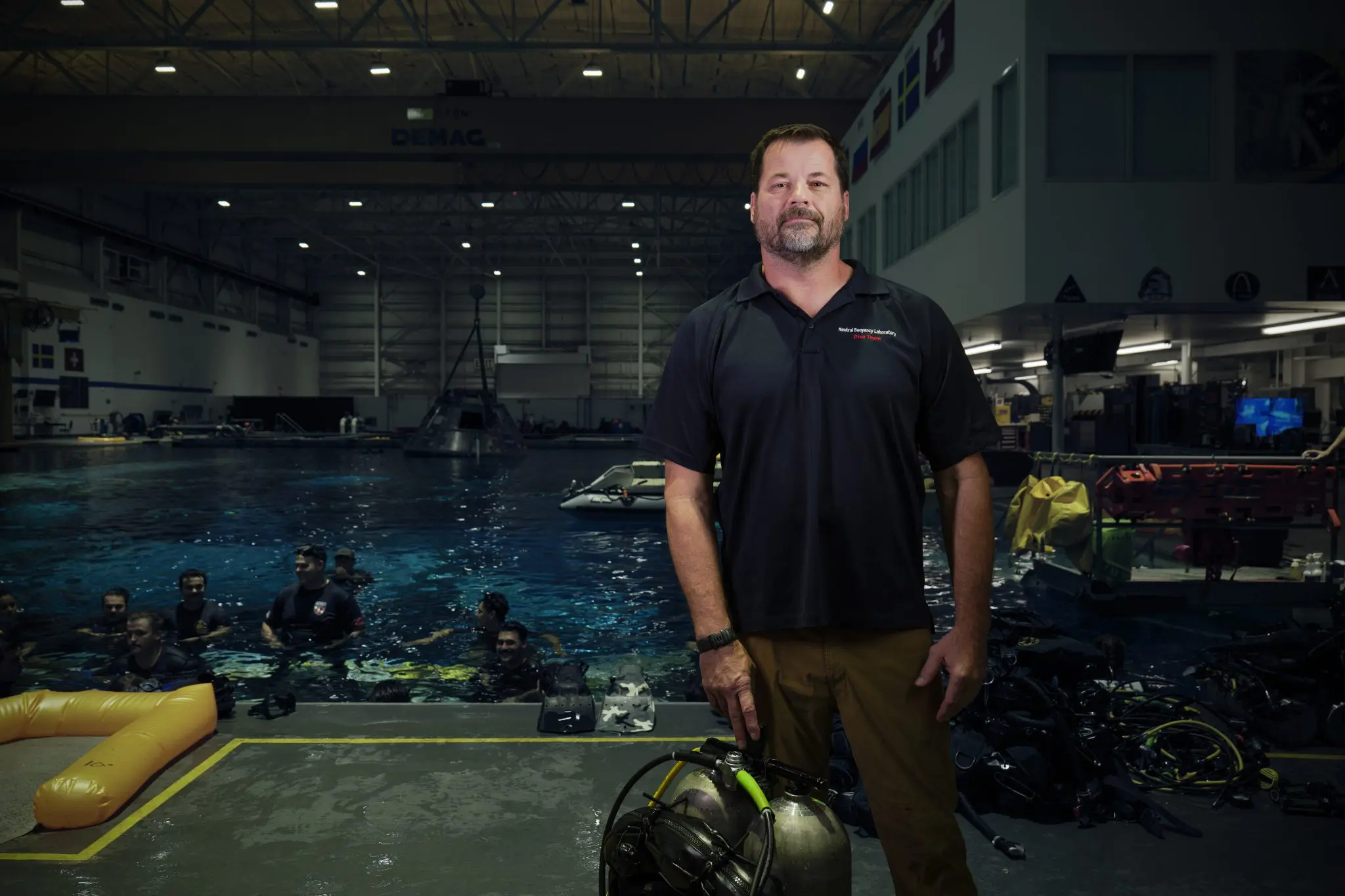
The successful return of the Artemis II astronauts to Earth relied on a large and meticulously prepared at-sea team; six small boats worked with four helicopters and a Navy ship to recover the crew and their Orion spacecraft. Tim Goddard, NASA open water lead, is responsible for the design, certification, procurement, and training of both the NASA and Navy teams, and all the necessary hardware for this complex operation. Goddard explained that his team alone includes “over 50 folks in the water and in different boats,” with members positioned underwater, on the surface, and maneuvering small boats. This marks Goddard’s third Orion recovery, but the first with a flight crew onboard, shifting the primary focus from capsule retrieval to ensuring the astronauts’ immediate safety.
Navy teams, along with all associated hardware, were crucial for a safe recovery. This comprehensive oversight ensured a coordinated effort to retrieve both the astronauts and the Orion spacecraft from the Pacific Ocean, ultimately transferring them to a waiting Navy amphibious ship. The scale of the operation was considerable, involving a complex interplay of maritime and aerial assets. Goddard detailed that the team utilized six small boats and relied on four helicopters and the host Navy ship simultaneously. Beyond Goddard’s direct team, the larger operation encompassed Navy ship operations, communications, vessel traffic management, and critical medical support, demanding seamless orchestration of resources. The recovery of the spacecraft itself, after the crew was secure, could take up to nine hours within the Navy ship’s well deck.
Goddard’s team didn’t simply react on recovery day; they engaged in extensive preparation, beginning with training runs utilizing representative Orion hardware at NASA’s Neutral Buoyancy Laboratory in Houston. These exercises then transitioned to San Diego, progressing from bay operations to full open ocean simulations. “By the time they do the real mission, they have hours and hours on each type of facet or each phase of that recovery,” Goddard explained, emphasizing the importance of repetition. This was Goddard’s third Orion recovery, but with the addition of a flight crew, the priority decisively shifted. He acknowledged the increased weight of responsibility, adding that once the crew and capsule were recovered, he felt immense relief.
Neutral Buoyancy Laboratory Training for Orion Operations
Beyond the visible choreography of ships and helicopters surrounding a splashdown, the successful recovery of the Orion spacecraft relies heavily on meticulous preparation within the Neutral Buoyancy Laboratory at NASA’s Johnson Space Center in Houston. This facility, one of the world’s largest indoor pools, serves as the primary training ground for the combined NASA and U.S. Navy teams tasked with securing both the crew and the capsule following missions like Artemis II. The team practices extensively long before recovery day to ensure the complicated process goes smoothly. This intensive training isn’t a one-time event; Goddard’s team repeatedly practices the recovery sequence with representative Orion hardware, building proficiency through countless repetitions. The progression from simulations to bay operations in San Diego, and ultimately to open ocean conditions, ensures the team is prepared for the real-world challenges of a recovery.
Having previously overseen the recovery of Orion during Exploration Flight Test-1 and Artemis I, Goddard acknowledges a significant shift in focus with crewed missions. He said, underscoring the paramount importance of astronaut safety, a responsibility that brought “a lot of weight and stress” to the entire team.
This is a very complex set of operations.
Tim Goddard, NASA open water lead
Capsule Recovery Evolution with Crewed Artemis Missions
Tim Goddard, NASA’s open water lead, brings a unique depth of experience to the Artemis II recovery operation, stemming from a 27-year career as a Navy diver and subsequent work at NASA in the 1990s. This holistic approach is critical, particularly as the Artemis program transitions from uncrewed test flights to missions carrying astronauts. Goddard’s team has previously recovered the Orion capsule during Exploration Flight Test-1 and the Artemis I mission, but the inclusion of a flight crew fundamentally altered priorities. The scale of the recovery operation is considerable, involving a coordinated effort between multiple teams and assets. The team has six small boats in the water and relies on four helicopters and the host Navy ship simultaneously, with over 50 personnel in the water and in different boats. These exercises then progressed to San Diego, building proficiency through repetition.
This emphasis on preparation proved vital with Artemis II, as the primary focus shifted from capsule recovery to crew safety. “Once we get the crew safe and sound on the ship, we transfer our focus and shift our operations to the recovery of the capsule,” Goddard explained. The emotional weight of this responsibility was significantly amplified with human lives at stake; where previous missions brought elation upon securing the capsule, this time, the feeling of relief was “tenfold” once the crew was recovered and the capsule safely returned to San Diego. “Over half of my time at NASA has been supporting this operation,” Goddard stated, adding, “That’s a long time, and to finally have the Moon mission go off and bring the folks back, it’s an immense pleasure.”
Over half of my time at NASA has been supporting this operation.



See today’s quantum computing news on Quantum Zeitgeist for the latest breakthroughs in qubits, hardware, algorithms, and industry deals.