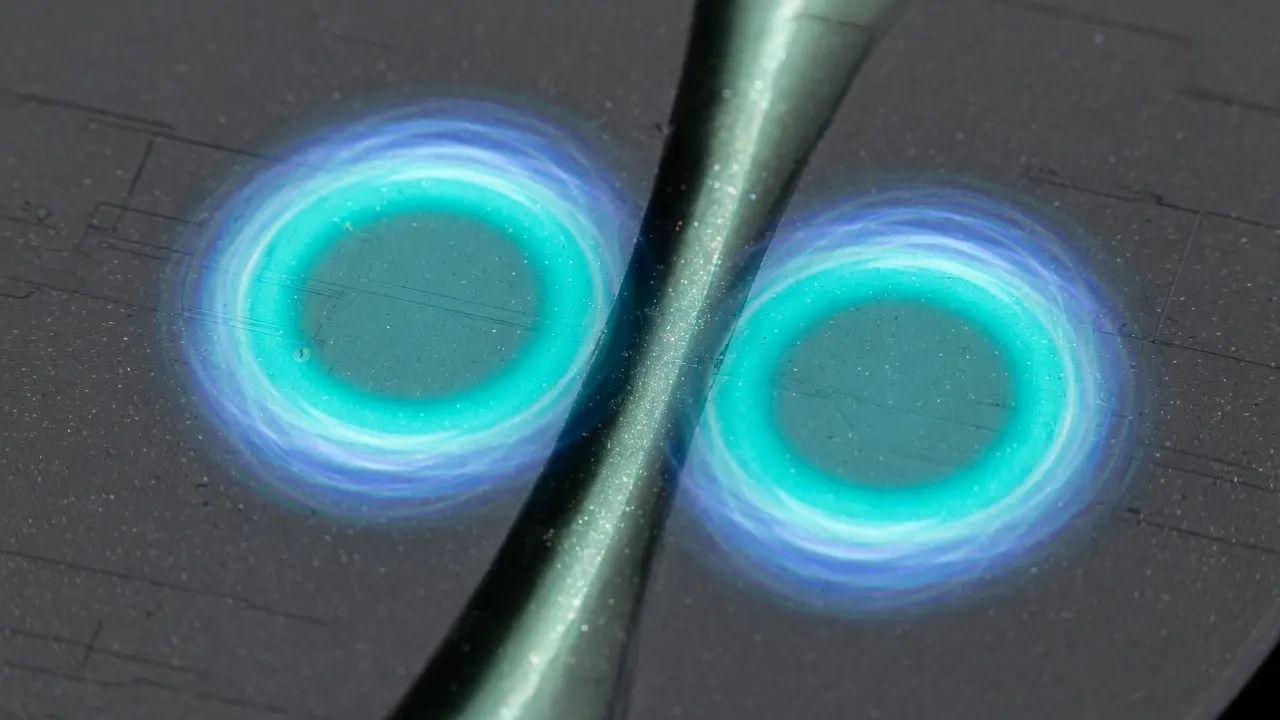
Researchers of China have, for the first time, directly observed the conversion of mesons into baryons, and back, using a cold-atom non-Abelian lattice gauge simulator. Here they realize a non-Abelian lattice gauge model with dynamical matter in an analog cold-atom simulator and directly observe its hadronic dynamics using site- and spin-resolved quantum gas microscopy. By tailoring resonant tunneling in a spin-dependent optical superlattice, the team characterized the conversion efficiency as a function of mass, gauge coupling and net baryon density.
Non-Abelian Lattice Simulation of Hadronic Dynamics
The realization of a truncated one-dimensional SU(2) quantum link model with independently tunable mass and gauge coupling enabled the tracking of an initial mesonic state’s conversion into baryonic or vacuum-like configurations through slow mass ramps. This control over fundamental parameters distinguishes this work from prior quantum simulations, which often faced limitations in manipulating non-Abelian gauge interactions. Researchers of China harnessed two hyperfine states and site-occupation configurations of ^(87)Rb atoms to jointly encode both matter and gauge fields, a technique that was essential to simulating the complex interplay of quarks and gluons.
The team’s approach circumvents challenges inherent in digital implementations, such as circuit depth and noise, by using the inherent coherence of a cold-atom system. Near resonance, the experiment revealed coherent oscillations between mesons and baryon-antibaryon pairs, a phenomenon predicted by quantum chromodynamics but difficult to observe directly.
Tian-Yi Wang of the Hefei National Laboratory, University of Science and Technology of China, and colleagues report, to their knowledge, the first cold-atom realization of a non-Abelian lattice gauge theory with dynamical matter. The team’s use of staggered particle-hole encoding to define hadronic identities, specifically distinguishing between mesons, baryons and vacuum states, was important for the observation. Hadronic identities depend on both the measured occupation and the matter sublattice, with the experiment encoding mesons on two bond sublattices, baryons and antibaryons and vacuum sites with holes and doublons.
This encoding scheme allowed for the precise tracking of particle conversions, revealing the underlying dynamics of the system. The ability to manipulate and observe these conversions represents a step toward understanding the behavior of strongly interacting matter at the most fundamental level.
The researchers’ work addresses long-standing challenges in simulating real-time dynamics and finite-density matter, which have historically been hampered by sign problems in conventional Monte Carlo methods. The precise control afforded by the cold-atom simulator, combined with the direct observation capabilities of quantum gas microscopy, promises to yield further insights into the strong force and the structure of hadrons.
This approach offers a complementary pathway to traditional theoretical models and experimental investigations at high-energy colliders, potentially bridging the gap between theoretical predictions and experimental observations. The findings provide a new platform for studying coherent meson-baryon conversion, potentially offering insights into the strong force that binds quarks together within protons and neutrons.
Encoding Matter and Gauge Fields with ^87Rb Atoms
The experiment’s methodology includes a Stern-Gerlach-type spin readout combined with site-resolved fluorescence imaging to distinguish between the atomic configurations representing different hadronic states. Following the dynamics, a magnetic-field gradient within a transverse superlattice separates the alpha and beta components into neighboring readout rows before the atoms are pinned for imaging.
This process allows for a detailed space-time map tracking the exchange between matter excitations and color-electric flux during successive conversion cycles. The observed dynamics establish an atomic platform for studying non-Abelian gauge dynamics, opening a pathway to microscopic investigations of nonequilibrium dynamics in strongly interacting matter, and providing a new tool for understanding the fundamental forces that bind quarks into hadrons.
Resonant Tunneling Implements SU(2) Quantum Link Model
Quantum gas microscopy reconstructed hadronic populations and color-electric flux, allowing for detailed observation of these particle conversions. The experimental setup uses the staggered potential and interaction-gradient detuning to independently tune the mass and gauge coupling, critical parameters in understanding the strong force. Slow mass ramps then distinguished between mesonic, baryonic and vacuum regimes, mapping the boundaries where these conversions occur. When mesonic and baryon-antibaryon configurations approached energy degeneracy, time-resolved measurements revealed repeated production and regeneration of baryon-antibaryon pairs.
The team quantified conversion efficiency by scanning across variations in mass and gauge coupling, and further investigated its dependence on ensembles exhibiting finite net baryon density. The SU(2) quantum link model, as implemented, is described by a Hamiltonian where fermionic matter-field operators and SU(2) gauge field matrix elements define interactions on each lattice link.
The researchers truncated the gauge links at = 1/2, retaining the j = 0,1/2 representations and working within a specific Gauss-charge sector, G_ℓ^2 = 2, G_ℓ^z = 1, to describe SU(2) gauge dynamics in a uniform background of static adjoint color charges. Simulations of the full Bose-Hubbard model on 20 sites also captured a delayed growth of a quantity denoted , visualizing changes in hadronic composition and the regeneration of meson bonds.
Local density maps reconstructed from spin-resolved snapshots revealed the matter excitation density and the link Casimir, providing a detailed picture of the conversion process. Specifically, a local meson-to-baryon-antibaryon conversion increased the matter excitation number from two to four, simultaneously changing the intervening link’s energy from 0 to 3/4.
This precise measurement of changes in these quantities provides a direct observation of the underlying dynamics, offering new insights into the behavior of strongly interacting matter and validating the analog simulation approach. The team’s work establishes a novel platform for exploring non-Abelian gauge theories, potentially circumventing limitations encountered in both digital quantum simulations and traditional computational methods.
Observed Meson-Baryon Oscillations via Microscopy
The team employed a transverse Stern-Gerlach separation technique to map the spin components onto distinct readout rows before imaging, allowing for the resolution of holes, single atoms and doublons, configurations essential for identifying the different hadronic states. This is particularly important because these configurations would otherwise be lost due to light-assisted collisions during standard imaging procedures. The team’s ability to observe these oscillations and quantify the conversion efficiency represents a step towards understanding the strong force that governs interactions within hadrons.
The researchers found that the system’s behavior strongly depends on the interplay between mass and gauge coupling, as visualized in their schematic diagrams showing the transition between mesonic, vacuum and baryonic regimes. By using an analog quantum simulator, the team has demonstrated a pathway toward simulating these complex systems without encountering the same computational hurdles.
Hadronic Regimes Characterized by Mass and Coupling
Each of the parallel one-dimensional chains, approximately 20 sites long and containing around 230 atoms in total, is a miniature laboratory for observing these conversions. Neighboring chains are separated by an initially empty lattice row, providing auxiliary sites for a Stern-Gerlach readout technique that measures the resulting particle populations.
These mass ramps, conducted over 100 milliseconds, correspond to 20. 6(4)ℏ/κ, with κ/h fixed at 32. 8(6) Hz and held constant, allowing for systematic investigation of the conversion boundaries. Distinguishing the three hadronic regimes, mesonic, baryonic and vacuum, relies on jointly analyzing the meson fraction and staggered polarization.
This observation emphasises the complex relationship between finite baryon density, mass and gauge coupling in shaping the observed conversion response. “The competition between quark-mass and color-electric energies that shapes the hadronic regimes also governs the dynamical conversion between mesonic and baryonic configurations,” the paper states, highlighting the fundamental physics at play. Pair annihilation, a key component of this cycle, reverses changes and restores low-Casimir links on the bonds where mesons initially formed.
These observations extend beyond simply confirming a predicted phenomenon; the simulator provides microscopic access to hadrons and color-electric flux, offering a unique platform for studying the dynamics of strongly interacting matter. This control allows for the observation of mesons, color-singlet baryons and their interconversion at finite net baryon density. The researchers have, in effect, realized an analog simulator of a truncated one-dimensional SU(2) gauge theory, providing a novel approach to understanding the complex behavior of quarks and gluons.
👉 More information
🗞 Coherent meson-baryon conversion in a cold-atom non-Abelian lattice gauge simulator
✍️ Tian-Yi Wang, Wei-Yong Zhang, Tie-Jin Zhong, Ming-Gen He, Zhao-Yu Zhou, Zhen-Sheng Yuan and Jian-Wei Pan (Hefei National Research Center for Physical Sciences at the Microscale and School of Physical Sciences, University of Science and Technology of China, Hefei, China); Hui Sun (Hefei National Laboratory, University of Science and Technology of China, Hefei, China)
🧠 ArXiv: https://arxiv.org/html/2611.31888v1


See today’s quantum computing news on Quantum Zeitgeist for the latest breakthroughs in qubits, hardware, algorithms, and industry deals.