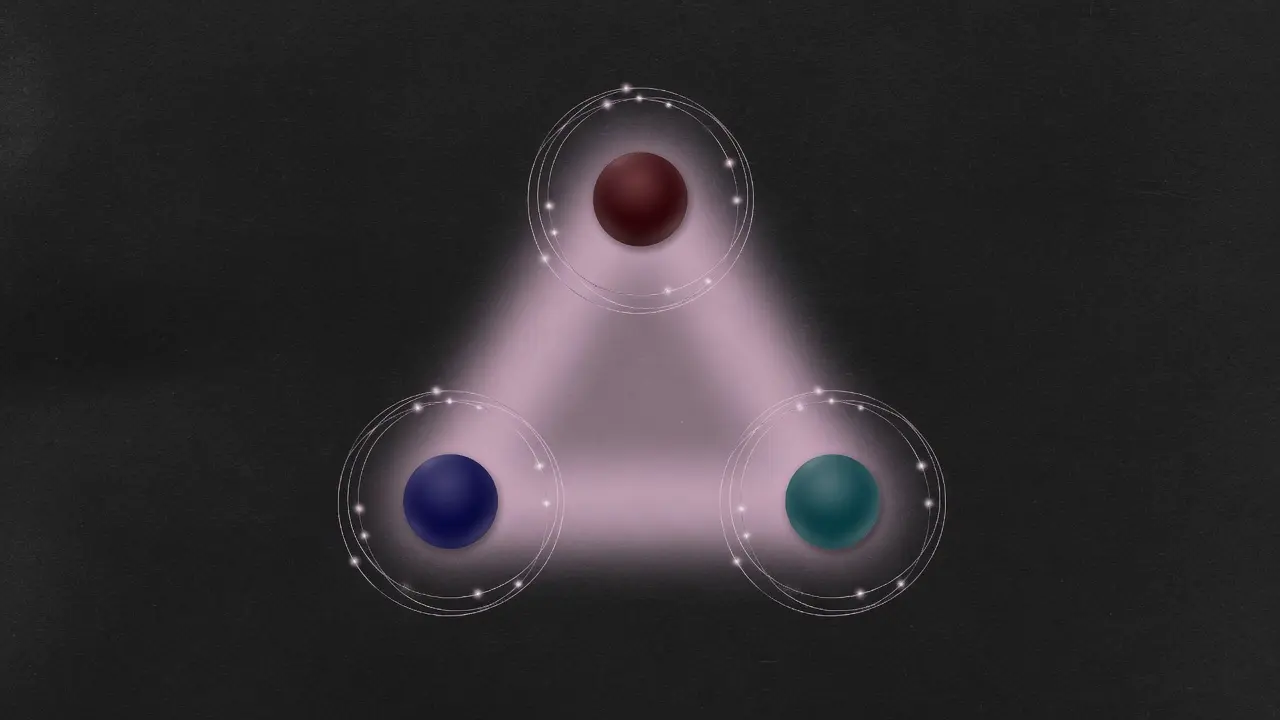
Researchers at the Korea Advanced Institute of Science and Technology and the University of Jyväskylä have demonstrated a quantum advantage in privacy-preserving data analysis using remarkably limited resources. Their work establishes that a single shared qubit pair is sufficient to outperform classical methods, even when each user communicates only one bit of information.
The team formulated a new framework, measurement local differential privacy, to protect private inputs and prove this advantage holds for various data types in high-privacy scenarios. These results demonstrate that quantum advantage in locally private hypothesis testing can persist under simultaneous constraints on entanglement dimension and classical communication.
Entanglement-Assisted Classical Communication for Privacy
Recent work demonstrates a quantum advantage in privacy-preserving hypothesis testing is achievable with only one shared qubit pair and one bit of classical communication per user, challenging expectations about the entanglement resources needed for such advantages. EACC relies on pre-shared entanglement between users and a server, with only classical messages exchanged during the process, a departure from previous demonstrations requiring direct quantum state transmission.
The study establishes that quantum local differential privacy (QLDP) classical-to-quantum channels can support measurement local differential privacy (MLDP)-compliant EACC simulations, a framework designed to protect private inputs from arbitrary shared quantum states and server-side measurements. In the high-privacy regime, certain optimal QLDP mechanisms can be realized with one-bit classical communication, albeit using high-dimensional entanglement. The ratio of the achieved error exponent to the optimal one under the LDP constraint is at least 5/4 for all alphabets of size v ≥ 3 and approaches 3/2 as v grows.
Measurement Local Differential Privacy (MLDP) Framework
Researchers demonstrated that any quantum local differential privacy (QLDP) classical-to-quantum (CQ) channel can be replicated by an EACC protocol adhering to MLDP, using generalized quantum teleportation. This simulation is not merely theoretical. It highlights a pathway for translating existing quantum privacy mechanisms into systems using shared entanglement and classical communication. This trade-off emphasises a key challenge in balancing communication overhead with the complexity of pre-shared quantum resources.
Further investigation focused on establishing the theoretical underpinnings of EACC implementations and developing protocols that achieve quantum advantage with limited entanglement and communication. This result is notable because it defies the expectation that substantial entanglement resources are necessary to outperform classical methods in privacy-preserving data analysis.
One-Bit Communication with High-Dimensional Entanglement
Investigations into entanglement-assisted classical communication (EACC) reveal a surprising efficiency; a quantum advantage in hypothesis testing can be maintained even when users transmit only one bit of classical information. Protocols were constructed using geometric arrangements of qubit measurements on the Bloch sphere, sometimes supplemented by shared classical randomness, to achieve this advantage.
These protocols demonstrably exceed the performance of optimal classical local differential privacy (LDP) mechanisms in the high-privacy limit for every non-binary input alphabet, meaning any input set with three or more possibilities. For symmetric hypothesis testing, the researchers used shared randomness to build the necessary protocols, achieving error exponents that surpass those of optimal classical LDP mechanisms even with the constraints of one-bit communication and a single qubit pair.
Quantum Advantage with Single Qubit Pair & One Bit
This finding challenges the expectation that substantial entanglement is necessary to realize a quantum speedup in privacy-preserving tasks. These newly developed protocols build on existing techniques for entanglement-assisted classical communication, but specifically examine the scenario where entanglement is pre-shared between users and a server, and communication is limited to single bits.
The team’s investigation addresses whether quantum advantage can be maintained under these constraints, and how much entanglement is truly necessary to achieve it. “We therefore investigate whether the entanglement requirement can also be reduced to a single entangled qubit pair without sacrificing the one-bit communication constraint or the quantum advantage,” the paper states, outlining the core question driving the research. The local dimension required for the construction, however, can increase exponentially with the size of the input alphabet.
Geometry of Qubit Measurements for MLDP Compliance
A quantum advantage in hypothesis testing is sustained even with a single shared qubit pair, according to new work detailing protocols based on the arrangement of qubit measurements. The team introduced Measurement Local Differential Privacy, or MLDP, to define privacy constraints on input-dependent measurements, bounding the ratio of joint probabilities of communicated outcomes and subsequent server-side measurements. The work establishes that these EACC protocols can satisfy MLDP.
This limitation motivated the development of dimension-constrained EACC protocols, specifically designed to operate with minimal resources. By exploiting the geometry of qubit measurements and arranging Bloch vectors in tetrahedral configurations, the researchers were able to maintain a quantum advantage while minimizing the required entanglement and classical communication. The key idea, they explain, is to balance the need for distinguishability in hypothesis testing with the constraints imposed by MLDP.
High-Privacy Limit Preserves Quantum Advantage
A quantum advantage in data analysis can be maintained even with minimal entanglement resources, according to new findings. The team’s work establishes that this advantage holds true for any input alphabet containing three or more elements, operating in what is termed the “high-privacy limit.” This limit refers to scenarios where a strong level of privacy protection is prioritized. This quantifiable improvement demonstrates the efficiency of the quantum approach.
These findings build on previous studies that explored quantum local differential privacy (QLDP), a method for protecting private inputs during quantum data analysis. While earlier work focused on transmitting quantum states, this research investigates whether the advantage persists when users rely on pre-shared entanglement and communicate solely through classical bits. Shared classical randomness is incorporated when needed to further enhance privacy and performance. The team also investigated the local dimension, the size of the quantum state space, required for this advantage.
Theorem 1, as presented in the study, details the optimal performance metrics for asymmetric and symmetric hypothesis testing. For fixed alphabet sizes and privacy parameters, the optimal performance is quantified by equations defining the error exponents. This result is particularly significant given the trade-off between entanglement and classical communication. While high-dimensional entanglement could achieve optimal results in certain scenarios, the team proved that a substantial advantage remains even with minimal pre-shared quantum resources and limited classical data transfer. The work suggests that efficient privacy-preserving data analysis is possible even in resource-constrained environments.
👉 More information
🗞 Quantum Advantage in Privacy-Preserving Hypothesis Testing via Entanglement-Assisted Classical Communication
✍️ Ji-Ho Jung and Si-Hyeon Lee (School of Electrical Engineering, Korea Advanced Institute of Science and Technology (KAIST), Yuseong-gu, Daejeon, Republic of Korea); Seung-Hyun Nam (Faculty of Information Technology, University of Jyväskylä, Mattilanniemi 2, Jyväskylä, Finland)
🧠 ArXiv: http://arxiv.org/abs/2611.34029v1




See today’s quantum computing news on Quantum Zeitgeist for the latest breakthroughs in qubits, hardware, algorithms, and industry deals.