

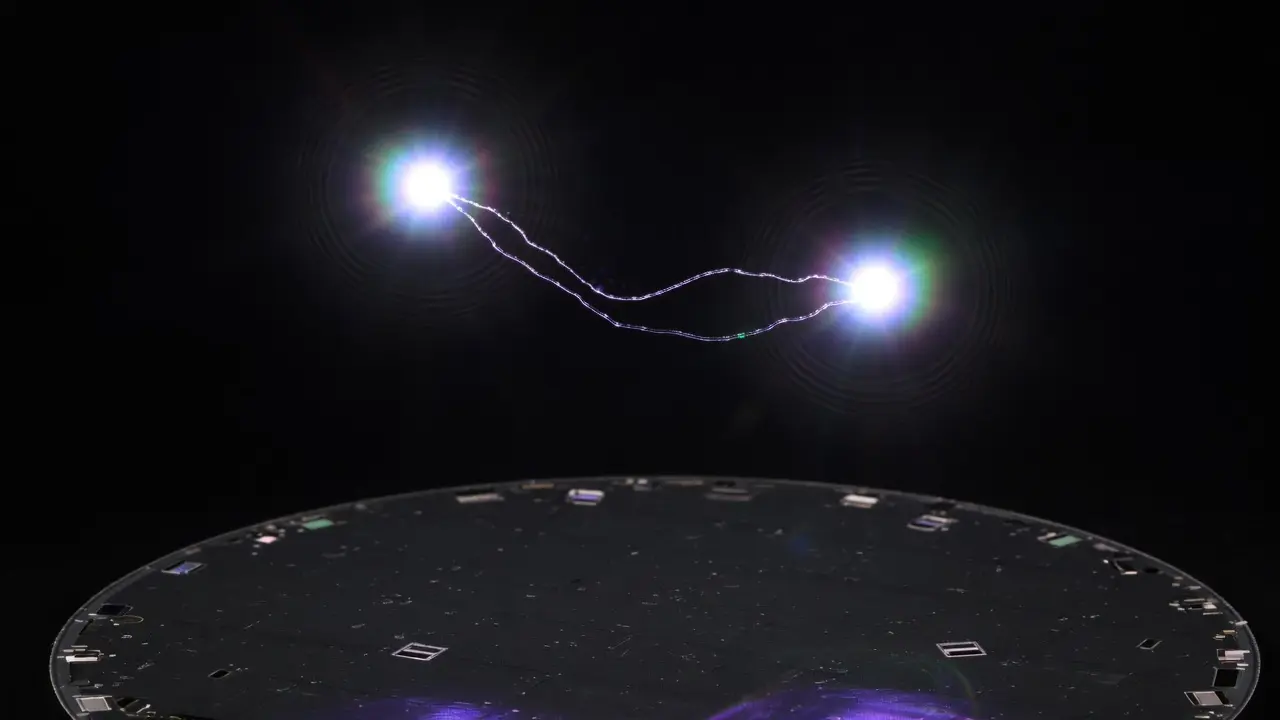
Researchers from Tsinghua University and the University of Science and Technology of China have extended qubit coherence beyond the “break-even point.” The team demonstrated this advance by implementing an autonomous quantum error correction protocol using only drives and dissipation with a binomial code encoded in a long-lived bosonic mode. This is the first experimental realization of an AQEC-protected bosonic logical qubit extending coherence time to 1.04 times that of its constituent physical qubits, proving coherence can be extended through engineered control and energy release. These results highlight the potential of autonomous error correction for building scalable, universal quantum computers.
Bosonic Mode Encoding Extends Logical Qubit Coherence
The protocol, derived from quantum channel simulation, applies to any error-correcting code, offering a potentially versatile approach to stabilizing quantum states. Traditional quantum error correction relies heavily on reading out qubit states to identify and correct errors, but this process introduces its own limitations, including fidelity constraints and hardware delays. Autonomous QEC, in contrast, stabilizes logical codewords through continuous coherent control and energy release, offering a path toward more scalable quantum computing architectures.
The binomial code uses the unique properties of bosonic systems, where single-photon loss is the dominant source of error; logical codewords are defined in a way that a single-photon loss maps erroneous states into orthogonal, identifiable states. High-fidelity control over the bosonic mode’s expansive Hilbert space was achieved through dispersive coupling with an ancilla qubit and optimization via the GRAPE algorithm.
Autonomous QEC Protocol Derivation from Quantum Channel Simulation
This technique bypasses the need for measurement-based feedback, a common limitation in scaling quantum systems, by instead relying on precisely introduced drives and engineered dissipation to maintain qubit coherence. The core of this advancement lies in a method for realizing autonomous quantum error correction (AQEC) through the simulation of dissipation processes, a strategy that requires neither precise Hamiltonian engineering nor complex feedback loops. A Stinespring dilation unitary was employed to create effective continuous recovery dissipators, managed through hierarchical entropy control, and the team reports that experimental imperfections contribute only mildly to dissipator performance.
Break-Even Point Surpassed with Drives and Dissipation
The experiment achieved a result where coherence lasted 0.04 times longer than its physical counterparts, a result achieved through a novel approach relying solely on engineered drives and dissipation. This surpasses the critical “break-even point” where error correction actively extends qubit life rather than being overwhelmed by decoherence, a milestone for building practical quantum computers. The experiment, conducted in collaboration between institutions in Beijing and Hefei, used an autonomous quantum error correction protocol applicable to a range of error-correcting codes, moving beyond reliance on complex measurement-based feedback systems.
This advance distinguishes itself from many prior error correction attempts by eliminating the need for measurement-based feedback, a technique often limited by readout fidelity and hardware constraints. Instead, the team implemented a protocol inspired by quantum channel simulation, introducing drives that provide coherent control and engineered dissipation to stabilize logical codewords.
The core of this method involves carefully manipulating the energy release within the system, effectively counteracting the environmental noise that typically degrades quantum information. This approach, detailed in the published work, offers a pathway toward more scalable quantum computing architectures by reducing the complexity of control systems.
The experimental setup encoded information within a long-lived bosonic mode, a quantum state with properties suited to this stabilization technique. The researchers report that this method extends coherence time, a measure of how long a qubit can reliably hold information, beyond the performance of the individual physical qubits used to construct it.
Lindblad Master Equation Describes Decoherence and Recovery
The Lindblad master equation provides a mathematical framework for understanding how quantum systems lose coherence and how that loss can be actively countered. This equation, dρ/dt = []ρ, details the rate at which a quantum state ρ degrades due to interaction with the environment, quantified by error operators and their associated rates . The recent work demonstrates that carefully engineered dissipation, guided by this equation, can not only mitigate decoherence but also actively recover quantum information.
The team’s autonomous quantum error correction (AQEC) protocol uses the principles embedded within the Lindblad master equation to introduce “recovery dissipators”, operations designed to return errors to the code subspace. These dissipators, represented by , act at rates , ensuring that errors are corrected while maintaining orthogonality between recovery operations.
This approach differs from traditional error correction by eliminating the need for continuous measurement, a significant source of complexity and error in many quantum systems. The success of this method hinges on balancing the rate of error correction with the potential for introducing additional decoherence, a parameter optimized through the equation’s variables.
AQEC Implementation Using Ancilla Qubits and Storage Cavity
The experimental setup incorporated a storage cavity, designated , alongside two ancilla qubits, and , to facilitate autonomous quantum error correction. This architecture features a hierarchical approach to managing quantum entropy, with directly interacting with the storage cavity to extract error information and enabling autonomous removal of that entropy without disturbing the logical qubit’s state. Visualizing the progression of the logical qubit’s state was achieved through Wigner function tomography, a technique used to map the quantum state onto a classical phase space.
Measurements of the logical state, designated |-Y_L⟩, immediately after encoding revealed characteristic interference fringes, indicating a high-fidelity initial state with a fidelity of 98.5%. The Wigner function after one complete round of AQEC showed a fidelity of 87.6%, a measurable improvement over the 74.0% fidelity observed after the same free evolution period without the PASS drives.
This intermediary cavity facilitates a high-fidelity swap of excitations, a critical step in the autonomous error correction process. The team employed optimal control pulses via qubit to initialize the system, purify the quantum state and perform state tomography on the storage cavity , ensuring precise control over the quantum operations. The implementation of the AQEC protocol on a bosonic binomial code demonstrated the potential for passively protecting complex quantum states.
The observed performance, with the logical qubit coherence extended beyond the break-even point, suggests that this approach offers a viable pathway toward scalable quantum computing. Imperfections in the experimental setup contributed to a mild degradation in dissipator performance, but the overall results validate the theoretical framework and identify ancilla coherence as a current limitation.
Knill-Laflamme Condition Enables Continuous Error Correction
The Knill-Laflamme condition, a cornerstone of quantum error correction, now underpins a method for continuous error mitigation, moving beyond the limitations of traditional measurement-based approaches. This protocol, derived from quantum channel simulation, allows for arbitrary error-correcting codes to be stabilized through engineered dissipation and coherent control, specifically, the introduction of drives that actively counteract decoherence. The work details how this stabilization extends beyond simply maintaining the existing qubit state; it actively improves it.
A key equation governing this process reveals a fundamental trade-off inherent in autonomous quantum error correction (AQEC). The effective decay rate, approximately calculated as + , demonstrates that a faster correction rate, smaller τ, reduces second-order photon losses but simultaneously increases the potential for errors induced by the correction itself. This balance is critical, as even perfect correction ( = 1) results in an irreducible loss of per cycle, highlighting the unavoidable presence of noise.
The optimal error correction interval is then calculated as = , a value determined by the balance between these competing effects. The researchers estimated an average success rate of error correction to be approximately 92.4%, based on fidelity measurements after a single encode-decode cycle. This figure informed the calculation of the optimal correction interval, and the resulting performance demonstrates a departure from traditional error correction strategies.
A discretized approximation to the ideal continuous dissipator, they found, emerges from a trade-off between second-order errors and operation-induced errors. The normalization condition, + + = 1, was preserved throughout the evolution, indicating the system’s stability. This preservation is achieved through the careful manipulation of code subspace (P_c), error subspace (P_e), and uncorrected subspace (P_u) populations, guided by the Knill-Laflamme condition.
The team’s approach differs from conventional methods by focusing on continuous stabilization rather than discrete error detection and correction cycles. This continuous process relies on the implementation of control pulses to realize an AQEC gate that acts on the composite cavity-ancilla system, transforming logical and error states. “This enables the realization of arbitrary on the composite cavity-ancilla system,” the researchers write, detailing the versatility of their approach.
This achievement signifies an important step toward scalable quantum computing, as it demonstrates a pathway for building robust quantum systems without relying solely on increasingly complex and resource-intensive error correction schemes. The method’s reliance on drives and dissipation, rather than complex measurement feedback loops, suggests a potentially simpler and more efficient architecture for future quantum processors.
See today’s quantum computing news on Quantum Zeitgeist for the latest breakthroughs in qubits, hardware, algorithms, and industry deals.