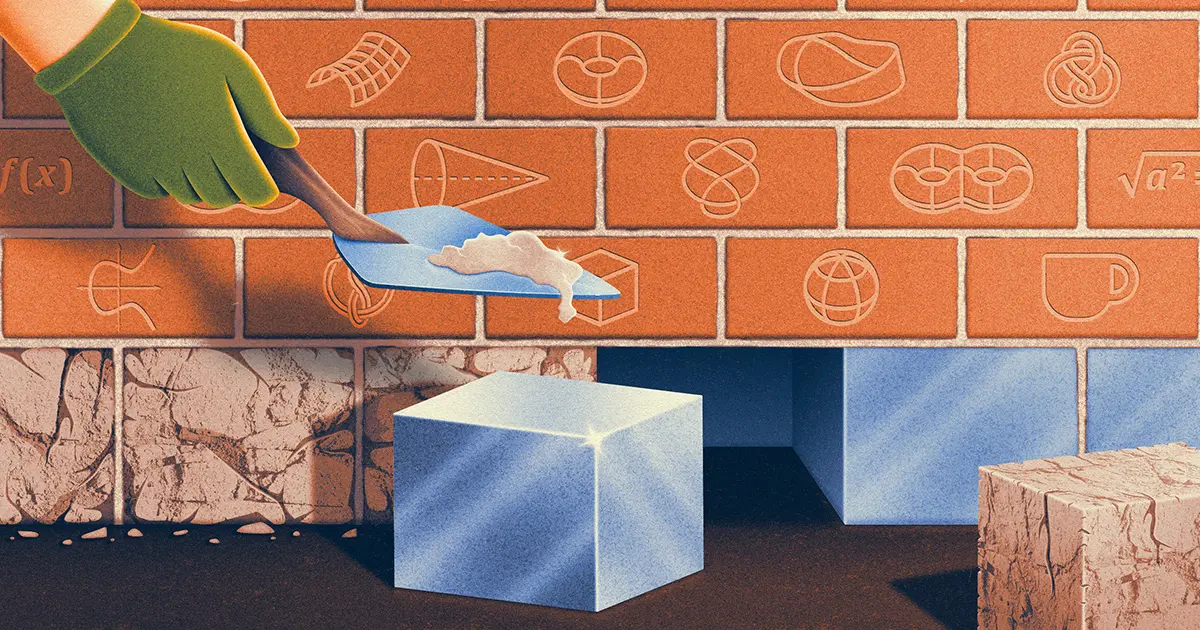
Over 100 years after the development of foundational mathematics coincided with a shift to modern mathematics, Peter Scholze of the Max Planck Institute for Mathematics in Bonn and Dustin Clausen of the Institute of Advanced Scientific Studies in France are attempting a complete rebuild of the field’s core concepts. The pair are proposing to replace how mathematicians rigorously account for stretching and bending in shapes, moving beyond the common analogy where shapes are considered the same if one can be stretched or compressed into the other without tearing. Rather than simply identifying equivalence, they aim to describe shapes in a way that disregards distance while respecting underlying structure. “They are solving a problem we didn’t know we had,” said Ravi Vakil, a mathematician at Stanford University and president of the American Mathematical Society, “because we already had what we thought were reasonable solutions.” Their new approach, utilizing a concept resembling infinitely fine dust, seeks to overcome limitations inherent in existing topological foundations.
Topology’s Limitations in Modern Algebraic Mathematics
For over a century, topology has served as a cornerstone of mathematics, but its foundations are now facing scrutiny. Developed alongside revolutions in logic and set theory, topological spaces initially marked the shift from 19th-century to modern mathematics, becoming integral to a vast range of mathematical disciplines. This approach, while powerful, has limitations when applied to algebra, leading researchers to seek alternatives. These condensed sets retain the beneficial properties of topological spaces while circumventing their drawbacks, offering a potentially superior foundational material.
Scholze and Clausen’s Development of Condensed Sets
The foundations of mathematics, built upon the concept of topological spaces over a century ago, are undergoing a significant re-evaluation thanks to the work of Peter Scholze and Dustin Clausen. While topology traditionally defines shapes by their underlying structure, allowing for stretching and bending without tearing, its application to modern algebra has presented persistent challenges. For years, mathematicians adapted, accepting limitations within these established frameworks, but Scholze and Clausen are now pursuing a more radical solution: a complete replacement of topological spaces with a novel mathematical construct known as condensed sets. The development of condensed sets is not without its complexities; the new definitions and concepts are complicated and demanding to learn. Scholze himself expresses uncertainty regarding the widespread adoption of this framework, yet views it as a crucial initial step in a larger program to fundamentally understand the behavior of numbers.
This approach mirrors a dynamic often seen in mathematical research, where developing new tools can reveal previously unknown possibilities, causing seemingly insurmountable challenges to appear more manageable. This interplay between technique and discovery can reshape the mathematical landscape. The ambition of this work extends beyond simply finding new routes to existing mathematical goals, but rather potentially reshaping the field itself.
For me personally, condensed sets changed something very basic about how I think about mathematics.
Scholze describes his approach as “trying to give names to what is there,” prioritizing clear definition over laborious proof. However, these spaces present limitations when applied to algebra, a core area of mathematical study. Although the definitions and concepts involved are complex, Scholze acknowledges that these condensed sets represent only the initial step in a broader program to understand the fundamental behavior of numbers, suggesting a long-term commitment to redefining mathematical principles.
I think topologists don’t actually like topological spaces, because it’s not a convenient category.
Euler and Early Topology Before Formal Spaces
The seemingly abstract world of topology has surprisingly practical roots, extending back to 18th-century problem-solving. Long before the formal definitions of spaces and sets, mathematicians were grappling with questions of connectivity and arrangement, laying the groundwork for a field that would later underpin diverse areas like data analysis and materials science. A prime example is Leonhard Euler’s work in 1736 concerning the problem of the seven bridges of Königsberg. This wasn’t about calculating distances or areas, but rather determining if a path existed that traversed each bridge exactly once, a recognizably topological result, as the size of the landmasses or bridge lengths were irrelevant. “Only the pattern of how they connect to each other does,” highlights the core principle at play. For nearly two centuries following Euler’s work, topological research progressed incrementally, hampered by a lack of rigorous language.
The mid-19th century saw August Ferdinand Möbius analyze the now-famous Möbius strip, a curious object with surprising real-world applications in conveyor belts designed for even wear. Simultaneously, Möbius began developing key ideas for classifying shapes based on the number of holes they contained, using loops drawn on their surfaces. However, as John Stillwell wrote in 1996 of Poincaré’s work, “Along with great breakthroughs, there is also confusion.” Poincaré, a pioneer in the field, found himself conceptually ahead of the tools available to express his ideas precisely. The resolution to this linguistic challenge arrived not from within geometry itself, but from the emerging field of set theory. The turn of the 20th century witnessed a fervent debate about the foundational axioms of mathematics, with researchers striving to establish a firm basis for their theories.
Felix Hausdorff, a mathematician who also penned poetry and plays, played a pivotal role. He published Fundamentals of Set Theory, providing the first comprehensive description of topological spaces. These spaces, capable of encoding intricate or minimal structure, became the bedrock upon which much of modern mathematics would be built.
The ideas were evolving in Bonn way faster than the rest of the world could consume them.
Hausdorff and the Foundations of Modern Topology
The bedrock of modern mathematics, surprisingly, wasn’t always so solid. While topology is often illustrated with the playful equivalence of a coffee cup and a doughnut, the rigorous foundation for understanding such shapes emerged from a confluence of mathematical revolutions over a century ago. This wasn’t merely about identifying similarity; it was about defining shapes in a way that prioritized underlying structure over precise distance, allowing for bending and stretching without tearing. These spaces allow mathematicians to forget about distance while respecting underlying structure. This arose from a broader effort to solidify the foundations of mathematics itself, a period marked by intense debate over axioms and the very nature of proof. Researchers realized that intuitive assumptions about numbers could be flawed, prompting a search for unshakeable principles. Set theory provided the language to navigate these debates, and Hausdorff’s topological spaces became a cornerstone of this new, abstract landscape. This framework, though foundational, would later prove inadequate for certain areas of advanced mathematics, prompting Peter Scholze and Dustin Clausen’s current efforts to rebuild from the ground up.
They were asking us to think in the direction we would want to think anyway.
Mathematicians are fundamentally reshaping the bedrock of their discipline by challenging the century-old concept of topological spaces, seeking to resolve limitations in how algebra interacts with this foundational framework. “A whole slate of mathematics has become much simpler,” Vakil added, highlighting the broad impact of this work.
They don’t have to be as nice as they are.




See today’s quantum computing news on Quantum Zeitgeist for the latest breakthroughs in qubits, hardware, algorithms, and industry deals.