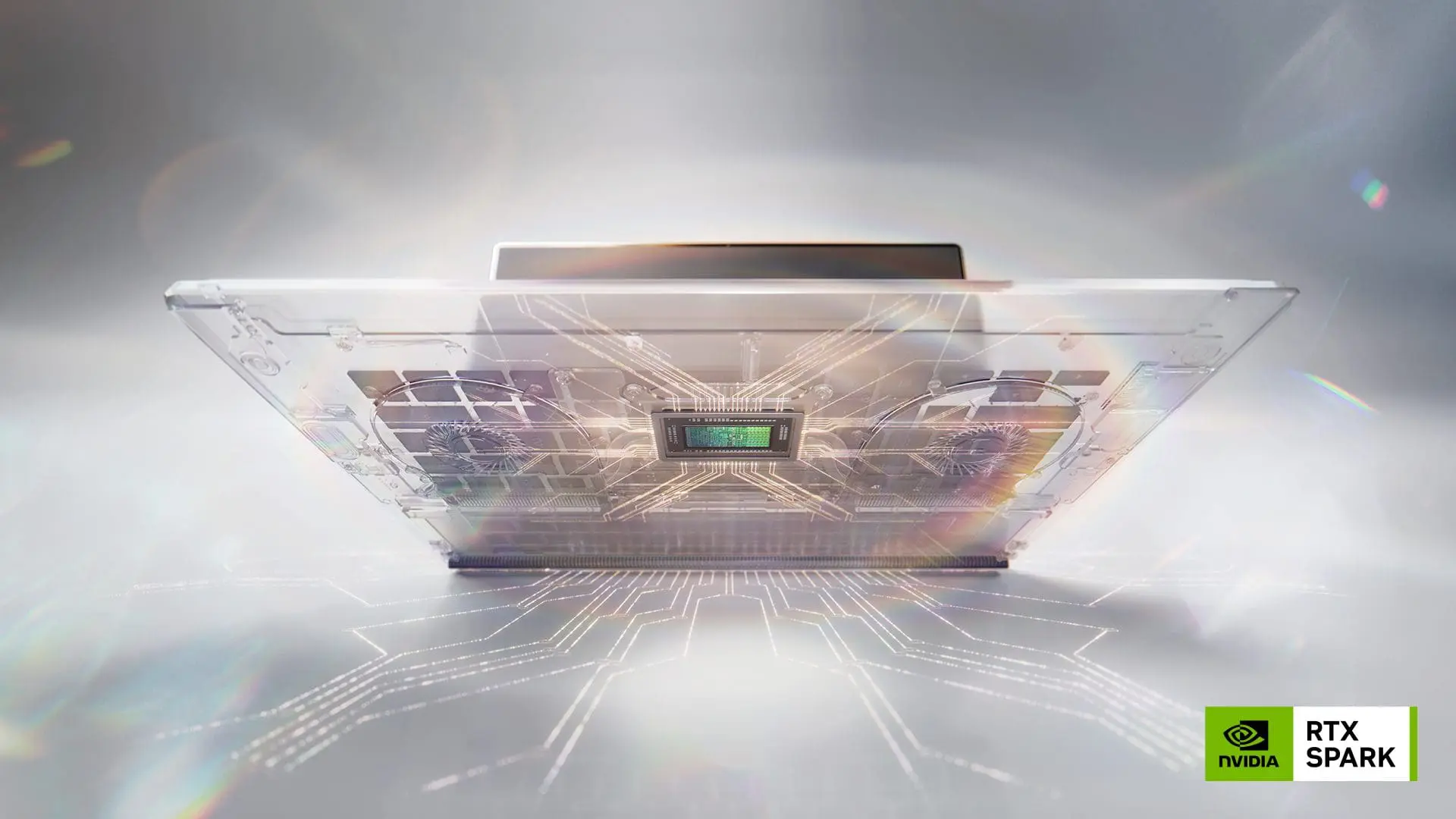
NVIDIA has unveiled RTX Spark, a superchip pairing a Blackwell RTX GPU with 6,144 CUDA cores alongside a 20-core NVIDIA Grace CPU, reshaping Windows personal computers for the emerging age of AI agents. This new architecture, developed in collaboration with MediaTek, moves beyond traditional application launching to a model where users simply ask, and the PC completes the task. “The PC is being reinvented,” said Jensen Huang, founder and CEO of NVIDIA. RTX Spark delivers up to 1 petaflop of AI compute and 128GB of unified memory, addressing a growing demand demonstrated by projects like OpenClaw and Hermes Agent already achieving results on developer networks; NVIDIA and Microsoft are positioning this hardware as the foundation for secure, private, on-device AI experiences.
RTX Spark Superchip Integrates Blackwell GPU and Grace CPU
This pairing, facilitated by the NVIDIA NVLink-C2C chip-to-chip interconnect, moves beyond traditional architectures by prioritizing unified processing for artificial intelligence tasks, impacting both AI development and gaming experiences. The superchip packs 6,144 CUDA cores into the Blackwell RTX GPU, delivering substantial computational power tailored for increasingly complex AI workloads.
This isn’t simply about adding more transistors; the integration with the Grace CPU, co-designed with MediaTek, addresses the growing demand for efficient processing of AI agents directly on user devices. NVIDIA and Microsoft are targeting a future where PCs function less as tools and more as “teammates,” capable of proactively assisting users. “For forty years, you launched apps.” This hardware capability is coupled with new security features developed in collaboration with Microsoft, including new Windows security primitives and the NVIDIA OpenShell runtime, aimed at ensuring agents operate securely and under full user control. Vincent Koc, chief architect at the OpenClaw Foundation, affirmed the importance of this security, stating, “We are strong supporters of deploying agents like OpenClaw securely into the Windows ecosystem.” The combined hardware and software approach is intended to address limitations that previously hindered widespread adoption of on-device AI, enabling more robust and private agent experiences. Beyond AI, the superchip is engineered to deliver high-fidelity graphics and performance for demanding creative applications and gaming, supporting features like DLSS 4.5 Ray Reconstruction and RTX Video with 4x Frame Generation.
NVIDIA OpenShell and Windows Security Enable On-Device AI Agents
The convergence of advanced hardware and operating system security is reshaping the potential of personal computing, moving beyond traditional application-based workflows toward a future populated by on-device AI agents. While intelligent assistants are not new, the ability to run sophisticated agents directly on a user’s PC, securely and privately, has been a significant hurdle. NVIDIA and Microsoft are now addressing this challenge with a combined approach centered on the RTX Spark superchip and a new suite of Windows security features, establishing a foundation for a new generation of personal AI. This isn’t simply about increased processing power; the RTX Spark superchip, featuring 6,144 CUDA cores and fifth-generation Tensor Cores with FP4 precision, is designed to handle the intensive computational demands of these agents.
This processing capability is paired with a 20-core NVIDIA Grace CPU, connected via the NVIDIA NVLink-C2C chip-to-chip interconnect, representing a departure from conventional PC architecture. Broad adoption necessitates a secure environment, and this is where the collaboration with Microsoft becomes paramount. The core of this security lies in new Windows security primitives coupled with NVIDIA OpenShell. These features aren’t merely about preventing malicious activity; they provide a framework for identity management, containment, and policy enforcement, ensuring agents operate safely and under complete user control. NVIDIA OpenShell further refines this control, allowing users to define agent permissions, intelligently route queries based on privacy preferences, and even mask sensitive information before it’s sent to cloud models. This layered approach is intended to unlock a range of on-device capabilities, from automating tasks within Windows applications to generating images and video, and even assisting with coding and semantic file searches.
Nous Research CEO Dillon Rolnick anticipates a future where these agents become integral assistants, stating, “RTX Spark and NVIDIA OpenShell give Hermes users a powerful and secure environment for agents to run and work alongside you. You realize you’re buying a full-fledged assistant, not a typical laptop.” The ambition, as articulated by Microsoft chairman and CEO Satya Nadella, is to deliver “unmetered intelligence to every home and every desk with Windows,” and the RTX Spark platform represents a significant step toward realizing that vision.
RTX Spark brings everything NVIDIA has built – CUDA, RTX, our AI platform – into a single superchip. The personal AI computer.
Jensen Huang, founder and CEO of NVIDIA
RTX Spark Delivers Up To 1 Petaflop for AI Compute
The pursuit of on-device artificial intelligence received a boost with the unveiling of the RTX Spark superchip; NVIDIA is positioning this as a fundamental shift in personal computing, moving beyond applications to proactive, AI-driven assistance. This pairing, connected via the NVIDIA NVLink-C2C interconnect, represents a departure from traditional PC architecture, prioritizing integrated CPU-GPU performance for optimized AI workloads. This capability extends beyond agent functionality, enabling users to render 90GB 3D scenes, edit 12K video, and even run 120-billion-parameter large language models with a 1 million token context. NVIDIA’s collaboration with Adobe exemplifies this broader vision; the companies are rearchitecting Adobe Premiere and Photoshop to fully leverage RTX Spark’s capabilities, promising up to a 2x performance increase in AI-driven creative workflows.
RTX Spark and NVIDIA OpenShell give Hermes users a powerful and secure environment for agents to run and work alongside you. You realize you’re buying a full-fledged assistant, not a typical laptop.
Dillon Rolnick, CEO of Nous Research
Full-Stack RTX Powers Creation, Gaming, and 12K Video Editing
This isn’t merely an incremental upgrade in processing power; NVIDIA is delivering a complete, integrated system designed to handle the demands of increasingly sophisticated AI, high-resolution content creation, and immersive gaming experiences. The superchip’s ability to render ultralarge 90GB 3D scenes with OptiX and DLSS demonstrates a capacity previously reserved for high-end workstations, now potentially available in slim, portable laptops. Beyond raw graphical prowess, RTX Spark’s architecture is specifically engineered to manage the computational load of advanced AI applications.
The inclusion of 6,144 CUDA cores within the Blackwell RTX GPU, coupled with fifth-generation Tensor Cores featuring FP4 precision, provides a substantial leap in AI compute performance. The system’s 128GB of unified memory is critical for these demanding workloads, ensuring seamless data transfer between the GPU and CPU. “For forty years, you launched apps.” This departure from traditional PC architecture, developed in collaboration with MediaTek, prioritizes optimized AI performance by minimizing latency and maximizing bandwidth between processing units. The impact on creative professionals is significant; NVIDIA is partnering with Adobe to rearchitect Premiere and Photoshop for RTX Spark, promising up to 2x faster AI, editing, coloring, and effects across creative workflows. “The best creative work in the world happens in Adobe tools from Adobe Firefly to Photoshop and Premiere, and the expansion of our partnership with NVIDIA and Microsoft will make those experiences faster and more powerful than ever,” said Shantanu Narayen, chair and CEO of Adobe. The capabilities extend beyond professional applications, with RTX Spark also poised to deliver a substantial boost to gaming performance. Users can anticipate playing AAA games at 1440p resolution and over 100 frames per second with ray tracing, DLSS, and Reflex enabled, alongside new RTX features like DLSS 4. This holistic “full-stack” approach, encompassing hardware and software optimization, aims to redefine the boundaries of what’s possible on a personal computer.
Running solutions like OpenShell and the Microsoft security primitives on RTX Spark will enable users to leverage a fully integrated stack for private, personal agents running on device.
Vincent Koc, chief architect at the OpenClaw Foundation
RTX Spark Laptop Designs Prioritize Portability and Visual Fidelity
The expectation of high-performance computing often conjures images of bulky towers and limited mobility; however, NVIDIA’s RTX Spark superchip challenges this notion by prioritizing a sleek, portable form factor without sacrificing visual fidelity or processing power. Designed for integration into both slim laptops and compact desktop PCs, RTX Spark aims to redefine the personal computing experience, moving beyond the traditional application-launching model towards an environment where the machine proactively assists the user. “For forty years, you launched apps.” With RTX Spark and Microsoft Windows, you ask, and the PC does the work. This emphasis on portability is evident in the engineering of RTX Spark-powered laptops, which are designed to be as thin as 14 millimeters and weigh as little as three pounds. These devices will feature precision-machined aluminum chassis, balancing durability with a modern aesthetic, and color-accurate tandem OLED displays enhanced with NVIDIA G-SYNC technology.
The focus on visual quality extends beyond mere display technology; the superchip itself incorporates a fifth-generation Tensor Core with FP4 precision, alongside 6,144 CUDA cores within the NVIDIA Blackwell RTX GPU, enabling high-fidelity graphics and accelerating AI-driven tasks. This combination allows for rendering of exceptionally large 90GB 3D scenes using OptiX and DLSS, and editing of 12K 4:2:2 video with the NVIDIA Blackwell decoder. Beyond aesthetics and raw power, RTX Spark’s architecture is geared towards supporting the increasing demands of on-device AI agents. Major hardware manufacturers, including ASUS, Dell, HP, Lenovo, Microsoft Surface, and MSI, are already developing RTX Spark-powered designs, signaling broad industry support for this new approach to personal computing.
For forty years, you launched apps. With RTX Spark and Microsoft Windows, you ask – and the PC does the work.
Jensen Huang, founder and CEO of NVIDIA



See today’s quantum computing news on Quantum Zeitgeist for the latest breakthroughs in qubits, hardware, algorithms, and industry deals.