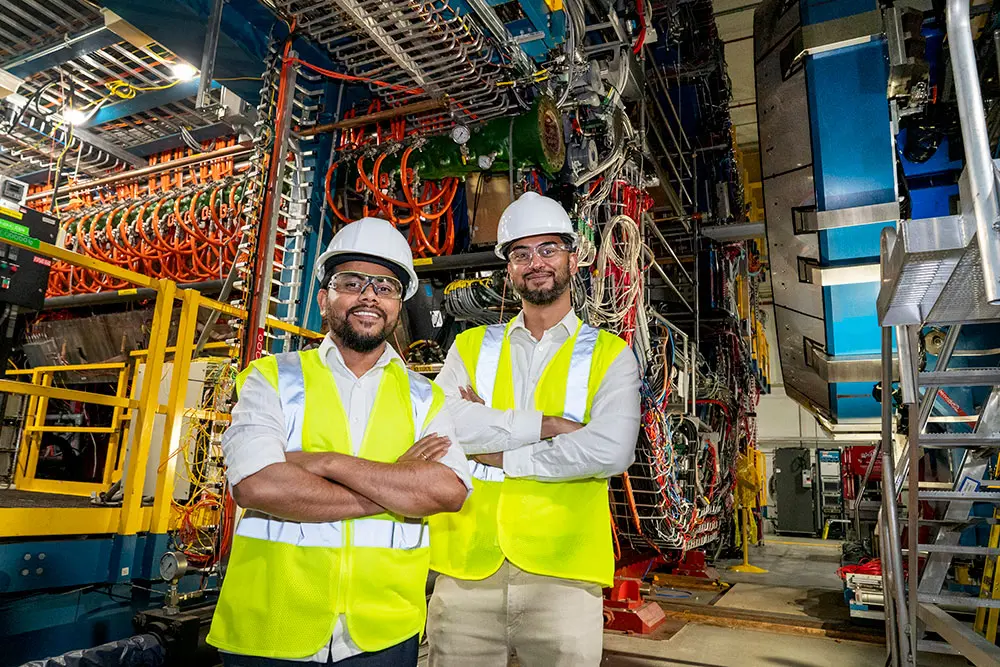
Rather than smashing atomic nuclei together, physicists at the Relativistic Heavy Ion Collider (RHIC) are now using near-miss collisions to create a novel imaging technique, revealing the distribution of gluons within those nuclei. The 2.4-mile racetrack at the U.S. Department of Energy’s Brookhaven National Laboratory is using photons surrounding speeding ions to interact with gluons, the particles that bind visible matter. Researchers are tracking the decay daughters of J/psi particles formed in these close encounters to build a map of the gluon distribution. Ashik Ikbal, a STAR collaborator from Kent State University, said this work extends many ways people have used light to probe hidden structures in our world, studying gluons at a scale smaller than atoms. These findings offer a preview of techniques planned for the future Electron-Ion Collider and contribute to mapping gluons, the building blocks of nearly all visible matter.
RHIC’s Near-Miss Collisions Reveal Internal Nuclear Structure
This innovative approach, detailed in a recent publication in Physical Review Letters, uses the electromagnetic energy surrounding accelerated ions to probe the internal structure without shattering the nucleus itself. The 2.4-mile racetrack at the U.S. Department of Energy’s Brookhaven National Laboratory is using photons surrounding speeding ions. The technique centers on photons emitted by the rapidly moving ions; these photons interact with gluons, the particles responsible for binding quarks within protons and neutrons, in a passing nucleus. Initial attempts utilized rho mesons, but scientists are now tracking the decay daughters of J/psi particles to improve resolution, as the J/psi particles offer a significant improvement in resolution and clarity. A crucial element of this advancement lies in the spin of the J/psi’s decay products, electrons and positrons.
Unlike the daughter particles of rho mesons, these possess a quantum property that dramatically alters the observed interference pattern. Prithwish Tribedy, a Brookhaven Lab/STAR collaboration physicist, explained that if you think of a repeating wave with alternating peaks and dips, the rhos and their daughter pions produced interference waves with essentially the exact same pattern, peaks lined up with peaks, dips lined up with dips. However, when researchers tracked the electron and positron daughters of J/psi decays, they produced the opposite pattern, opposite from the rhos, their pion daughters, and even their own J/psi parents. Wherever there were low points became high points, and the high points became low points. This “flipped” interference pattern, consistently observed across collisions involving gold, zirconium, and ruthenium ions, confirms that the observed interference originates from the decay daughters, providing a reliable signal for mapping gluon distribution.
At the EIC, virtual photons emitted by electrons will serve as the primary imaging beam, building upon the foundation laid by these near-miss collision experiments. Mapping out gluons is a central goal of the EIC, and these new results provide a preview of this imaging technique and a way to test its assumptions.
By precisely correlating the momentum and angles of the decay particles with the parent particle’s spin, scientists can effectively “geolocate” gluons within the nucleus, revealing the intricate architecture of these fundamental building blocks of matter. Wangmei Zha, a professor at USTC and member of the STAR collaboration, emphasized that the parent particles are ultimately what scientists are using to “see” inside the nucleus, because they are the ones closest to the gluon-triggered action, but knowing that the daughters give direct access to those interactions is what makes this imaging possible.
Seeing this flipped pattern and alignment with predictions in data from collisions using three different types of nuclei gives us confidence that the daughters are the true source of the interference.
Kaiyang Wang, a student at USTC
Photon-Gluon Interactions Map Gluon Distribution Within Nuclei
The pursuit of understanding the strong force, which binds quarks and gluons into protons and neutrons, has led physicists to increasingly sophisticated methods of probing the heart of matter. Rather than directly impacting nuclei, scientists are now leveraging “near-miss” collisions, a method that allows for probing without complete disintegration, offering a gentler approach to internal structural analysis. This innovative technique hinges on the electromagnetic energy surrounding ions as they race around the 2.4-mile RHIC racetrack. These photons interact with gluons within nuclei whizzing by in the opposite direction, generating new particles and revealing information about the nucleus’s internal structure. Researchers are tracking the decay daughters of J/psi particles to establish the foundation for using J/psi particles and their spin to map out the distribution of gluons within the ions, with the J/psi’s spin providing a sharper signal for mapping gluon distributions. Scientists can then infer the spin information of the parent J/psi particles from the momentum and angles of these decay daughters, ultimately pinpointing the location of the gluon that initiated the interaction.
In this case, we’re using light to map out features at a scale much smaller than atoms to study the gluons that hold quarks together inside the protons and neutrons of atomic nuclei.
J/psi Particle Decay Confirms Interference Pattern Origin
Unlike traditional high-energy collisions, RHIC scientists are now exploiting instances where gold ions pass extremely close to one another, allowing for a non-destructive probe of the nucleus’s internal structure. The technique hinges on photons surrounding the ions as they circulate the 2.4-mile RHIC racetrack. These photons can interact with gluons inside the nuclei, triggering the creation of J/psi particles. Researchers are tracking the decay daughters of these J/psi particles, specifically, electron-positron pairs, to infer the gluon distribution. Initial attempts utilized rho mesons, but limitations in their resolution prompted a focus on tracking J/psi particles to improve it. The combination of spin and the higher resolution enabled by the smaller J/psi particles add dimension and detail to the process of mapping gluons within nuclei.
J/psi particles also live longer than rhos before decaying, giving more time for separation between their own interference patterns and that of the particles into which they decay – in this case, electrons and positrons.
Zebo Tang, a professor from the University of Science and Technology of China (USTC)
Spin-Dependent Interference Enhances Gluon Imaging Resolution
Scientists are now leveraging the spin of particles created in near-miss collisions to map the distribution of gluons, the fundamental force carriers responsible for binding quarks within atomic nuclei, with unprecedented resolution. The 2.4-mile racetrack at the U.S. Department of Energy’s Brookhaven National Laboratory is using photons surrounding speeding ions to interact with gluons, acting like the beam of a giant X-ray machine. Unlike traditional high-energy collisions, RHIC scientists are now exploiting instances where gold ions pass extremely close to one another, allowing for a non-destructive probe of the nucleus’s internal structure. Initial attempts utilized rho mesons, but limitations in their short lifespan and resolution prompted a focus on tracking J/psi particles to improve resolution. Researchers are tracking the decay daughters of J/psi particles created in these close encounters to build a foundation for using J/psi particles and their spin to map out the distribution of gluons within the ions.
The J/psi’s spin provides a sharper and more reliable signal. Researchers observed that the J/psi particles decay into electron-positron pairs, possessing a quantum property absent in the rho’s decay products: spin. This spin characteristic dramatically alters the observed interference pattern, providing a critical validation of the imaging process, and allows scientists to effectively “geolocate” gluons within the nucleus.
The parent particles are ultimately what we are using to ‘see’ inside the nucleus, because they are the ones that are closest to the gluon-triggered action, but knowing that the daughters give us direct access to those interactions is what makes this imaging possible.
Wangmei Zha, a professor at USTC

See today’s quantum computing news on Quantum Zeitgeist for the latest breakthroughs in qubits, hardware, algorithms, and industry deals.