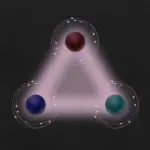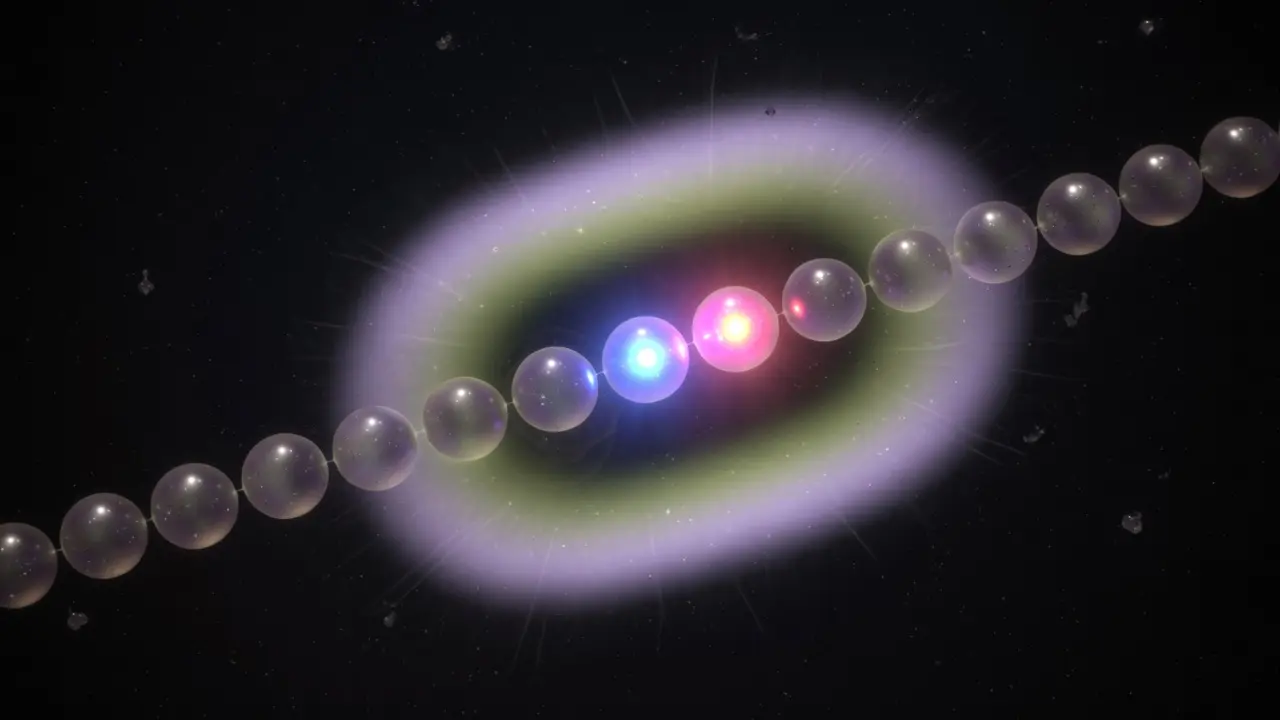
Bob each holding a four-level particle. With the aid of an auxiliary qubit, the receiver can recover the input state probabilistically with unit fidelity. The overall success probability is derived and shown to be independent of the input state. Analytical expressions for optimal average teleportation fidelities, with and without the controller’s cooperation, are obtained while keeping the sender’s joint measurement fixed and averaging uniformly over pure qutrit input states with all measurement outcomes included; their difference defines the control power of this protocol. For the shared states considered here, a controller measurement basis is determined.
Unit Fidelity Qutrit Teleportation Surpasses Probabilistic Recovery Limits
Quantum teleportation now reaches unit fidelity, perfect information reconstruction, a feat earlier methods struggled to achieve beyond probabilistic recovery; this is consistently maintained regardless of the qutrit’s starting properties. The new protocol employs a nonmaximally entangled channel and an auxiliary qubit for transmitting any unknown qutrit, overcoming limitations found in prior high-dimensional systems that required specific entanglement or suffered from imperfect state transfer.
A team at College of Physics and Hebei Normal University demonstrated their protocol transmits an arbitrary unknown qutrit, a three-level quantum digit instead of two, using a channel where entanglement isn’t maximised; they achieved unit fidelity upon successful transmission. They focused explicitly on “shared states considered here,” leaving open whether these optimised control strategies translate effectively across different entanglement configurations or more complex channel characteristics.
Optimised control demonstrates potential but requires broader testing with diverse quantum states
This work establishes a pathway to reliable qutrit transmission, important for advanced computing architectures demanding greater information density, though researchers acknowledge their analysis remains limited in scope. Is there a universally applicable controller measurement basis maximising both influence and success rate irrespective of the initial entangled state? Still, even acknowledging this focus on specific entangled states, and lack of proven universal applicability, it represents major progress in optimising qutrit transmission; qutrits are three-level versions of qubits offering increased information capacity for future computers.
The researchers optimised ‘quantum teleportation,’ transferring information between particles without physical movement using these qutrits, which offer higher capacity than standard qubits. This protocol achieves full reconstruction of the input state upon successful transfer via an auxiliary qubit controlled by Charlie, demonstrating durability to imperfect channel characteristics, unlike previous work often requiring perfect initial conditions.
By optimizing the controller’s measurement basis, researchers achieved unit fidelity in reconstructing the original qutrit’s state when transmission succeeded, regardless of its starting properties. The study quantified how much influence the controller has over this process and identified measurements that simultaneously maximize both control power and success probability for specific shared states. These results clarify aspects of controlled teleportation involving particles with unequal local dimensions.
👉 More information
🗞 Controlled teleportation of an unknown qutrit and its control power
✍️ Xiao-Xu Li and Feng-Li Yan (College of Physics); Ting Gao (Hebei Normal University)
🧠 ArXiv: https://arxiv.org/abs/2611.32511



See today’s quantum computing news on Quantum Zeitgeist for the latest breakthroughs in qubits, hardware, algorithms, and industry deals.