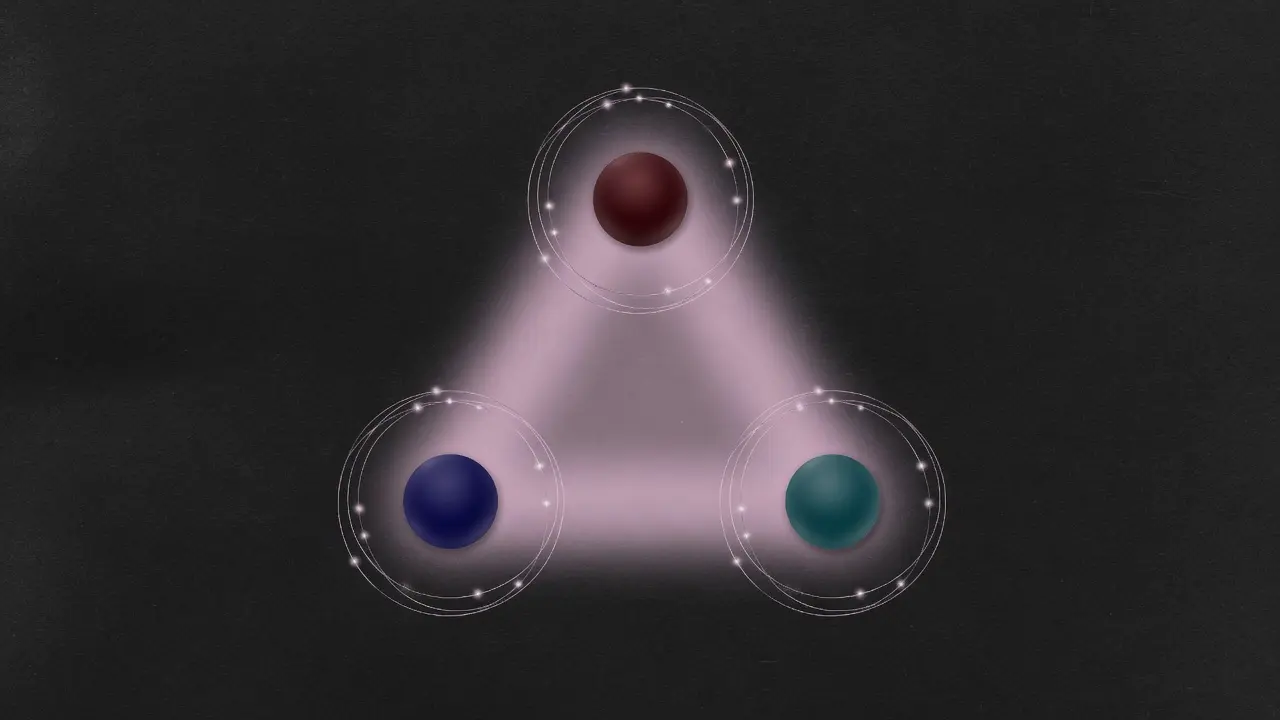
Entangled Bell-diagonal qubit states, pairs exhibiting quantum correlation, appear identical when measured using their singlet fraction but yield differing rates under specific operations preserving positive partial transpose (PPT). These entangled isotropic states do not always reach their theoretical limit for quantum communication, especially if one of their defining probabilities is zero.
Limitations exist in how efficiently information can be transmitted using these isotropic states, a specific type of quantum correlation. The states do not consistently achieve previously predicted theoretical limits for data transmission speed when utilising PPT operations; these operations are allowed moves linking certain quantum pieces together.
This finding clarifies fundamental boundaries within quantum communication and shows optimal performance is only attainable if a defining probability associated with entanglement is non-zero. Limitations have been uncovered in the efficiency of information transfer via isotropic states, a way to describe the relationship between two entangled qubits by listing probabilities for different shared properties.
The discovery clarifies fundamental boundaries within quantum communication and establishes a ‘speed limit’, similar to the Rains bound, on reliable quantum data transfer through noisy channels. However, it remains unclear what determines whether an entangled state can actually *reach* this theoretical maximum.
Rains Bound Limitations Refine Asymptotic Bounds for Quantum Channel Capacities
Previous claims about reaching the Rains bound are incorrect; entangled isotropic states consistently fall short of this theoretical limit for quantum communication in every finite dimension. David Kutasov, Santa Barbara and Marco Túlio Rodrigues de Carvalho now demonstrate a definitive separation between two Bell-diagonal qubit states sharing an identical singlet fraction through attainable rates using positive partial transpose (PPT) operations. The Rains bound is only reached when one specific entanglement probability vanishes.
Specifically, certified asymptotic bounds have narrowed to between 1.00344789 and 1.015863168 ebits per copy, a value falling below a previously held upper endpoint of 1.0159669071; these findings establish a stricter upper limit on the two-way quantum capacity for depolarizing channels than prior finite-block numerics indicated. Achieving this maximum rate requires that one defining probability associated with the state be zero, as every mixed isotropic state falls strictly below this limit regardless of its dimension.
Isotropic Entangled States Fail to Consistently Reach Theoretical Quantum Communication Limits
This work clarifies theoretical limits of quantum communication by demonstrating that a maximum achievable rate doesn’t guarantee its realization in practice; even with ideal preparations, performance may fall short. This raises a key tension: previous numerical simulations suggested the bounds *were* attainable, but this now definitively proves they are not consistently reached by isotropic entangled states, mixed states where all orientations have equal probability. Still, this discovery doesn’t invalidate years of simulation work; it highlights an important distinction between theoretical limits and practical performance.
The specific type of entangled state matters greatly when attempting to achieve the absolute maximum data transmission rate, as entanglement alone isn’t enough. Researchers at the University of York demonstrated that different capacities for quantum communication can be exhibited by entangled Bell-diagonal qubit states under PPT operations, those preserving positive partial transpose ensure information isn’t transmitted faster than light allows. This confirms attainment of the Rains bound requires one defining probability associated with the state to be zero, offering insight into why previous simulations may have overestimated achievable rates in real-world scenarios.
This research showed that two entangled qubit states sharing similar characteristics can still exhibit differing performance limits when transmitting quantum information via positive partial transpose (PPT) operations. Consequently, researchers established a stricter upper bound of 1.015863168 ebits per copy for the two-way quantum capacity of a depolarizing channel, refining previous estimates based on numerical simulations. These findings highlight how entanglement alone does not guarantee optimal communication and clarify the relationship between theory and practical limitations in quantum data transmission.
👉 More information
🗞 When does a noisy Bell pair attain the Rains bound?
✍️ Matthew Barber and Stefano Pirandola (University of York)
🧠 ArXiv: https://arxiv.org/abs/2611.33317


See today’s quantum computing news on Quantum Zeitgeist for the latest breakthroughs in qubits, hardware, algorithms, and industry deals.