
Researchers can now observe materials’ dynamic processes at a fine scale thanks to the Quantum Emitter Electron Nanomaterial Microscope, or QuEEN-M, a new platform available through the CNM user program. The instrument integrates an atomic-resolution scanning transmission electron microscope with capabilities including cathodoluminescence spectroscopy and ultrafast electron pulsing, enabling time-resolved studies with sub-nanometer spatial resolution, a combination previously difficult to achieve. A key feature is the Attolight CL system’s fiber-coupled parabolic mirror design, decoupled from the sample holder, offering a novel approach to signal collection. Future development will extend into near-atomic-resolution photon-induced near-field electron microscopy (PINEM), promising deeper insight into light, matter interactions and transient electromagnetic fields. QuEEN-M supports research spanning quantum information science, microelectronics, and materials science.
QuEEN-M Integrates STEM with Multimodal Spectroscopy Capabilities
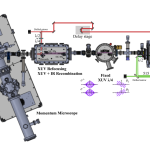
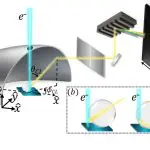
The QuEEN-M platform, a new nanoscale imaging tool at the CNM, merges atomic-resolution scanning transmission electron microscopy with a suite of spectroscopic techniques to probe quantum and functional materials. Beyond conventional electron microscopy, the system incorporates cathodoluminescence, electron energy-loss, and energy-dispersive X-ray spectroscopies alongside 4D-STEM, allowing researchers to characterize materials with increased detail. A key advancement lies in the instrument’s ability to observe dynamic processes; a nanosecond electrostatic beam blanker and a picosecond RF-cavity-based ultrafast electron pulser facilitate time-resolved studies at sub-nanometer resolution. The integrated Attolight CL system utilizes a fiber-coupled parabolic mirror design, a configuration intended to optimize signal collection and minimize sample heating during analysis. Future upgrades will introduce mirror-coupled laser illumination for direct observation of light-induced changes in materials, extending QuEEN-M’s capabilities to the study of transient electromagnetic fields.
Researchers are now able to investigate material behavior at previously inaccessible timescales thanks to the integration of a picosecond RF-cavity-based ultrafast electron pulser with a probe-corrected STEM at the QuEEN-M facility. This combination delivers sub-nanometer spatial resolution and the capacity to observe dynamic processes across a broad range of temporal scales, a feat difficult to achieve with earlier instrumentation. The nanosecond electrostatic beam blanker complements the RF pulser, extending the range of observable phenomena.
The Quantum Emitter Electron Nanomaterial Microscope(QuEEN-M)is a next-generation platform for nanoscale cathodoluminescence (CL) imaging and ultrafast dynamic studies of quantum and functional materials, available through the CNM user program.
CNM

See today’s quantum computing news on Quantum Zeitgeist for the latest breakthroughs in qubits, hardware, algorithms, and industry deals.