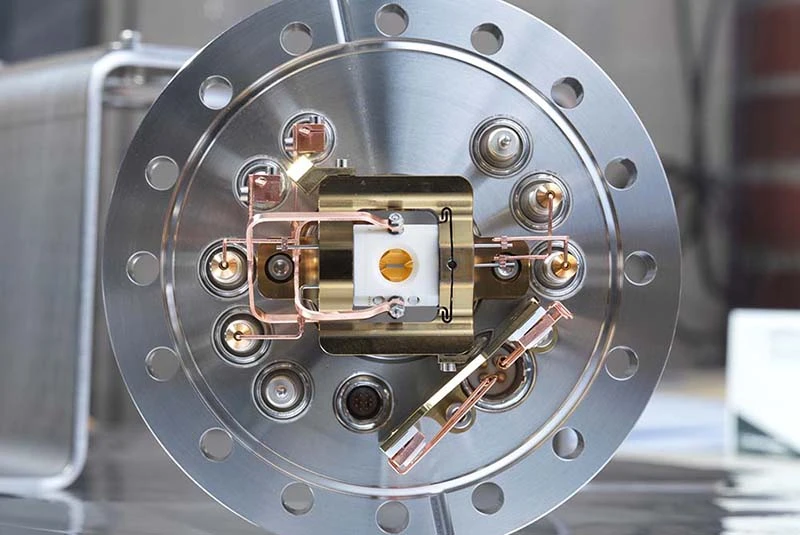
A fully functioning 20-qubit quantum computer now fits within the footprint of standard information technology infrastructure, as demonstrated by AQT’s “Pine trap” system. The company has successfully contained 20 fully-connected qubits inside a standardized 19-inch rack, a size commonly used for existing servers, potentially easing integration and cloud accessibility. Individual qubit control is achieved through precise measurement of crosstalk, the influence of exciting one qubit on all others, quantified in a documented matrix for a 20-qubit register. More complex algorithms require more qubits. AQT states that its system offers a feature where any qubit can connect to any other without computational overhead, which generally improves performance and supports the implementation of more complex algorithms. This advance builds on ion-trap quantum computing developed in Innsbruck, Austria, demonstrating crosstalk error rates at the 1e-5 level, which supports scalable, fault-tolerant quantum computing.
AQT Pine System Demonstrates 20-Qubit, Fully-Connected Register
AQT’s Pine system has achieved a significant milestone in quantum hardware development; the company demonstrated control of 20 fully-connected qubits within a standardized 19-inch rack, a form factor common to existing data center infrastructure. This compact design contrasts with many current quantum prototypes requiring specialized cooling and housing, potentially easing integration with conventional computing resources and cloud accessibility. More qubits are needed for interesting algorithms, highlighting the importance of scaling qubit counts for practical applications. Individual qubit control within the AQT Pine trap relies on precise measurement of crosstalk, the unintended influence of operations on neighboring qubits. AQT researchers excite each qubit individually with a laser beam, then meticulously monitor the resulting impact on the entire 20-qubit register, documenting the crosstalk percentages in a detailed matrix. This process quantifies the degree to which manipulating one qubit affects others, enabling fine-tuned control and error mitigation. The demonstrated crosstalk error rates currently stand at the 1e-5 level, a figure that suggests the system’s potential for scalability via quantum error correction, which requires error rates lower than 1%. This level of control is crucial because undesired coupling between qubits is a significant challenge in quantum computing. The company asserts that “cross-talk between qubits is undesired – and at a fault-tolerant level in our solution,” indicating that the Pine system is designed to minimize these interactions. AQT claims that these low error rates allow end-users to implement algorithms without needing to implement hardware-specific error mitigation techniques, simplifying the development process and broadening accessibility. Building on the ion-trap quantum computing platform developed in Innsbruck, Austria, the Pine system is the first quantum computer that fits inside a standardized 19-inch rack.
Here we demonstrate cross-talk error rates at the 1e-5 level.
AQT
1e-5 Level Cross-Talk Achieved for Fault-Tolerant Computing
The pursuit of stable qubits remains a central challenge in realizing practical quantum computation, with unwanted interactions between qubits, known as crosstalk, posing a significant obstacle to scaling up systems. While many groups demonstrate increasing qubit counts, maintaining fidelity and control becomes exponentially more difficult as registers grow; AQT has now demonstrated a system achieving crosstalk at the 1e-5 level within a 20-qubit register, a threshold considered essential for fault-tolerant quantum computing. A single qubit is addressed with a laser beam, and the resulting impact on surrounding qubits is carefully monitored, revealing the degree of unintended coupling. This compact design facilitates integration into current data centers and cloud environments, potentially accelerating the deployment of quantum computing resources.
The system’s fully-connected architecture further distinguishes it, allowing any qubit to connect to any other without incurring computational overhead, which generally reduces performance. The company states that “our fully-connected quantum register allows you to connect any qubit to any other qubit without a computational overhead that generally reduces the performance,” highlighting a potential advantage over architectures with limited connectivity. AQT reports average coupling to next-neighbor qubits of 0.6%, with plans to suppress this value to the 1e-5 level, compatible with current requirements for fault tolerance.
We show average coupling to next-neighbor qubits of 0.6%.



See today’s quantum computing news on Quantum Zeitgeist for the latest breakthroughs in qubits, hardware, algorithms, and industry deals.