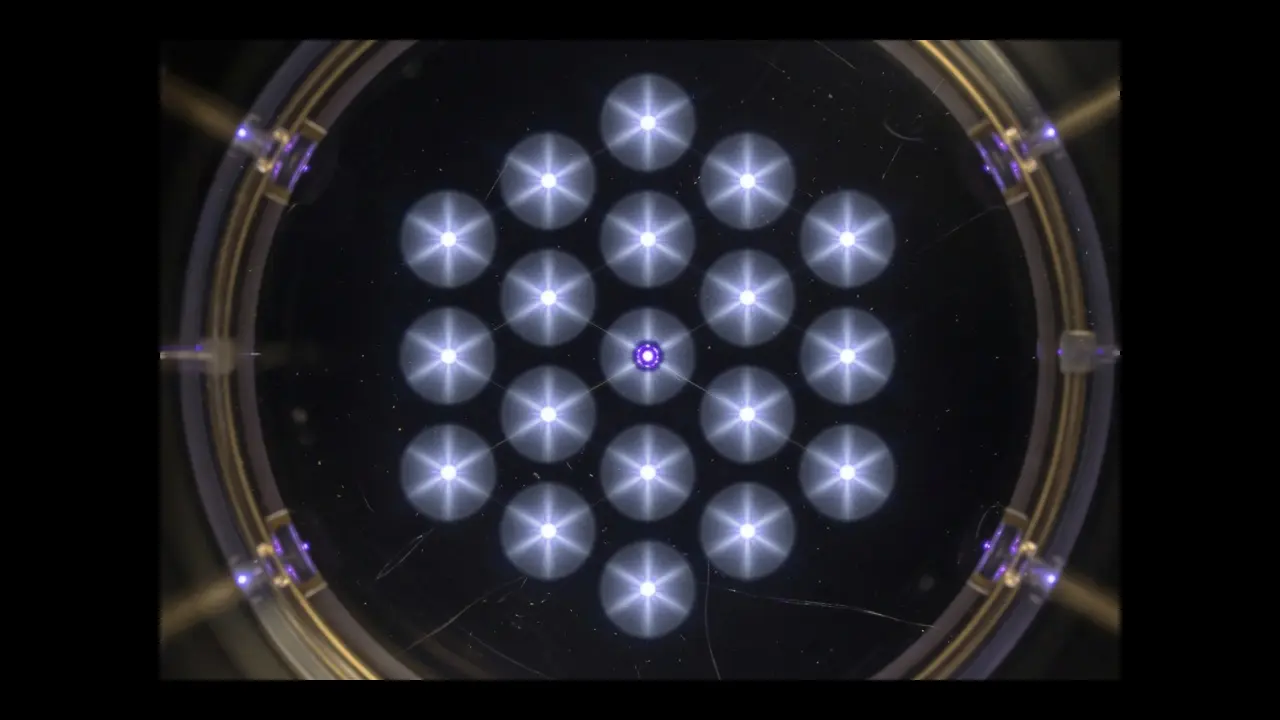
Exploiting excited-state quantum phase transitions enhances sensing capabilities through single-mode bosonic squeezing; this offers a metrological advantage over conventional methods. Driving protocols designed to use diverging susceptibilities to improve signal-to-noise ratios in parameter estimation with experimentally relevant generators. This approach circumvents limitations caused by the breakdown of adiabaticity affecting ground-state critical systems, allowing for improved precision at points where the frequency ratio between qubit and boson approaches infinity.
A new method improves sensor precision by harnessing the properties of “excited quantum states”, rather than relying on traditional approaches using “ground states”. The technique exploits instabilities within systems undergoing specific changes, quantum phase transitions, to amplify signals. It offers advantages over existing methods which struggle when energy differences between states become very small; it achieves this through enhanced ‘squeezing’ of single modes in bosonic systems.
A key element is ‘single-mode bosonic squeezing’, understood as focusing all your energy into one precise push instead of spreading it out, reducing noise while enhancing sensitivity. Driving protocols improved signal detection using experimentally relevant generators and circumvent limitations affecting conventional approaches when the energy difference between states becomes very small. But will this method prove strong enough for real-world applications.
Excited state criticality unlocks high precision sensing beyond adiabatic limits
Up to two orders of magnitude improvement in the signal-to-noise ratio were observed utilising excited state criticality compared with conventional methods; this breakthrough surpasses limitations imposed by “the death of adiabaticity” which previously hindered precision measurements near ground states. Driving protocols exploiting diverging susceptibilities within strongly coupled qubit-boson systems enabled enhanced parameter estimation at frequency ratios approaching infinity, a regime inaccessible through traditional techniques. Single-mode bosonic squeezing proved key to circumventing energy gap issues and achieving superior sensitivity in quantum sensors, opening new possibilities for advanced metrology applications reliant on precise signal detection.
Reducing quantum noise in one aspect of light, single-mode bosonic squeezing was instrumental to success, allowing researchers to surpass previous limitations when measuring near qubit energy levels. Specifically, quadrature ratio enhancements scaling approximately with system size raised to the power 0.55 (∆ 0.55 ) were achieved via geodesic driving protocols within strongly coupled systems; linear trajectories scaled instead at ∆ 0.6>>>2.<<< Furthermore, increasing coupling strength λ boosted achievable squeezing without needing larger system sizes or longer preparation times, an advantage unavailable for ground state transitions limited by a maximum squeeze of six.
Bosonic Squeezing Enhances Signal Detection But Requires Noise Resilience Testing
The work clearly demonstrates an advantage in signal detection by shifting focus from ground states to excited ones and circumventing issues with ‘the death of adiabaticity’, but the extent of this improvement against real-world noise remains unanswered. Details regarding durability when faced with imperfections inherent in actual devices or fluctuating environmental conditions did not provide; acknowledging that such factors could diminish gains is sensible, as no quantum system operates in complete isolation from disturbance. This research offers an alternative path for improving sensor precision and expands possibilities beyond traditional methods reliant on stable ground states.
The team from Charles University and the Czech Academy of Sciences demonstrated exploiting excited-state quantum phase transitions enhances sensing precision, relying on manipulating systems at points of instability to amplify signals during measurement. Single-mode bosonic squeezing proved central to improved signal detection by reducing noise within these measurements. By circumventing limitations affecting conventional critical quantum metrology with ground states where diminishing energy gaps hinder performance, this opens new avenues for exploration.
This research showed that using excited-state quantum phase transitions improves the precision of parameter estimation in a qubit-boson system. The team achieved single-mode bosonic squeezing and demonstrated an advantage over traditional methods reliant on stable ground states, which are limited by factors like ‘the death of adiabaticity’. This approach boosts signal detection by amplifying signals at points of instability within the system; coupling strength increased achievable squeezing without requiring larger systems or longer preparation times. These findings offer alternative strategies for enhancing sensor sensitivity and expanding possibilities beyond conventional techniques.
👉 More information
🗞 Critical excited states in quantum metrology
✍️ Marek Kuchař and Michal Macek (Affiliation: Czech Academy of Sciences)
🧠 ArXiv: https://arxiv.org/abs/2611.15683


See today’s quantum computing news on Quantum Zeitgeist for the latest breakthroughs in qubits, hardware, algorithms, and industry deals.