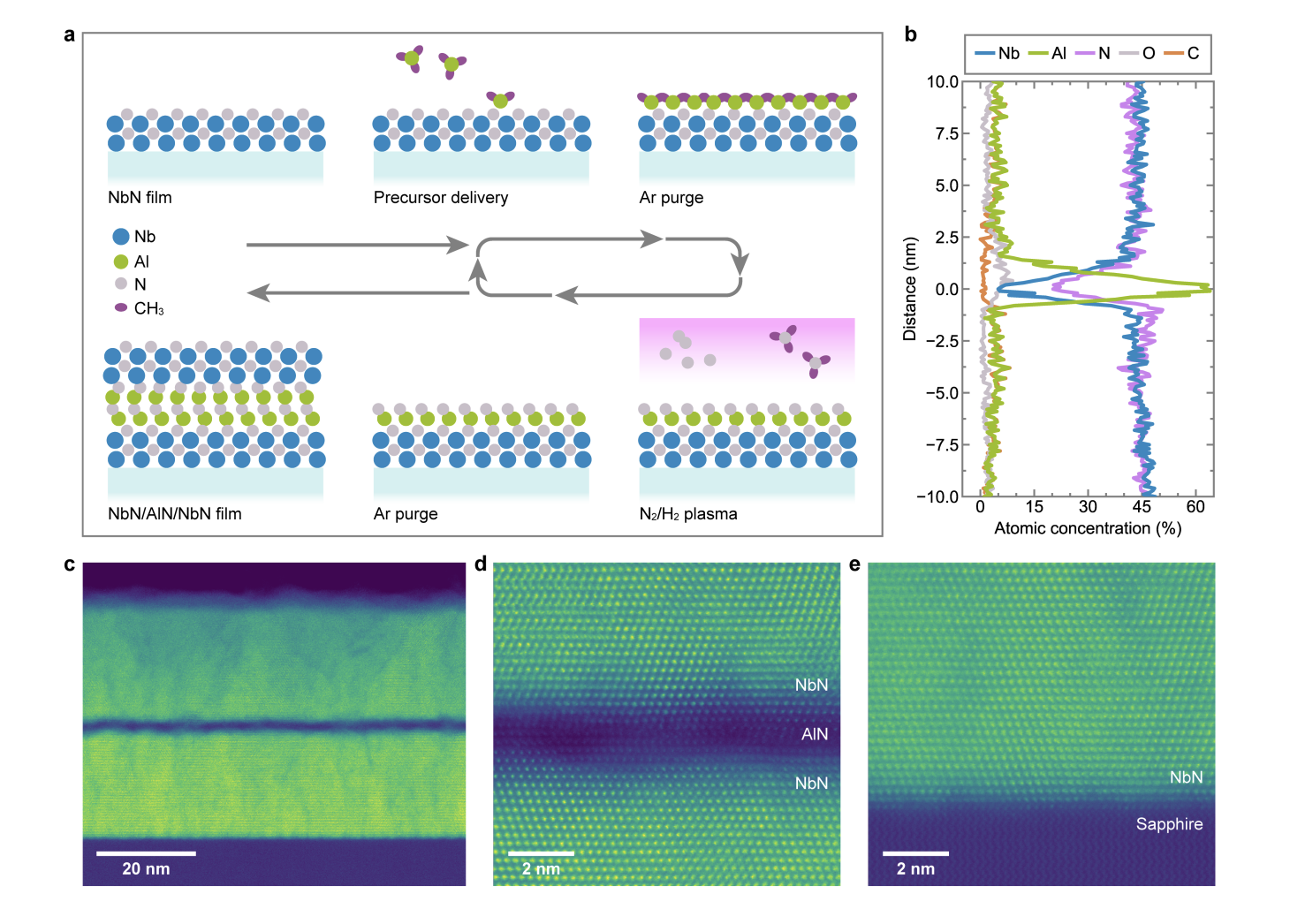
The pursuit of practical quantum computers demands qubits that function reliably and can be manufactured using industrial-scale processes, and a team led by Danqing Wang from Yale University, Yufeng Wu, and Naomi Pieczulewski from Cornell University now demonstrates a significant step forward in achieving this goal. They report the creation of superconducting qubits built entirely from nitride materials, fabricated using a technique called atomic layer deposition, an established method for creating precise thin films. By carefully controlling the deposition process, the researchers achieve exceptional control over the qubit’s properties, observing a vast range of electrical currents and, crucially, maintaining qubit coherence for microseconds even at relatively high temperatures. This achievement establishes atomic layer deposition as a powerful technique for building quantum circuits and paves the way for more scalable and practical quantum computers that can operate at warmer temperatures than currently possible.
Achieving High Coherence Times at Elevated Operating Temperatures
Measurements reveal that transmon qubits fabricated from these all-nitride trilayers maintain microsecond-scale relaxation times, even when tested at temperatures exceeding 300 millikelvin. This is a significant achievement, as it indicates the potential for operating qubits at higher temperatures, reducing the demands on cryogenic cooling systems. By precisely controlling the thickness of the AlN barrier at the atomic level, they achieved tunable Josephson junctions, a crucial component for building complex quantum circuits. The ability to control layer thickness with such precision, coupled with the scalability of the ALD process, positions this approach as a promising platform for developing superconducting qubits capable of operating at elevated temperatures and supporting large-scale quantum computation.
ALDmons Demonstrate Extended Temperature Operation
This research demonstrates a new platform for superconducting qubits based on thin films grown using atomic layer deposition, specifically NbN/AlN/NbN trilayers. By precisely controlling the thickness of the AlN barrier layer during deposition, scientists achieved a wide range of critical current densities, spanning seven orders of magnitude, and confirmed the uniformity and quality of the resulting material. These qubits, termed ALDmons, exhibit microsecond-scale relaxation times even at temperatures above 300 millikelvin, significantly expanding the operational temperature window for superconducting quantum devices compared to existing aluminum-based technologies. While current devices exhibit relaxation times in the range of 1.
4 microseconds, detailed analysis suggests that the dominant sources of loss remain unresolved, with potential contributions from substrate quality, etching processes, and device packaging. Future work focuses on optimizing these aspects, alongside exploring alternative nitride combinations, to further enhance qubit coherence and potentially enable high-frequency operation in the millimeter wave regime. These advancements establish a scalable and industry-compatible foundation for next-generation superconducting quantum technologies.
🗞 All-nitride superconducting qubits based on atomic layer deposition
🧠 ArXiv: https://arxiv.org/abs/2511.08931



See today’s quantum computing news on Quantum Zeitgeist for the latest breakthroughs in qubits, hardware, algorithms, and industry deals.