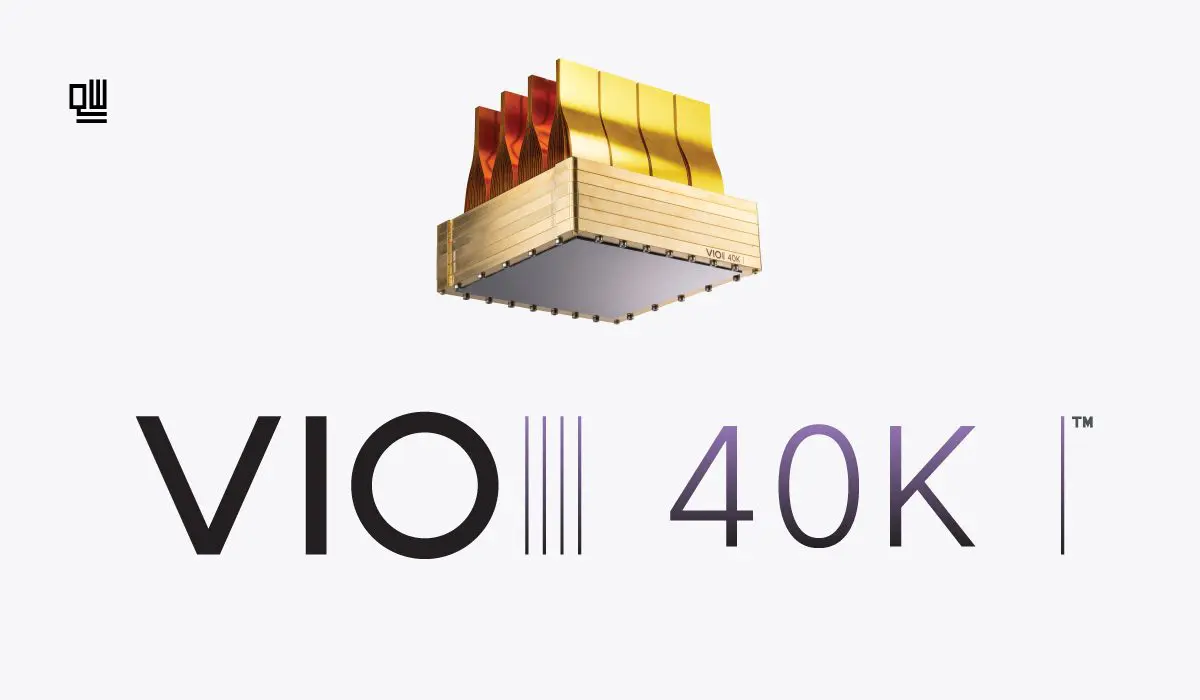
QuantWare announced a scaling breakthrough with VIO-40K™, delivering quantum processors capable of 10,000 qubits for the first time. Based in Delft, The Netherlands, the company’s new generation QPU utilizes its VIOTM scaling architecture to create QPUs exceeding current industry standards by a factor of 100. VIO-40K supports 40,000 input–output lines through chiplet modules connected via ultra-high-fidelity chip-to-chip connections, offering exponentially more compute per dollar and per watt. This innovation removes a critical scaling barrier, paving the way for economically viable quantum computers and unlocking the potential of quantum computing across multiple fields.
VIO-40K™: A New Quantum Processor
QuantWare has announced a breakthrough in quantum processing with VIO-40K™, a new processor delivering 10,000 qubits. This represents a significant leap forward, being 100 times larger than currently available QPUs in the industry. For nearly a decade, the quantum field has been limited to around 100 qubits; even IBM’s leading device, slated for 2028, will only reach 120 qubits. VIO-40K addresses these scaling bottlenecks, enabling the creation of much more powerful quantum computers.
The VIO-40K processor utilizes QuantWare’s VIO 3D scaling architecture, supporting 40,000 input–output lines through interconnected chiplet modules. This design offers exponentially more compute power per dollar and per watt compared to systems relying on multiple, smaller, networked QPUs. Importantly, the VIO architecture is available to the entire industry, allowing any organization using superconducting qubits to create more powerful processors.
To meet anticipated demand, QuantWare is constructing Kilofab, a large-scale QPU fabrication facility scheduled to open in 2026. Located in Delft, The Netherlands, Kilofab will be dedicated to manufacturing VIO-40K processors and will increase QuantWare’s production capacity by 20 times. Reservations for VIO-40K are being accepted now, with initial shipments expected in 2028, promising economically relevant quantum computers are now within reach.
Overcoming QPU Scaling Bottlenecks
For nearly a decade, quantum processing unit (QPU) sizes have been limited to around 100 qubits, with recent advancements reaching 120 qubits by 2028. This stagnation stemmed from inherent scaling bottlenecks in QPU hardware, pushing the industry toward costly solutions involving networking numerous smaller processors. QuantWare’s VIO architecture addresses these limitations, enabling the creation of significantly larger QPUs – with the newly announced VIO-40K delivering 10,000 qubits – and promising a substantial increase in compute power per dollar and per watt.
QuantWare’s VIO-40K utilizes a 3D scaling architecture consisting of chiplet modules connected via ultra-high-fidelity chip-to-chip connections, supporting 40,000 input–output lines. This approach unlocks the potential for very large QPUs, and is available to the entire industry, allowing any organization working with superconducting qubits to create more powerful processors. The company emphasizes that VIO removes the scaling barrier, enabling economically relevant quantum computers, and is accessible through the Quantum Open Architecture (QOA).
To meet anticipated demand, QuantWare is constructing Kilofab, an industrial-scale QPU fab scheduled to open in 2026. Located in Delft, The Netherlands, Kilofab will be dedicated to manufacturing VIO-40K processors and will increase QuantWare’s production capacity by 20 times. This fab, combined with compatibility with NVIDIA’s NVQLink platform and CUDA-Q, will integrate hyperscaled quantum compute with classical AI supercomputing, delivering a developer interface for these resources.
“For years, people have heard about quantum computing’s potential to transform fields from chemistry to materials to energy, but the industry has been stuck at 100-qubit QPUs forcing the field to theorize about interesting but far-off technologies,” said Matt Rijlaarsdam, CEO of QuantWare.
Matt Rijlaarsdam, CEO of QuantWare
Kilofab: Scaling Production Capacity
QuantWare is addressing quantum processing limitations by building Kilofab, an industrial-scale QPU fabrication facility. Scheduled to open in 2026 and located in Delft, The Netherlands, Kilofab will be dedicated to manufacturing VIO-40K processors. This fab is projected to increase QuantWare’s production capacity by a factor of 20, establishing it as one of the world’s largest quantum fabrication facilities and supporting the demand for scaled quantum computing.
Kilofab’s purpose is to manufacture the VIO-40K processor, which delivers 10,000 qubits, 100 times larger than currently available QPUs. This breakthrough is enabled by QuantWare’s VIO 3D scaling architecture and consists of chiplet modules connected with ultra-high-fidelity connections. The VIO technology is available to the entire industry, allowing any organization working with superconducting qubits to create more powerful QPUs.
The successful integration of thousands of physical qubits requires overcoming immense crosstalk and thermal dissipation challenges inherent in tightly packed superconducting circuit designs. QuantWare’s VIO architecture mitigates these effects by dedicating significant silicon real estate to optimized routing layers. These advanced interposers act as signal multiplexers, ensuring that the fidelity of the individual transmon qubits remains high even as the density increases by a factor of one hundred, a critical engineering feat previously considered prohibitively complex.
Beyond raw qubit count, the industry focus is shifting toward achieving Fault-Tolerant Quantum Computing (FTQC), which demands highly robust quantum error correction (QEC) codes. VIO-40K’s scale is crucial for encoding logical qubits; achieving reliable computation requires grouping hundreds or thousands of physical qubits to detect and correct decoherence errors. The system’s inherent modularity allows for the stepwise implementation of increasingly complex, and resource-intensive, error-correcting overhead layers.
Furthermore, the design emphasizes an open-source modular standard, greatly accelerating ecosystem development. By exposing the VIO architecture to the wider industry, QuantWare is facilitating a shift away from proprietary, vertically integrated systems. This standardization lowers the barrier to entry for academic research and commercial hardware integration, accelerating the transition from early-stage Noisy Intermediate-Scale Quantum (NISQ) devices toward deployable, fault-tolerant quantum computation units.
The VIO-40K processor integrates with NVIDIA’s NVQLink, providing a low-latency, high-throughput connection to classical AI supercomputing. This integration, along with the NVIDIA CUDA-Q platform, offers developers access to these hyperscaled quantum compute resources. Reservations for VIO-40K are being accepted now, with initial devices slated for customer delivery in 2028.

See today’s quantum computing news on Quantum Zeitgeist for the latest breakthroughs in qubits, hardware, algorithms, and industry deals.