QuantumDiamonds has secured €91 million in funding to scale production of its quantum-based chip inspection technology, a significant investment that positions Europe as a key player in semiconductor manufacturing. The financing includes €76 million in non-dilutive funding approved under the European Chips Act, making QuantumDiamonds one of the first startups awarded manufacturing funds alongside established industrial players like GlobalFoundries and Carl Zeiss. Deployments of the company’s technology began in March and April 2026 with installations in the U.S. and Taiwan, indicating rapid adoption by key chipmakers. Kevin Berghoff, CEO and co-founder of QuantumDiamonds, said the firm aims to address yield challenges stemming from increasingly complex 3D chip architectures.
€91 Million Funding Fuels QuantumDiamonds’ Expansion
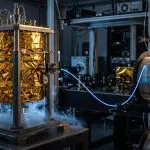
QuantumDiamonds secured €91 million in funding, a substantial investment signaling confidence in its approach to semiconductor inspection and positioning the firm as a key player in bolstering European chip manufacturing capabilities. A significant portion, €76 million, arrives as non-dilutive funding via the European Chips Act, a structure that distinguishes this financing from typical venture capital rounds and underscores the EU’s strategic commitment to the technology. The company’s technology addresses critical limitations in current chip inspection methods, which struggle to identify defects within increasingly complex 3D chip architectures; industry analysis shows that a single percentage point improvement in yield can be worth millions of dollars a week for a high-volume device. QuantumDiamonds’ QDm. 1 system utilizes atomic-scale defects in synthetic diamonds to detect magnetic fields with extreme precision, effectively visualizing electricity flow and pinpointing defects at the nanoscale.
A Tier 1 U.S. chip designer, working with the QD technology, reported a significant time saving, stating, “We’d been trying to debug this chip for six weeks. You found the defect in under a minute.” Deployments were established in March and April 2026 in the U.S. and Taiwan, demonstrating early adoption by leading chipmakers, and the company plans to more than double its engineering team over the next 12 months.
QD can become Europe’s next ASML: a first-of-a-kind technology, built and scaled here, in a $104 billion equipment market that the entire AI economy depends on.
Daria Saharova, Managing Partner at World Fund
QuantumDiamonds is addressing a critical bottleneck in advanced chip manufacturing; traditional inspection tools struggle to identify defects within the increasingly complex, three-dimensional architectures of modern semiconductors, directly impacting production yields and costs. The company’s QDm. This capability enables non-destructive 3D current imaging at the nanoscale, allowing for pinpoint accuracy in locating and assessing the depth of chip defects. A Tier 1 U.S. chip designer relayed, “We’d been trying to debug this chip for six weeks. You found the defect in under a minute,” and this ability allows for inspection at the wafer level, enabling high-throughput fabrication inspection.
Since our initial seed investment in late 2023, the pace of technical progress at QD has been exceptional.
Mason Sinclair, Partner at IQ Capital
QuantumDiamonds, a Munich-based semiconductor equipment firm, is one of the first startups awarded manufacturing funding under the European Chips Act following a €91 million funding round, demonstrating a strong vote of confidence in its novel inspection technology. Deployments of QuantumDiamonds’ systems occurred in the U.S. and Taiwan in March and April 2026. Daria Saharova, Managing Partner at World Fund, explained, “Europe uses around 20% of the world’s semiconductors while producing only 10%, and that gap is exactly where our strategic power leaks away,” emphasizing the strategic importance of supporting companies like QuantumDiamonds to secure Europe’s position in the semiconductor supply chain.
Europe uses around 20% of the world’s semiconductors while producing only 10%, and that gap is exactly where our strategic power leaks away.
Daria Saharova, Managing Partner at World Fund




See today’s quantum computing news on Quantum Zeitgeist for the latest breakthroughs in qubits, hardware, algorithms, and industry deals.