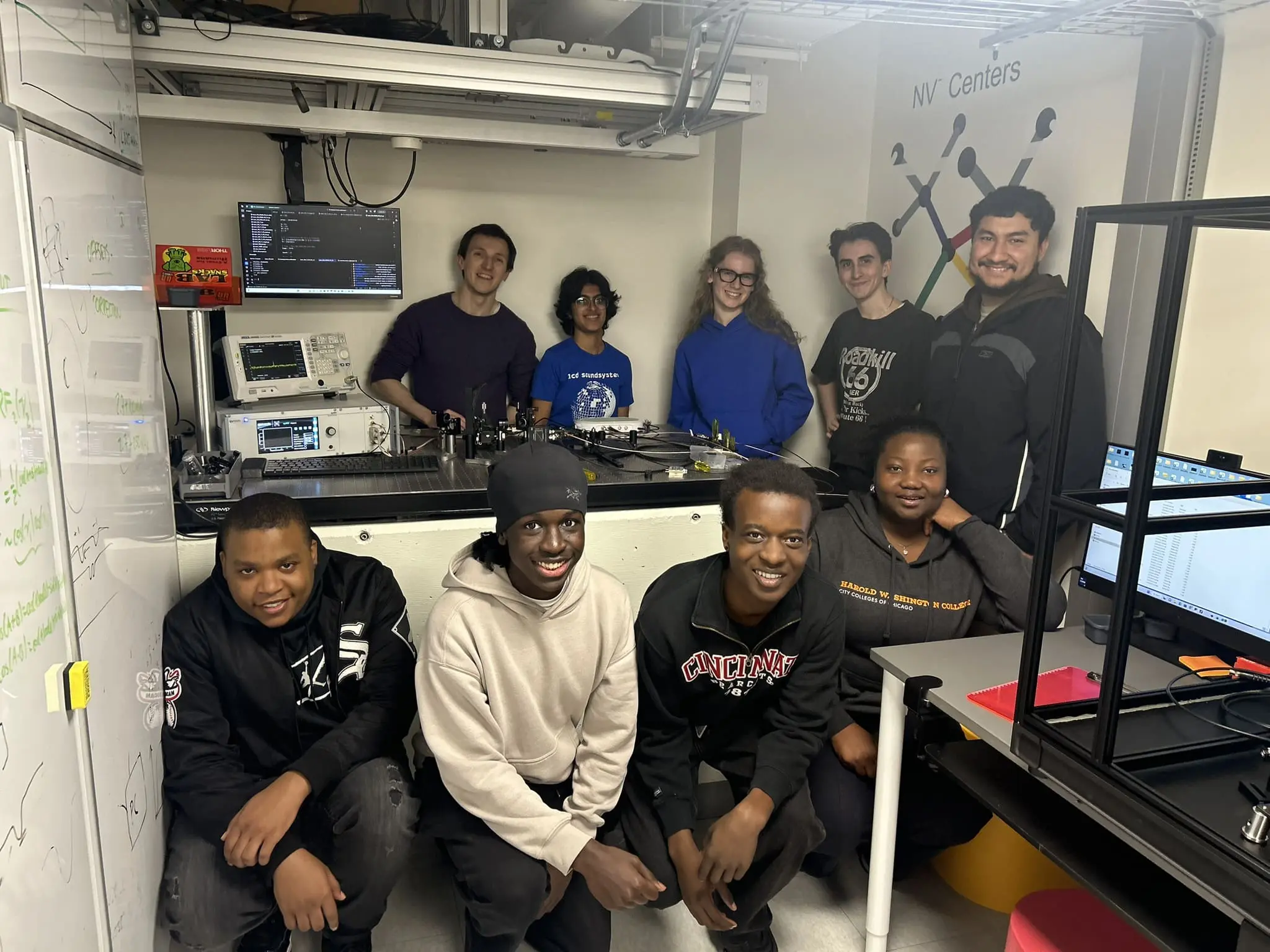
A Midwest quantum job market potentially reaching 191,000 within a decade is developing as the University of Chicago Pritzker School of Molecular Engineering launches a new workforce development program, directly connecting community college students with emerging quantum engineering roles. Seven City Colleges of Chicago students and recent alumni participated in a pilot program this spring, gaining hands-on experience in quantum control through a partnership with quantum computing company Quantum Machines and the Chicago Quantum Exchange. “I want to get in on the ground floor with quantum and gain the knowledge and experience needed to take the next step in this field as it continues to grow and evolve,” said Caleb Harris, an Olive-Harvey College graduate now studying at Purdue University Northwest. UChicago PME Instructor Danyel Cavazos emphasizes the necessity of a skilled workforce, stating that the quantum industry of the future can only succeed if there is a workforce of technicians and engineers ready to tackle the challenge of deploying and escalating these technologies.
Chicago Quantum Exchange Predicts 191,000 Midwest Quantum Jobs
A recent Chicago Quantum Exchange report estimates that the Midwest’s quantum job market could be as large as 191,000 within a decade, signaling substantial economic potential and a rapidly expanding industry. The curriculum, co-designed by UChicago PME Instructor Danyel Cavazos and Quantum Machines’ Kristina Callaghan, focused on quantum control, organizing all the inputs and outputs from the devices and signals into coherent quantum commands from researcher to qubit. “I like to think of it being similar to how an orchestra director puts together a set of instruments and the talent of a group of musicians into a wonderful concert,” Cavazos explained, drawing a parallel between experimental sequences and musical harmony. Quantum Machines provided its OPX+ controller unit, allowing students to gain practical experience with equipment used in professional research. This initiative reflects a broader strategy for workforce development, particularly as projects like the Illinois Quantum and Microelectronics Park make Chicago a major hub. Quantum Machines is looking to expand the program, aiming to repeat, grow, and expand it across the Midwestern quantum landscape.
Industry-led training and hands-on learning are both essential pieces of preparing the future quantum workforce for the specific demands of the fast-growing sector.
David Awschalom, the Liew Family Professor of Quantum Engineering and Physics at UChicago PME and the founding director of the CQE
UChicago PME & Quantum Machines Launch Workforce Pilot Program
The growing quantum industry is increasingly reliant on proactive workforce development, moving beyond theoretical research toward practical application and scalable technologies. The curriculum focused on quantum control, organizing all the inputs and outputs from the devices and signals into coherent quantum commands from researcher to qubit. Course teaching assistant Srimaye Peddinti explained that every week they ran a different experiment that a researcher or a graduate student would run as part of their daily tests or large research projects, emphasizing the program’s practical value. This initiative isn’t simply about imparting knowledge; it’s about fostering early engagement with the field. Caleb Harris, an Electrical Engineering student and graduate of Olive-Harvey College, exemplifies this proactive approach. The program’s success is evidenced by students like Andriana Chyzhyk, who prioritized a lab session over her own graduation ceremony, stating, “I just decided this one is more fun.”
By connecting lab space, instructors, students, and industry partners across institutions, we were able to leverage the region’s existing assets to pilot something new-and build a model that can grow with the needs of the quantum ecosystem.
Emily Easton, Director of Education and Workforce Development at CQE and co-lead for workforce development at the IQMP
Quantum Control Curriculum Integrates OPX+ Hybrid Controller
Caleb Harris exemplifies a proactive approach to entering the burgeoning quantum field; currently studying Electrical Engineering while holding an associate’s degree in Computer Science, he actively sought quantum education to position himself for early career opportunities. The program focused on quantum control, organizing all the inputs and outputs from the devices and signals into coherent quantum commands from researcher to qubit. Quantum Machines contributed its OPX+, a hybrid controller unit enabling students to interface with diverse quantum hardware, allowing them to execute experiments mirroring those conducted by researchers and graduate students. A recent report from the Chicago Quantum Exchange estimates that the Midwest’s quantum job market might be as large as 191,000 within a decade. This substantial projection underscores the urgency of workforce development, a sentiment echoed by Kristina Callaghan of Quantum Machines, who stated, “The need now is to put the foundations in place to train up a quantum workforce.” Quantum Machines is looking to repeat, grow, and expand the program beyond Chicago, aiming to replicate the model across the Midwestern quantum landscape.
This pilot is a good example of the programming we want to build – and scale – as the Midwest continues to drive US leadership in this potentially transformative sector.
David Awschalom, the Liew Family Professor of Quantum Engineering and Physics at UChicago PME and the founding director of the CQE


See today’s quantum computing news on Quantum Zeitgeist for the latest breakthroughs in qubits, hardware, algorithms, and industry deals.