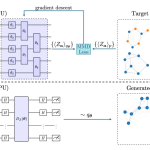
Researchers led by Markus Baumann at LMU Munich and colleagues at Siemens AG have demonstrated a novel approach to training quantum generative models that significantly enhances their ability to generalise to unseen data. Training an Instantaneous Quantum Polynomial-time (IQP) circuit utilising parity losses results in markedly improved performance in recovering previously unobserved data states when contrasted with conventional mean-squared-error (MSE) methods. Parity supervision functions as a powerful inductive bias, effectively transferring information gleaned from observed samples to structurally similar, yet unobserved, states, and represents a crucial mechanism for generalisation within IQP Born machines when appropriately aligned with both the underlying learning distribution and the specific circuit architecture. This provides a practical and effective training signal, and importantly, broadens the potential applicability of quantum generative modelling techniques.
Parity supervision facilitates generalisation to structurally similar unobserved states
Parity supervision facilitated the recovery of unseen high-value states with an improvement factor of 2 compared to IQP-MSE training, a level of performance previously unattainable using coordinate-wise mean-squared-error methodologies. Traditionally, generative models have struggled to extrapolate beyond the explicitly observed data within their training set, limiting their utility in real-world applications. This new advancement, however, demonstrably enables the recovery of structurally similar, unobserved states, representing a significant step forward. The researchers employed spectral reconstruction techniques to confirm that parity moments effectively transfer information from the observed samples to compatible, unseen states. The IQP circuit then refines this initial information, further highlighting the crucial role of parity supervision as a generalisation mechanism, but only when carefully aligned with the learning distribution and the inherent characteristics of the circuit architecture. This alignment is not merely coincidental; it suggests a deeper connection between the chosen training objective, the model’s structure, and the nature of the data itself.
A fundamental inductive bias is demonstrably imparted by parity supervision for IQP Born machines, proving that it is not simply a convenient and tractable training signal. Detailed analysis revealed substantial improvements in exact forward Kullback-Leibler (KL) divergence fit, a result that was not replicated when employing maximum-entropy control techniques. The KL divergence is a measure of how one probability distribution diverges from a second, expected probability distribution; a lower KL divergence indicates a better fit. While the current experiments are limited to controlled, exactly enumerable settings and have not yet been demonstrated on real-world, complex datasets, it is important to acknowledge the simplified environment of these successful experiments. Real-world quantum systems are inherently more complex and susceptible to noise, a significant challenge in quantum computation. Nevertheless, this technique refines our understanding of how quantum computers can learn patterns from limited data, mirroring the initial challenge of extrapolating beyond known states, and provides a key foundational element for future research into more complex and realistic scenarios. The ability to generalise from limited data is paramount for practical applications of quantum machine learning, and parity supervision offers a promising avenue for achieving this goal.
Successful quantum machine learning depends on careful system and objective design
A model’s capacity to extrapolate beyond its training data is absolutely crucial for achieving effective generalisation in machine learning, a feat that is particularly challenging when dealing with complex, discrete systems. Parity supervision has proven to be a viable technique for improving this capability within quantum circuits, but its success is contingent upon precise alignment between the learning distribution, the chosen training objective, and the underlying architecture of the circuit. The experiments were deliberately conducted within a “controlled, exactly enumerable setting”, allowing for rigorous analysis and precise control over the variables involved. This raises the important question of whether this necessary alignment represents a fragile condition, susceptible to disruption in more complex, less controlled environments. Further research will need to investigate the robustness of this approach to variations in the learning distribution and circuit parameters.
Functioning as an ‘inductive bias’, this method extends beyond the purely practical aspects of training complex quantum circuits. It effectively transfers information from known data to structurally similar, previously unseen states, enabling the model to make informed predictions about novel inputs. Spectral reconstruction revealed that parity moments pre-encode this information, providing a structured representation that the quantum circuit can then refine and utilise. This suggests a fundamental alignment between the learning process, the circuit’s design, and the inherent characteristics of the data itself is key to successful generalisation. This approach offers a valuable insight into the intricate interplay between these elements, which is vital for designing effective and robust quantum machine learning systems. Understanding these relationships will be crucial for developing quantum algorithms that can tackle real-world problems with limited data and in the presence of noise. The implications extend beyond simply improving the performance of existing algorithms; it provides a framework for designing entirely new quantum machine learning architectures tailored to specific data distributions and computational tasks.
The use of IQP circuits is particularly noteworthy as they represent a promising avenue for achieving quantum advantage in machine learning. IQP circuits are theoretically capable of solving certain computational problems much faster than their classical counterparts, but they are also notoriously difficult to train. Parity supervision offers a potential solution to this training challenge, enabling the development of more powerful and efficient quantum machine learning algorithms. Future work will focus on extending these findings to more complex datasets and exploring the potential for combining parity supervision with other training techniques. The ultimate goal is to develop quantum generative models that can reliably generalise to unseen data and unlock the full potential of quantum machine learning.
Researchers found that using parity supervision improved the ability of IQP circuits to generalise to previously unseen data, outperforming training with mean-squared-error. This matters because it demonstrates a method for effectively transferring information from observed samples to structurally similar, unobserved states within the model. The study identified parity supervision as a mechanism for generalisation when the learning task, objective, and circuit architecture are well aligned. Authors intend to extend these findings to more complex datasets and combine parity supervision with other training techniques.
👉 More information
🗞 Parity Supervision as a Driver of Generalization in Quantum Generative Modeling
🧠 ArXiv: https://arxiv.org/abs/2605.10258

See today’s quantum computing news on Quantum Zeitgeist for the latest breakthroughs in qubits, hardware, algorithms, and industry deals.