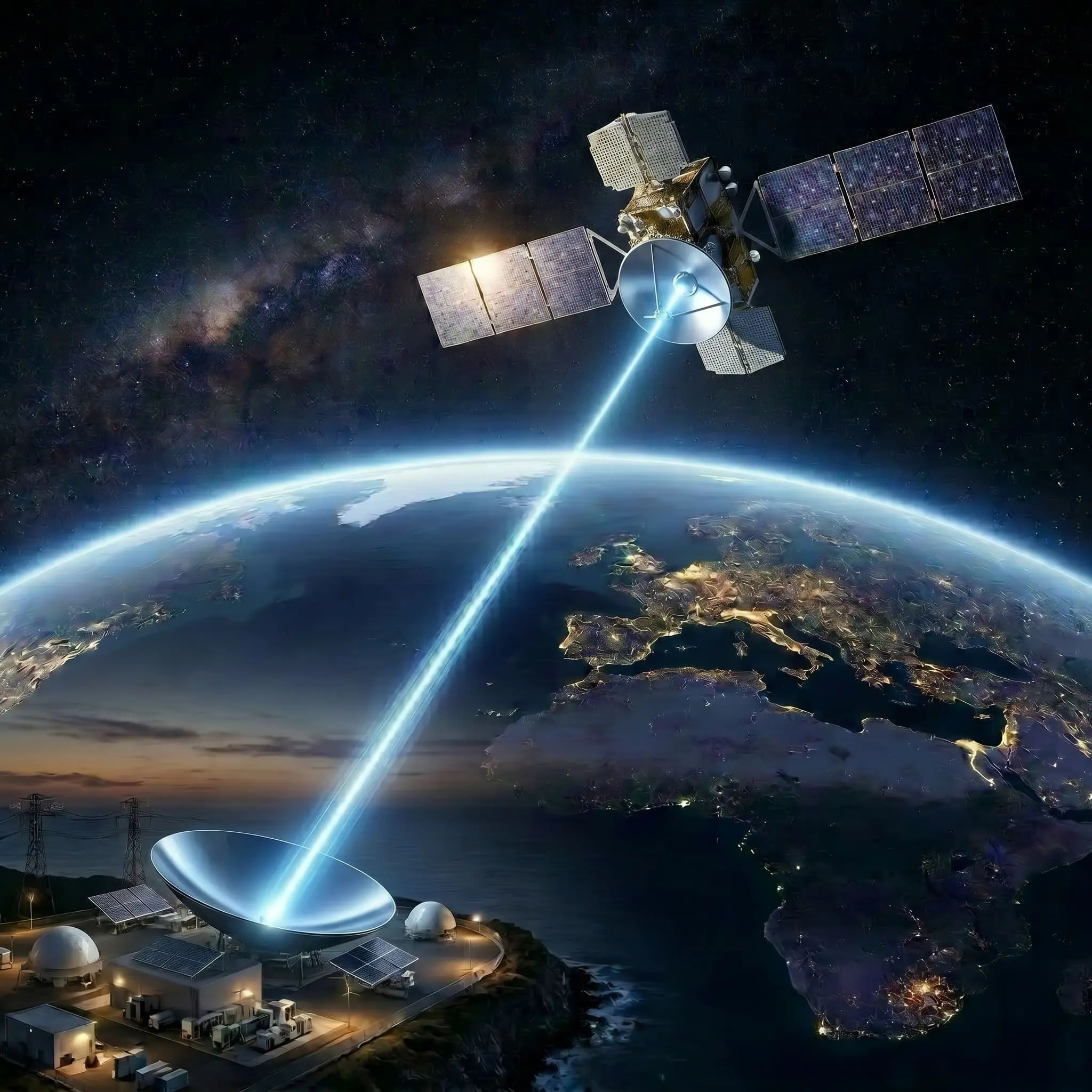
A new architecture utilising low Earth orbit satellites and stratospheric high altitude platforms enables transatlantic quantum entanglement distribution over 6,500km. Kimia Mohammadi of University of Waterloo and colleagues present a system that maximises entanglement distribution rates without requiring quantum memories or repeaters. The findings reveal this configuration can achieve approximately 5×10^6 secure key bits per year with 30cm ground receivers, a sharp improvement, nearly two orders of magnitude higher, compared to single medium Earth orbit satellite systems. This configuration highlights the potential of hybrid satellite-HAP networks to reduce complexity and enable scalable, long-range quantum communication.
Transatlantic quantum key distribution via low Earth orbit satellite and stratospheric relays
The researchers of Waterloo and Simon Fraser University have created a hybrid quantum communication architecture yielding approximately 5×10^6 secure key bits per year. This represents a nearly two order of magnitude improvement over existing single medium Earth orbit (MEO) satellite systems. This advance crosses a key threshold, enabling practical long-range quantum networks previously hampered by signal loss and complex infrastructure requirements. Quantum key distribution (QKD) offers unconditional security based on the laws of physics, unlike classical cryptography which relies on computational complexity. However, the range of QKD systems is fundamentally limited by photon loss in optical fibres and atmospheric turbulence in free space. This limitation has driven research into quantum repeaters, devices that extend the range of QKD by creating and swapping entanglement, but these remain technologically challenging and expensive to implement.
A low Earth orbit (LEO) satellite, supported by two stratospheric high-altitude platforms, or HAPs, acting as optical relays, achieved this enhanced rate, with HAPs operating in the stratosphere between 15 and 50km altitude. Detailed investigations into eight distinct link architectures for transatlantic quantum entanglement distribution over a 6,500km distance revealed that a 30cm aperture ground receiver is sufficient for this hybrid system. Simulations utilising Ansys STK, a set of tools for modelling space systems, determined an optimal orbital altitude of 15,000km and a 90-degree inclination for the LEO satellite to maximise photon pair reception annually, while adhering to a 30-degree elevation constraint to minimise atmospheric attenuation. Atmospheric attenuation, caused by absorption and scattering of photons, is a significant factor in free-space optical communication. The 30-degree elevation constraint ensures that the signal path through the atmosphere is minimised, reducing signal loss. The impact of space radiation on optical and electronic devices was also assessed, considering total ionising dose and single event effects, confirming their potential for mission survival for long-term deployment. Radiation hardening techniques and careful component selection are crucial for ensuring the reliability of space-based quantum communication systems. Achieving this rate does not yet account for the considerable engineering challenges of precisely coordinating and maintaining the stratospheric HAPs’ positions to consistently optimise beam alignment and mitigate weather-related interruptions. Maintaining stable platform positioning requires sophisticated control systems and potentially, adaptive optics to compensate for atmospheric distortions.
Viable transatlantic quantum key distribution circumvents limitations of quantum repeaters
The team’s findings offer a strong solution to the challenge of establishing long-distance quantum links, bypassing the need for costly and complex quantum repeaters. Quantum repeaters require the creation of long-lived quantum memories and efficient entanglement swapping protocols, both of which are currently beyond the reach of practical implementation. This research demonstrates a viable alternative that leverages existing technologies to achieve long-range quantum communication. Maintaining precise positioning of these high-altitude relays, and ensuring their continued operability in harsh atmospheric conditions, presents a significant engineering undertaking. Researchers have demonstrated a pathway to transatlantic quantum key distribution, utilising both low Earth orbit satellites and stratospheric platforms.
This hybrid approach, combining low Earth orbit satellites with high-altitude platforms, offers a substantial improvement in entanglement distribution rates compared to current methods. Instead of complex quantum repeaters, this hybrid architecture relies on existing technology to achieve a rate of approximately secure key bits per year with modest 30cm ground receivers. By deliberately positioning optical relays on high-altitude platforms, atmospheric limitations were mitigated and signal efficiency improved; these platforms operate between 15 and 50km above the Earth’s surface. The HAPs act as trusted nodes, receiving entangled photons from the satellite and re-transmitting them to the ground station, effectively extending the communication range. This approach, however, introduces a level of trust in the HAP operators, a consideration for certain security applications. The use of entanglement-based QKD, as opposed to prepare-and-measure schemes, is crucial for ensuring security against eavesdropping attacks. Entanglement guarantees a correlation between the photons, allowing for the detection of any interference from an attacker.
Further research will focus on optimising the system parameters, including the HAP positioning strategy, satellite orbital parameters, and ground receiver sensitivity. Investigating the feasibility of utilising multiple HAPs to create a mesh network could further enhance the system’s robustness and capacity. The development of more efficient single-photon detectors and low-loss optical components will also be critical for improving the overall performance of the system. Ultimately, this work paves the way for a future global quantum network, enabling secure communication across vast distances and facilitating the development of new quantum technologies.
The research demonstrated a hybrid satellite-HAP architecture significantly improves transatlantic quantum entanglement distribution. This configuration achieved an estimated secure key bits per year using 30cm ground receivers, exceeding rates possible with single satellite systems. By employing high-altitude platforms as optical relays, the system reduces complexity and mitigates atmospheric interference for long-range communication. The authors intend to optimise system parameters and explore multi-HAP networks to further enhance performance and robustness.
👉 More information
🗞 On the viability of Transatlantic Quantum Entanglement Distribution using Combined Satellite and Stratospheric Relay Nodes
🧠 ArXiv: https://arxiv.org/abs/2606.09805



See today’s quantum computing news on Quantum Zeitgeist for the latest breakthroughs in qubits, hardware, algorithms, and industry deals.