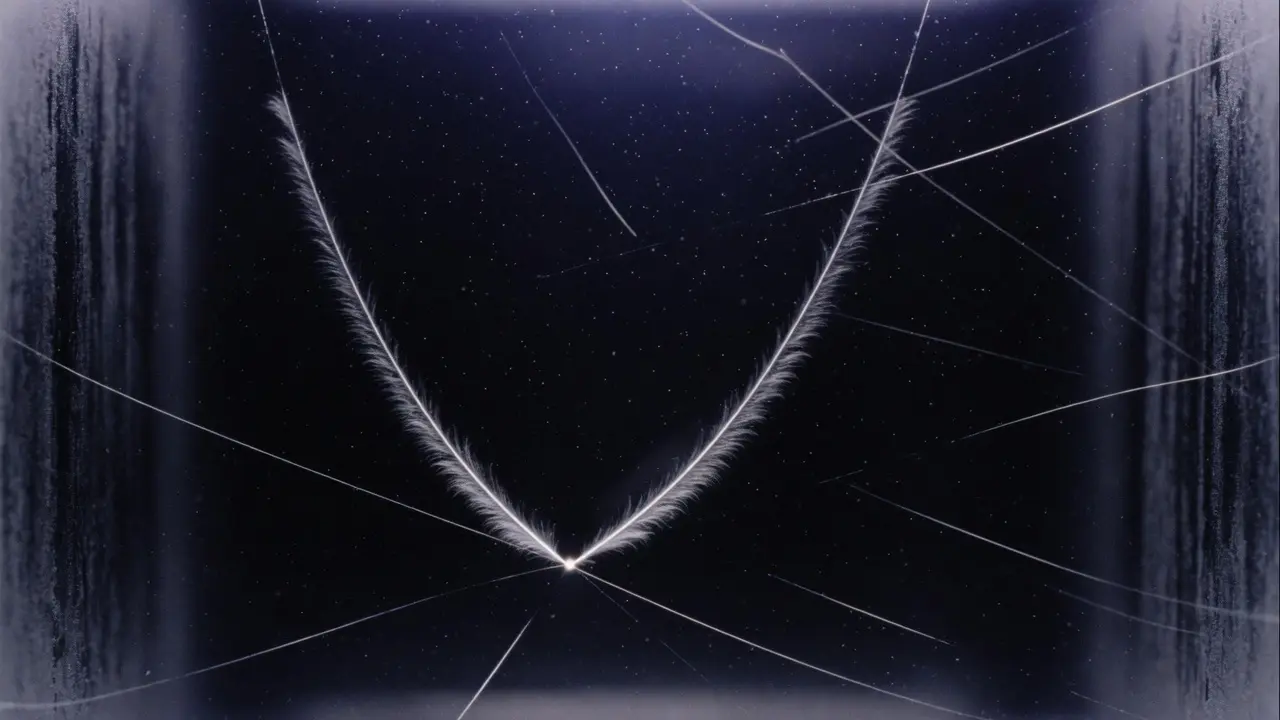
A new quantum circuit simulates Mueller dipole branching, a fundamental stochastic process governing particle interactions at small scales, by encoding splitting paths using event histories and preparing amplitudes from local rates. This enables computation of statevector probabilities with unprecedented accuracy, matching established benchmarks to numerical precision; it opens up possibilities for exploring complex high-energy physics phenomena previously limited by computational demands. The method describes how particles interact at very small scales through repeated splitting.
By encoding each split as a distinct pathway and using precise local rates, the circuit accurately reproduces established results from traditional calculations. This advancement allows detailed study of particle interactions previously limited by computing power, revealing information about fluctuations and correlations beyond simpler models.
This cascade’s evolution is governed by probabilities that depend on particle geometry and position, making detailed study computationally intensive with traditional methods. The team encoded each split as a distinct pathway using what they call ‘orthogonal event-history registers’, essentially recording multiple versions of a maze run simultaneously to track every possible route independently without interference. By accurately reproducing established results within an extremely narrow margin, their circuit opens up possibilities for exploring complex high-energy physics phenomena previously limited by computing power; it also allows examination of fluctuations beyond simpler models.
Quantum Simulation Validates Precise Modelling of Finite-State Dipole Branching Cascades
Statevector multiplicity probabilities from the quantum simulation agree with full continuous-time Markov chain benchmarks to within approximately 7times10-4, surpassing previous computational limits for modelling finite-state dipole branching. Traditional methods struggled with accurately representing all possible splitting pathways due to exponential growth in configurations.
This level of precision enables detailed examination of fluctuations and correlations previously obscured by numerical uncertainties, opening avenues for exploring complex high-energy physics phenomena like deep inelastic scattering (DIS). A normalized fourth factorial moment at largest rapidity measured 1.81 compared to 2.84 for an equal-mean Yule process, a sharp divergence indicating distinct cascade dynamics beyond simpler stochastic models.
The researchers determined that dipole size sectors exhibit correlations; specifically, they observed relationships linking dipoles of different sizes during cascade evolution. A fixed negative-binomial relationship successfully reproduced the rising trend seen in Shannon entropy measurements from the H1 experiment as values move towards smaller x, though it didn’t fully capture all details of those measured distributions. These results demonstrate explicit coherent encoding of finite-state dipole branching and clarify its relation to continuous-cascade fluctuations.
However, these numbers do not yet predict how well this simulation will scale with increasing complexity needed to match real experimental conditions or account for non-linear effects within full QCD evolution. Further investigation is required to determine if current theoretical frameworks adequately describe observed phenomena or require refinement.
Quantum Simulation Reveals Discrepancies With High Energy Particle Cascade Data
The new quantum circuit demonstrably matches established models of particle interactions, achieving precision previously unattainable with traditional methods; however, it doesn’t fully capture experimental reality, specifically failing to perfectly replicate charged-particle multiplicity distributions observed by experiments like H1 at high energies. This discrepancy raises an important question about whether current theoretical frameworks adequately describe all relevant physics governing these cascades or if the simulation requires further refinement to better connect with real-world data.
A coherent quantum circuit was constructed by scientists from NaThe researcherser dipole branching by recording every possible pathway without interference using ‘orthogonal event histories’. The team successfully encoded finite-state dipole branching, a key process in understanding how particles split during high energy collisions, using coherent quantum mechanics rather than relying on pre-calculated results.
By revealing differences in cascade fluctuations compared to simpler models and opening new questions regarding existing theories, this work will likely spur further development in modelling high energy interactions; a major era for understanding fundamental physics may begin here. This research provides valuable insights into the complexities of particle cascades at extreme energies, pushing the boundaries of both computational simulation and theoretical understanding. Ultimately, these findings highlight the potential of quantum computing as an essential tool for exploring some of the most challenging problems in modern physics.
The researchers developed a quantum circuit that accurately reproduces established calculations of finite-state dipole branching, a process describing how particles split during collisions. The circuit prepares transition amplitudes based on local splitting rates and successfully matches results from continuous-time Markov chains to within approximately 7times10-4.
However, when compared with data from experiments like H1, this encoding does not fully describe observed charged-particle multiplicity distributions; normalized fourth factorial moments were found to be $1.81 versus 2.84$ for an equal-mean Yule process. This suggests current theoretical frameworks may need further investigation to completely account for the complexities of high energy particle interactions.
👉 More information
🗞 Coherent quantum-circuit simulation of Mueller dipole branching at small x: multiplicity fluctuations and DIS phenomenology
✍️ Wei Kou and Xurong Chen (Chinese Academy of Sciences)
🧠 ArXiv: https://arxiv.org/abs/2611.33979


See today’s quantum computing news on Quantum Zeitgeist for the latest breakthroughs in qubits, hardware, algorithms, and industry deals.