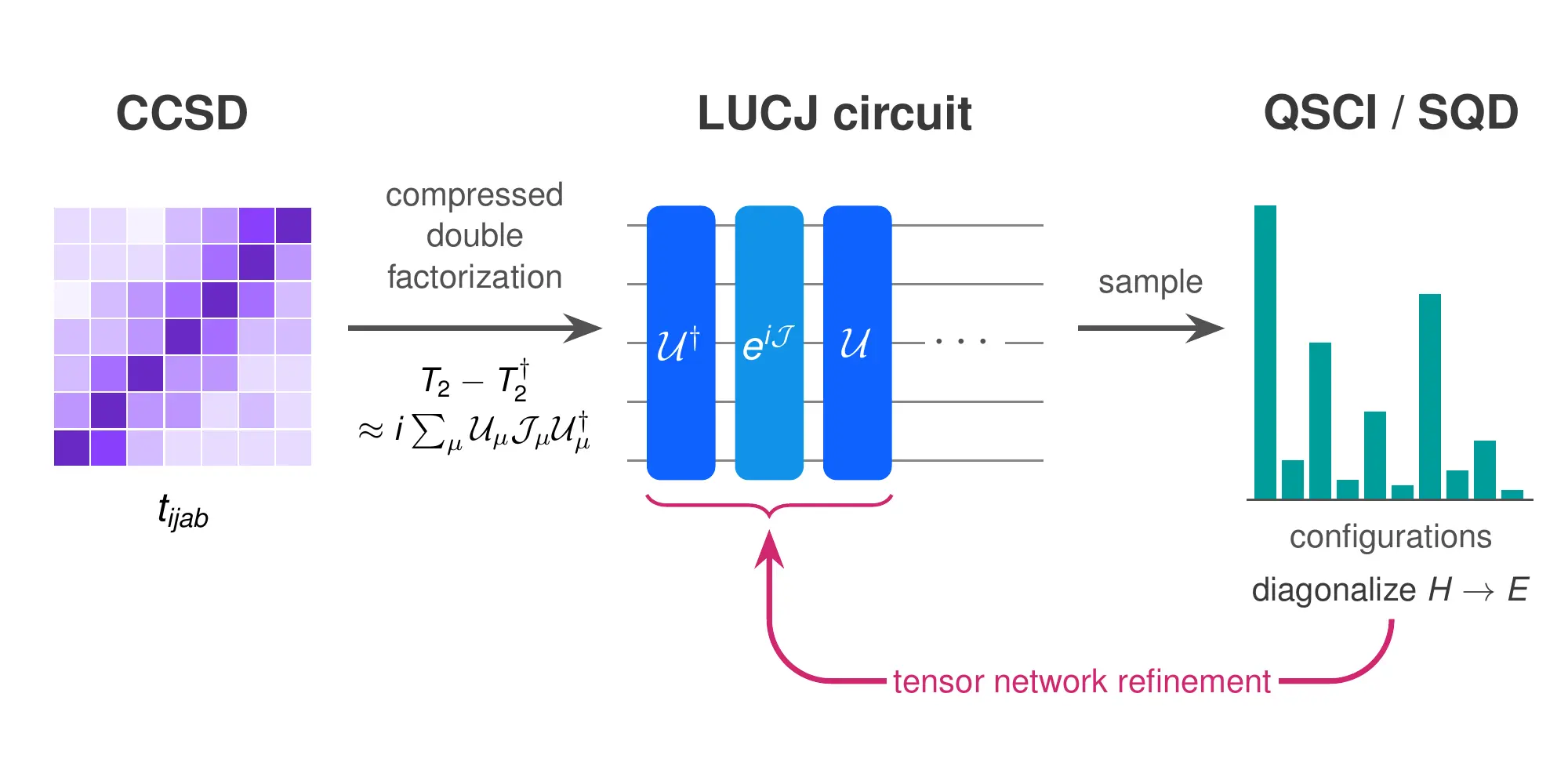
Researchers from IBM Quantum, the University of California, Los Angeles, The Cleveland Clinic, and Michigan State University are working to refine the accuracy of variational quantum algorithms for chemistry. Their work focuses on the local unitary cluster Jastrow (LUCJ) ansatz, a promising circuit whose initial parameters are derived from classical coupled cluster calculations. However, adapting this approach for current quantum computers, by truncating calculations and limiting interactions, degrades the accuracy of the classical approximation. The team proposes methods using compressed double factorization of coupled cluster amplitudes to improve parameter initialization and recover accuracy.
LUCJ Ansatz Limitations with Quantum Hardware
While the LUCJ ansatz offers a promising blend of physical insight and computational efficiency for modeling molecular energies, simply transferring parameters from classical coupled cluster calculations is insufficient to maintain precision. Discarding interactions necessary to fit the constraints of near-term quantum processors degrades the approximation to the classical CCSD method, impacting the resulting energy accuracy. This technique provides a novel way to bridge the gap between classical and quantum computations, allowing for more effective transfer of information from the CCSD calculation to the quantum circuit.
The approach aims to mitigate the loss of accuracy that occurs when the LUCJ ansatz is simplified for implementation on noisy intermediate-scale quantum (NISQ) devices. This is particularly relevant for sample-based algorithms like QSCI and SQD, which rely on classical simulation and energy minimization after initial parameter setting.
These prior studies explored pre-optimization techniques and synergistic pretraining to improve the performance of variational quantum eigensolvers. “A good starting choice for those parameters is crucial,” the researchers note, emphasizing the importance of accurate initialization for achieving reliable results. The current research extends this concept by focusing specifically on the LUCJ ansatz and developing a more sophisticated method for transferring classical information to the quantum realm.
Achieving this requires not only advancements in quantum hardware but also innovative algorithms and techniques for preparing and optimizing. The development of methods like compressed double factorization represents a step toward realizing this potential, enabling more efficient and accurate simulations of complex molecular systems.
Compressed Double Factorization Improves CCSD Parameter Fitting
One method uses compressed double factorization of coupled cluster, singles and doubles (CCSD) amplitudes to refine the initial circuit parameters, effectively reconstructing a more accurate approximation of the CCSD method. This compressed double factorization focuses on the orbital rotations and diagonal Coulomb operators within the LUCJ circuit, allowing it to better align with the CCSD amplitudes even after the circuit is simplified for hardware constraints.
The team validated these techniques using both exact state vector simulations, extending to systems of up to 52 qubits, and experiments on superconducting quantum processors with up to 65 qubits. These validations indicate that the methods can significantly improve the output of both expectation value- and sample-based quantum algorithms, important for tackling complex chemical problems.
The second method proposed is specifically tailored for sample-based algorithms, using approximate tensor network simulation to enhance the quality of samples generated by the ansatz circuit. Both methods function as classical preprocessing steps, constructing initial circuit parameters before potential optimization through quantum measurements.
Tensor Network Simulation Refines Sample-Based Algorithm Parameters
This classical simulation generates configurations and minimizes resulting energy, effectively tuning the circuit parameters before quantum measurements are taken. These results indicate a substantial reduction in energy errors when employing the refined parameter initialization. The team’s approach differs from simply optimizing parameters on the quantum computer itself. Instead, it focuses on constructing a better starting point for that optimization.
Validation on Systems of Up To 52 Qubits
The compressed double factorization technique directly addresses limitations inherent in adapting the LUCJ ansatz for near-term quantum hardware. Specifically, the method combats accuracy loss stemming from the necessary truncation of calculations and the imposition of connectivity constraints on quantum processors, both of which degrade the initial approximation to the classical CCSD method. This factorization concentrates on orbital rotations and diagonal Coulomb operators, elements critical for representing electron correlation within the quantum circuit. The team contributed the re-fitting procedure to the open-source library ffsim, facilitating wider adoption and further development.
Experimental Results on IBM Quantum Processors
This loss of accuracy stems from truncating calculations and removing interactions necessary to fit the circuit onto current hardware. To counter this, the team developed a re-fitting procedure that optimizes the remaining parameters after the circuit is shortened and constrained. This classical preprocessing step aims to closely replicate the original coupled cluster description, providing a more effective starting point for quantum computation. Validation of this approach, using exact state vector simulations, extended to systems comprising up to 52 qubits, demonstrating a substantial reduction in energy errors.
This open-source release allows other groups to build upon their work and explore the potential of improved parameter initialization for quantum chemistry applications. The researchers published their findings in Quantum, detailing the methods for improved parameter initialization. Wan-Hsuan Lin, Fangchun Liang, Mario Motta, Haimeng Zhang, Kenneth M. Merz Jr., and Kevin J. Sung are listed as authors on the paper, which details the techniques and results of their investigation.



See today’s quantum computing news on Quantum Zeitgeist for the latest breakthroughs in qubits, hardware, algorithms, and industry deals.