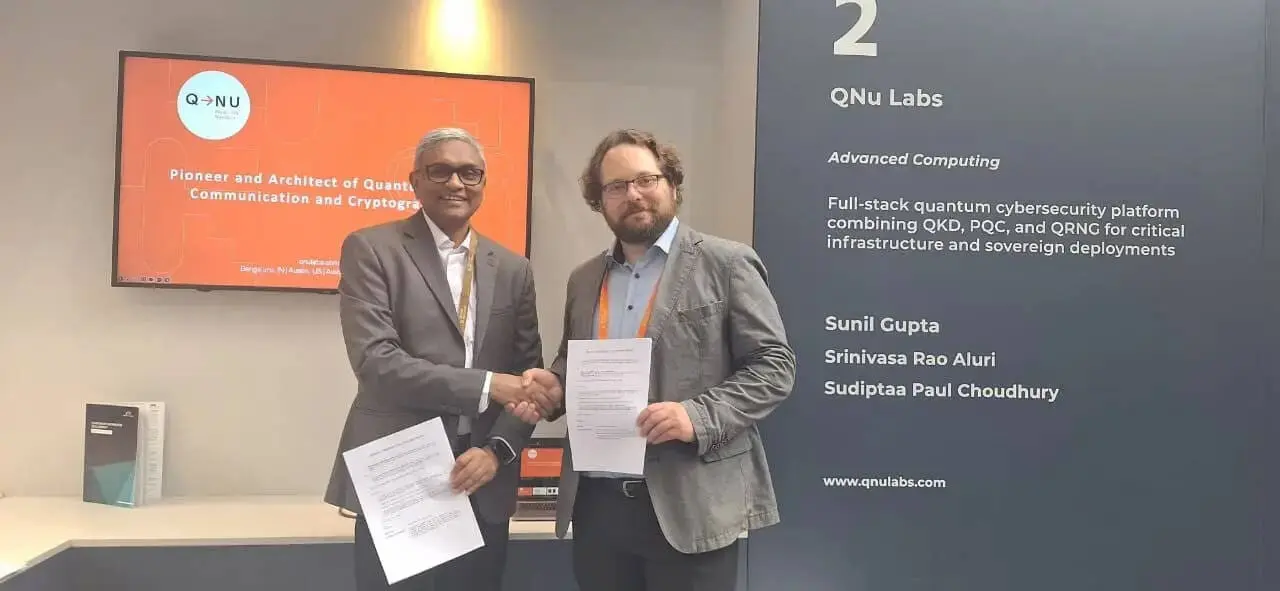
QNu Labs is collaborating with Eindhoven University of Technology (TU/e) to test and validate the long-term resilience of quantum key distribution (QKD) technology, a partnership announced during the Bharat Innovates event in Nice, France. The collaboration unites TU/e’s quantum networking expertise with QNu Labs’ experience deploying quantum solutions across sectors like defense and banking in India, aiming to advance global quantum security standards. “Europe and India share a common interest in building quantum communication infrastructure that is sovereign, trusted, and standards-compliant,” said Simon Rommel, assistant professor at Eindhoven University of Technology. QNu Labs, one of 120 Indian deep tech ventures selected to showcase the nation’s technological capabilities, is also deploying systems designed to defend against both conventional cyberattacks and emerging threats from agentic AI and future quantum computers.
QNu Labs and TU/e Collaborate on Quantum Key Distribution
At QNu Labs, we are building and deploying quantum-safe technologies that protect nations, enterprises, and critical infrastructure against threats from agentic AI, traditional cyber, and future quantum computers that are already on the horizon.
Sunil Gupta, co-founder & CEO, QNu Labs
Hybrid Quantum-Safe Network Demonstrated for BFSI Adoption
The convergence of quantum key distribution and post-quantum cryptography is now being actively demonstrated in practical network deployments, moving beyond theoretical security models. This network integrates QKD with post-quantum cryptography to offer layered protection against both present-day attacks and the potential decryption capabilities of future quantum computers, a strategy reflecting a proactive, multi-faceted defense. A research agreement between QNu Labs and Eindhoven University of Technology (TU/e) will concentrate on rigorous security testing, validation, and long-term resilience of QKD systems, ensuring the technology meets global expectations. QNu Labs has formalized a strategic agreement with SAGA Consultants to accelerate the adoption of these quantum-safe technologies within the Banking and Financial Services (BFSI) sector. “At QNu Labs, we are building and deploying quantum-safe technologies that protect nations, enterprises, and critical infrastructure against threats from agentic AI, traditional cyberattacks, and future quantum computers that are already on the horizon,” explained Sunil Gupta, co-founder & CEO of QNu Labs, emphasizing the broad scope of their security focus.
Europe and India share a common interest in building quantum communication infrastructure that is sovereign, trusted, and standards-compliant. This partnership with QNu Labs is a concrete step toward that shared goal and toward ensuring that QKD technology meets the rigour the world expects of it.
Simon Rommel, assistant professor, Eindhoven University of Technology




See today’s quantum computing news on Quantum Zeitgeist for the latest breakthroughs in qubits, hardware, algorithms, and industry deals.