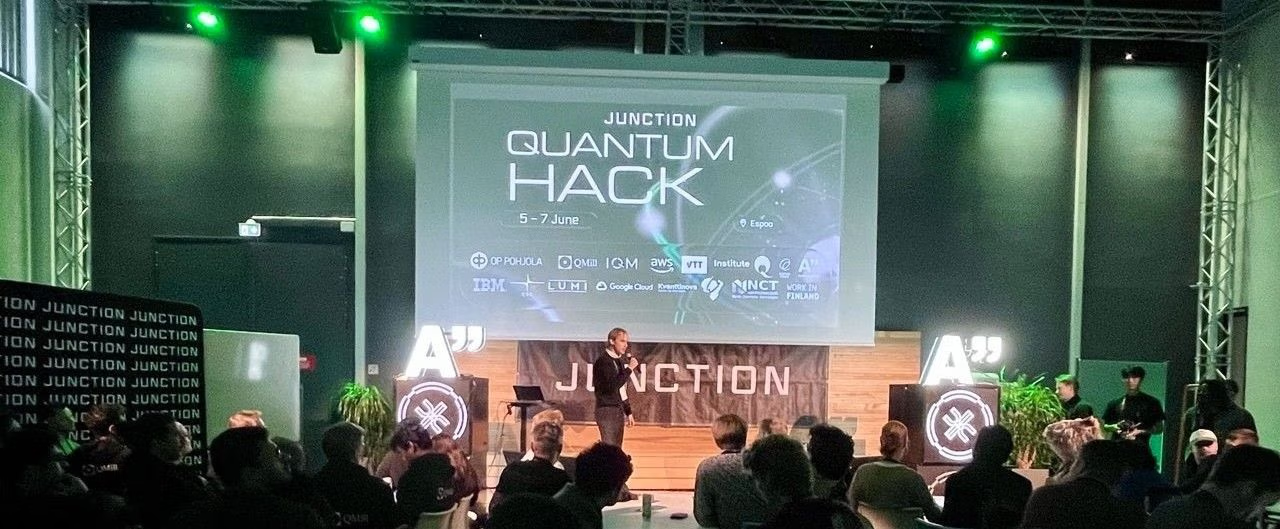
The highly competitive Junction Quantum Hack in Espoo, Finland, culminated in a victory for Team hell0 from Aalto University, which secured the grand prize by solving one more quantum circuit than the second-place team. Approximately 150 researchers, developers, and students representing over 30 countries participated in the 48-hour hackathon, tackling challenges designed to test their quantum skills. QMill presented a unique challenge, tasking participants with extracting secrets hidden within specially built quantum circuits; “I was positively surprised by the number of teams participating in our challenge,” says Clayton Leite, Quantum AI Engineer at QMill and a member of the judging panel. Three of the five finalist teams focused their efforts on QMill’s puzzles, demonstrating a high level of engagement with the platform and its complex problems.
QMill Circuits Challenge Participants at Junction Quantum Hack 2026
A key element of the 48-hour event was the QMill challenge, which presented participants with a unique task: deciphering quantum circuits specifically designed to conceal information. In collaboration with Amazon Web Services and CSC Lumi Supercomputer, QMill moved beyond typical algorithm implementation challenges, demanding a different skillset from competitors. The competition proved remarkably tight; Team hell0 from Aalto University secured both the overall hackathon grand prize and the QMill challenge victory by solving one more quantum circuit than the second-place team, LGU Hack. This narrow margin underscores the high caliber of participants and the demanding nature of the QMill circuits.
I saw on Saturday morning that most of the hard problems had already been cracked. Around 15 teams ultimately submitted results for the QMill challenge, with the top three, hell0, LGU Hack, and Team LAT, receiving awards. LGU Hack demonstrated an impressive initial pace, cracking 40 circuits by Saturday morning, but ultimately fell short due to an unsolvable circuit. The QMill challenge wasn’t just about speed; it also revealed valuable insights into the robustness of quantum circuit designs. “It seemed to me that most participants had little to no prior knowledge of quantum computing.
However, the challenge demonstrated that AI stress testing can contribute significantly when evaluating how robust the circuit designs are,” Clayton concluded. David Karpuk, Principal Quantum Algorithm Engineer at QMill and chief judge, observed that many teams continued working on the most difficult problems until the very last minute, enthusiastically engaging with the QMill platform and providing valuable technical feedback. “When I arrived at the event at 8AM on Sunday morning, I was pleasantly surprised to see so many teams still chipping away at our problems,” he said. Janne Heikkinen, Chief Product Officer at QMill, expressed satisfaction with the event’s success, stating, “We definitely shared the excitement! We are also pleased to see so many new users joining the QMill Quantum Advantage Services platform and their very good feedback.”
It seemed to me that most participants had little to no prior knowledge of quantum computing. However, the challenge demonstrated that AI stress testing can contribute a lot when evaluating how robust the circuit designs are.
Team hell0’s Strategy for Cracking QMill’s Quantum Circuits
Their victory was particularly narrow; they solved just one more of QMill’s quantum circuits than the second-place team, underscoring the intense competition and high caliber of participants at the event. Unlike many competitors, Team hell0 did not enter the hackathon with extensive prior knowledge of quantum computing, instead relying on a pragmatic approach to problem-solving.
The team’s strategy centered on efficient task division and a focus on immediately applicable methods, acknowledging the limitations of a 48-hour timeframe. “We knew from the start that we could not go very deep in only 48 hours,” explained Touko Ursin, a first-year Industrial Engineering and Management student at Aalto with a software background. “So we tried to learn which methods worked for which kinds of problems. It was enough to understand the ideas at a high level.” This approach allowed them to quickly adapt and prioritize techniques that yielded results, rather than pursuing in-depth theoretical understanding. They leveraged AI agents extensively, rapidly gaining experience in their application to quantum circuit analysis during the competition.
Initially, Team hell0 began with the challenge presented by OP Pohjola, but quickly expanded their focus to include QMill’s circuits, recognizing their unique appeal. “At first we were honestly a bit worried about what we had got ourselves into, because the QMill problems looked very technical.” Despite their initial apprehension, the team found the QMill challenge particularly engaging. “The QMill problems were really interesting. They were a bit different from the other challenges, and that made us want to work on them,” added Anni Tapionlinna, a second-year Industrial Engineering and Management student. Ultimately, they cracked 41 of the 49 circuits using only their laptops, demonstrating a strong overall performance and securing their victory with a single circuit advantage.
We started with the OP challenge, but there were four of us, so we thought we could also spend some time on QMill. At first we were honestly a bit worried about what we had got ourselves into, because the QMill problems looked very technical.
QMill Challenge Results: Performance Across 15 Teams
This remarkably narrow margin underscores the intense competition and rapidly developing skillset among participants, demonstrating a high level of proficiency achieved within a compressed timeframe. The hackathon attracted approximately 150 researchers, developers, students, and builders representing over 30 countries, signaling substantial international interest in advancing quantum technology. Fifteen teams submitted results to the QMill challenge, with LGU Hack claiming second place after initially cracking 40 circuits by Saturday morning. Their progress stalled on a single, particularly resistant circuit, ultimately determining the outcome. Team LAT rounded out the top three with a strong overall performance. The event revealed a surprising trend: many participants entered with limited prior knowledge of quantum computing. However, the challenge format proved effective in rapidly accelerating their understanding.
When I arrived at the event at 8AM on Sunday morning, I was pleasantly surprised to see so many teams still chipping away at our problems. Before I could even get a cup of coffee, several teams excitedly approached me with insightful technical questions, showing that they really had put a lot of effort into cracking our circuits.
These weren’t standard algorithmic challenges; QMill designed circuits specifically to hide secrets, tasking participants with extraction, a novel approach that moved beyond typical quantum problem-solving. This narrow lead underscores the demanding nature of the challenges and the rapid learning experienced by participants. The speed with which teams tackled initial problems was particularly notable, given the limited timeframe and computational resources available. The event also highlighted the potential of AI-driven approaches to quantum problem-solving.
The QMill problems were really interesting. They were a bit different from the other challenges, and that made us want to work on them. Solving them took a lot of time, though.

See today’s quantum computing news on Quantum Zeitgeist for the latest breakthroughs in qubits, hardware, algorithms, and industry deals.