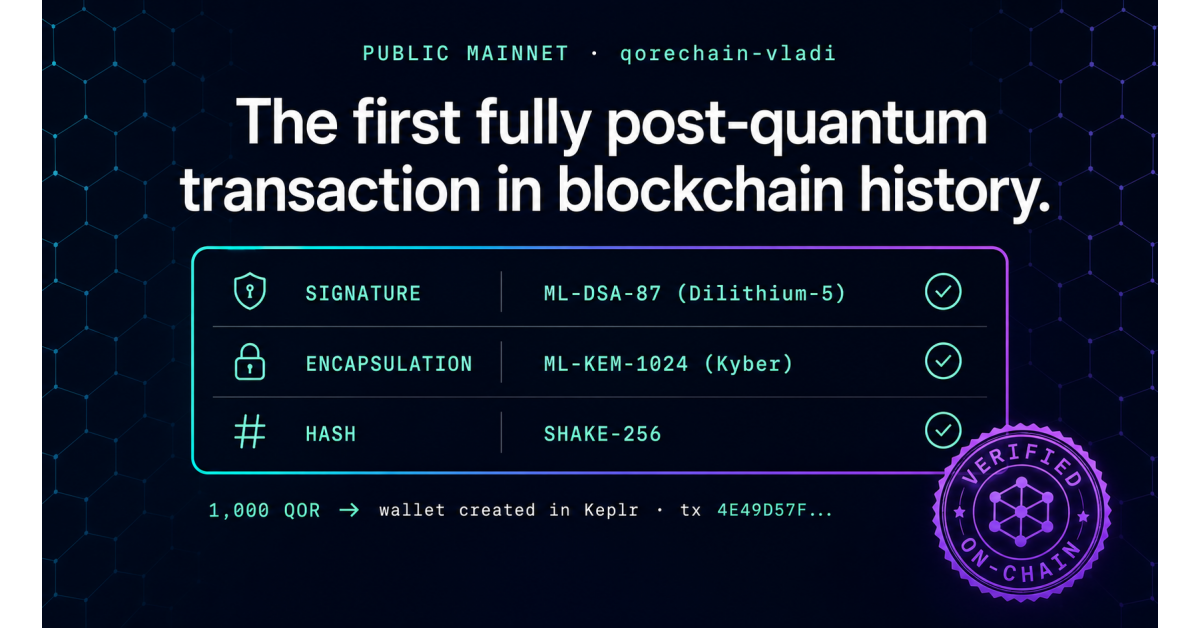
On July 2, 2026, QoreChain completed a transfer of 1,000 QOR, claiming it is the first fully post-quantum transaction on a live public blockchain mainnet, a transfer now independently verifiable on a public block explorer. Unlike many projects that address only single cryptographic components, QoreChain secured the transaction end-to-end using all three NIST-standardized post-quantum algorithms: ML-DSA-87, ML-KEM-1024, and SHAKE-256. The receiving wallet, created within the Keplr application, demonstrates compatibility with existing crypto infrastructure, potentially easing adoption for users. “Being first is not the point; being ready is,” said Tilak Patel, President and CEO of QoreChain, emphasizing the need for standardized, live, and verifiable post-quantum security as the threat of “Harvest Now, Decrypt Later” attacks looms for unencrypted blockchain data.
QoreChain Completes First End-to-End Post-Quantum Blockchain Transaction
Unlike many projects making similar claims, QoreChain highlights that its transaction employed post-quantum cryptography across the entire cryptographic pathway, not merely replacing a single element vulnerable to future quantum computers. Specifically, the transfer utilized three algorithms standardized by the United States National Institute of Standards and Technology: ML-DSA-87, ML-KEM-1024, and SHAKE-256, for signing, key exchange, and hashing respectively. This comprehensive approach, the company argues, is crucial for genuine long-term security in a post-quantum world. Liviu Epure, Founder and CTO of QoreChain, explained that for years, the company faced skepticism regarding the timing of this technology, stating, “For years, the response to our thesis was that it was too early.” He emphasized this demonstration moves beyond theoretical discussions, noting this isn’t a limited, experimental setup, but a fully functional transaction accessible through standard tools.
This accessibility is a key component of QoreChain’s strategy, as the company aims to deliver post-quantum security without disrupting established user workflows. The timing of this achievement is particularly relevant given the growing awareness of a tactic known as “Harvest Now, Decrypt Later.” Security researchers have documented this strategy, where encrypted data is collected and stored with the intention of decrypting it once sufficiently powerful quantum computers become available. Because blockchains permanently and publicly record transaction history, QoreChain argues that any ledger not secured with post-quantum cryptography from its inception risks retroactive exposure. Tilak Patel also stated, “Being first is not the point.” The transaction itself is publicly verifiable on the QoreChain explorer, inviting scrutiny from the cryptographic community.
Being first is not the point. Being ready is.
Tilak Patel, President and CEO, QoreChain Association
Disclaimer. This article is for informational purposes only and does not constitute investment, financial or professional advice. Quantum computing and the cryptography that secures digital assets both evolve rapidly and information may become outdated. Always conduct your own research and consult qualified advisers before making investment decisions. Digital assets are highly volatile and involve significant risk, including the potential loss of your entire investment, and past performance is not indicative of future results.




See today’s quantum computing news on Quantum Zeitgeist for the latest breakthroughs in qubits, hardware, algorithms, and industry deals.