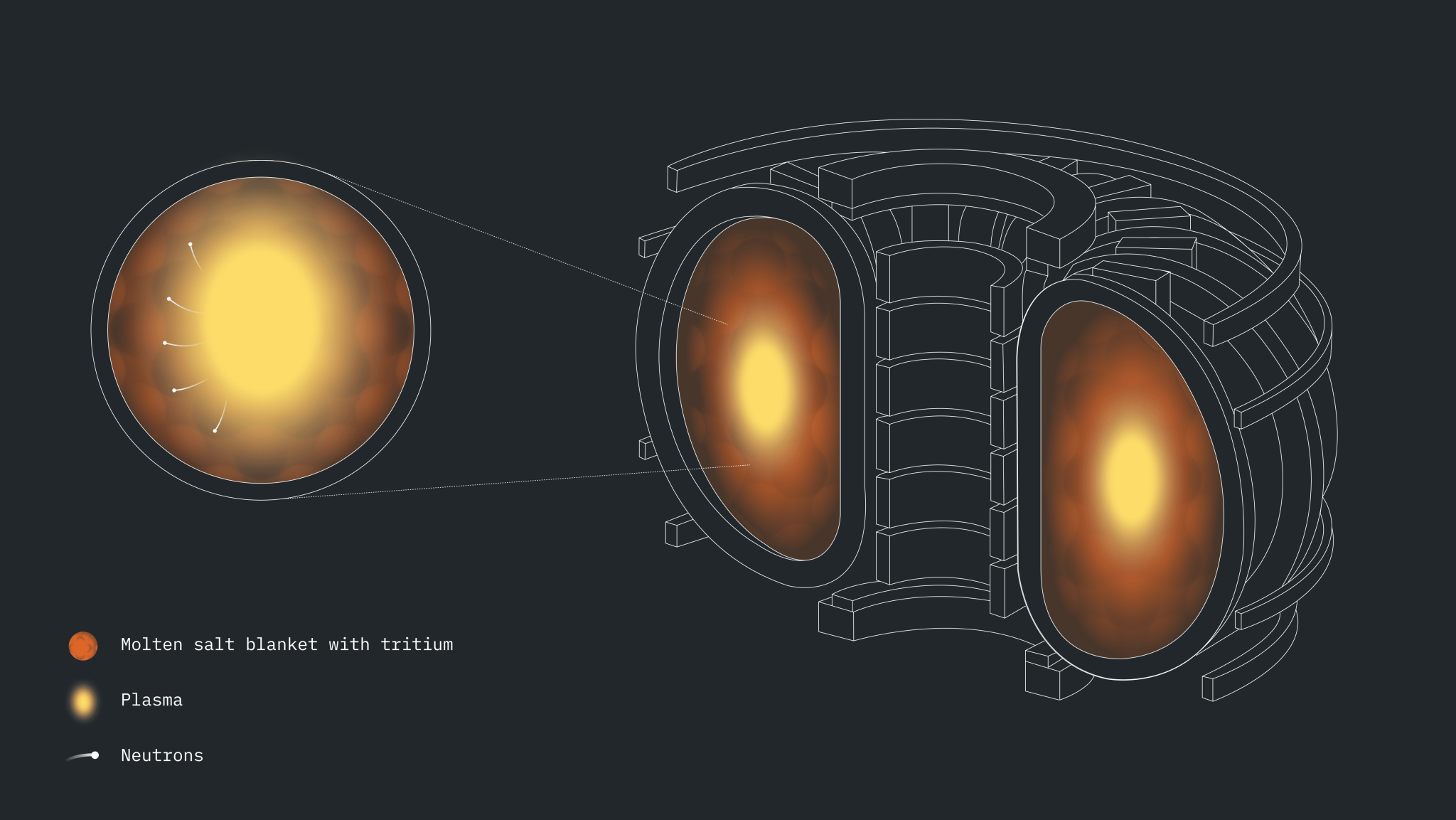
Researchers at Oak Ridge National Laboratory, IBM, and Cleveland Clinic are applying quantum computing to a critical challenge in fusion energy: efficiently sourcing its fuel. Released on arXiv on July 6, 2026, their work details a successful quantum-centric simulation of molten salts, materials proposed as “blankets” around fusion plasma to produce tritium, a rare hydrogen isotope essential for sustaining the reaction. The team reports matching the accuracy of the most demanding classical computational methods, a significant step toward designing self-sufficient fusion reactors. “When we started this work about five months ago, I did not expect to be at this place so soon,” said Tom Beck, Section Head for Science Engagement at Oak Ridge National Laboratory. This advance offers a promising pathway to computationally designing optimal molten salt blankets, potentially accelerating the realization of commercially viable fusion power.
Molten Salt Chemistry Fuels Fusion Reactor Tritium Breeding
Molten salt chemistry is emerging as a critical component in the pursuit of viable fusion energy, specifically addressing the challenging task of breeding tritium fuel within reactor designs. Recent research, released on arXiv on July 6, 2026, details a novel approach leveraging quantum-centric supercomputing to model the complex chemical interactions occurring within these molten salt blankets, indicating a rapid pace of progress in the field. Unlike conventional methods focused solely on containing the fusion reaction, this work centers on producing the necessary tritium, a rare isotope of hydrogen, directly within the reactor environment. The core challenge lies in the intricate chemistry governing tritium extraction from the molten salt. Deuterium, readily available from seawater, serves as one fuel source, but tritium is scarce; current global production totals only a few pounds a year, insufficient to sustain even a single one-gigawatt fusion plant for more than weeks.
A molten salt blanket, composed of lithium and fluorine, offers a solution by capturing neutrons released during fusion and converting them into tritium. However, accurately modeling this process has proven intractable for classical computers. This innovative approach utilizes density functional theory (DFT) to approximate molecular interactions, but recognizes DFT’s limitations when applied to the complex environment of molten salts. The team employed wave function-based embedding (EWF), fragmenting the calculation into smaller, manageable clusters solved by classical computers, with more complex clusters tackled by a quantum computer using sample-based quantum diagonalization (SQD). The researchers successfully modeled nine configurations of the molten salt FLiBe, each a small cluster of 21 ions, and computed their energies with and without tritium, validating the quantum-centric calculations against established classical methods.
While simulating a full-scale, one-meter thick blanket containing trillions of particles remains beyond current computational capabilities, this work represents a significant step towards a larger goal: a self-improving loop integrating quantum computers, supercomputers, and artificial intelligence. This envisioned workflow would begin with AI agents screening candidate salts, assessing their tritium breeding potential and thermal properties. Promising candidates would then undergo detailed modeling using supercomputers and AI stand-ins, with the most challenging chemical calculations, specifically predicting tritium binding, handled by quantum computers. The resulting data would then feed back into the AI, refining the selection process and iteratively optimizing the molten salt blanket design for maximum tritium production and reactor efficiency.
Quantum-Centric Supercomputing Models Tritium-FLiBe Interactions
The pursuit of commercially viable fusion energy is increasingly reliant on advanced computational methods, with a recent focus on leveraging quantum computing to overcome limitations in modeling complex material interactions. Currently, simulating the behavior of materials within a fusion reactor, specifically the molten salts intended to breed tritium fuel, presents a significant hurdle for traditional computational techniques. These molten salts, typically lithium and fluorine mixtures known as FLiBe, are proposed as “blankets” surrounding the fusion plasma, tasked with capturing neutrons and producing the tritium necessary to sustain the reaction. However, accurately predicting tritium extraction from these salts requires a level of chemical precision that has historically eluded classical computers, and direct experimentation is both costly and energy intensive. Researchers are now demonstrating the potential of quantum-centric supercomputing to address this challenge, representing a tangible step toward computationally designing optimal molten salt blankets.
The team employed a hybrid approach, combining classical computations with quantum algorithms to analyze the behavior of tritium within the molten salt matrix. This involved fragmenting the complex calculations into smaller, manageable pieces solved by classical computers, then utilizing a quantum computer to tackle the most intricate aspects, those involving significant atomic entanglement. The core of this innovation lies in a technique called wave function-based embedding (EWF), which allows researchers to focus quantum resources on the most critical parts of the molecular structure. Looking ahead, the team envisions a closed-loop system integrating AI, supercomputers, and quantum computers to accelerate materials discovery. This integrated approach promises to not only optimize molten salt compositions but also to address the broader engineering challenges of fusion power, including tritium recovery and reactor shielding, ultimately paving the way for a sustainable energy future.
Wave Function-Based Embedding Enables Complex Cluster Calculations
Unlike traditional methods struggling with accuracy, this hybrid quantum-AI workflow demonstrates a capacity to match the performance of the most demanding classical computational techniques, opening new avenues for materials design in fusion reactors. The core innovation lies in the application of wave function-based embedding (EWF), a technique that breaks down the immense computational challenge of modeling a large molecule into smaller, more manageable clusters, each a small cluster of 21 ions. Classical computers handle the bulk of these calculations, while a quantum computer tackles the most complex clusters, those exhibiting significant entanglement between atoms. This division, coupled with a method called sample-based quantum diagonalization (SQD), allows researchers to probe the electronic structure of the molten salt with unprecedented precision. This achievement is particularly noteworthy given the limitations of density functional theory (DFT), a common approach in computational chemistry.
Accurately predicting whether tritium will bind to corrosive fluoride ions or remain free as a gas is paramount for efficient fuel extraction, and the new quantum-centric approach offers the necessary level of accuracy. This integrated workflow will allow scientists to explore a vast database of molten salt compositions, rapidly screening candidates and focusing computational resources on the most promising materials. “I think it’s a huge contribution,” Beck added, highlighting the potential for accelerating fusion research and bringing the promise of clean, sustainable energy closer to reality.
Accuracy of Quantum Methods Matches Classical Density Functional Theory
The pursuit of viable fusion energy took a significant step forward recently, with researchers demonstrating that quantum computing methods can now achieve the same level of accuracy as the most demanding classical density functional theory (DFT) calculations, a crucial benchmark for modeling complex materials. This development, detailed in work released on July 6, 2026, directly addresses a key challenge in designing the molten salt “blankets” intended to breed tritium fuel within future fusion reactors. While fusion itself generates immense energy, sustaining the reaction requires a constant supply of tritium, a rare hydrogen isotope, and molten salts offer a promising pathway to produce it internally. Accurately predicting how tritium behaves within these molten salt mixtures has long been intractable for conventional computers.
The intricate interplay of atoms and electrons within the salt, particularly as it’s bombarded by neutrons and subjected to extreme temperatures, creates a computational burden that strains even the most powerful supercomputers. The team focused on modeling the interaction between tritium and a small cluster of 21 ions within the FLiBe molten salt, a mixture of lithium and fluorine. Existing DFT methods have proven unreliable, with errors in predicting free energy potentially reaching 10 percent, an unacceptable margin for this application. However, the new quantum-centric approach successfully matched the accuracy of these leading classical methods when applied to nine configurations of the molten salt. This achievement is not merely a theoretical exercise; it represents a crucial validation of the potential for quantum computing to accelerate fusion research.
The ultimate vision extends beyond this single step, encompassing a closed-loop system where AI agents propose and screen candidate salt compositions, supercomputers perform initial large-scale simulations, and quantum computers refine the most promising candidates with high-precision calculations. This integrated workflow, combining CPUs, GPUs, and quantum processing units, promises to unlock solutions to one of the most significant engineering challenges in realizing practical fusion power.
“When we started this work maybe five months ago, I did not expect to be at this place this soon,”
Tom Beck, Section Head for Science Engagement for the National Center for Computational Sciences at Oak Ridge National Laboratory (ORNL)




See today’s quantum computing news on Quantum Zeitgeist for the latest breakthroughs in qubits, hardware, algorithms, and industry deals.