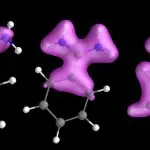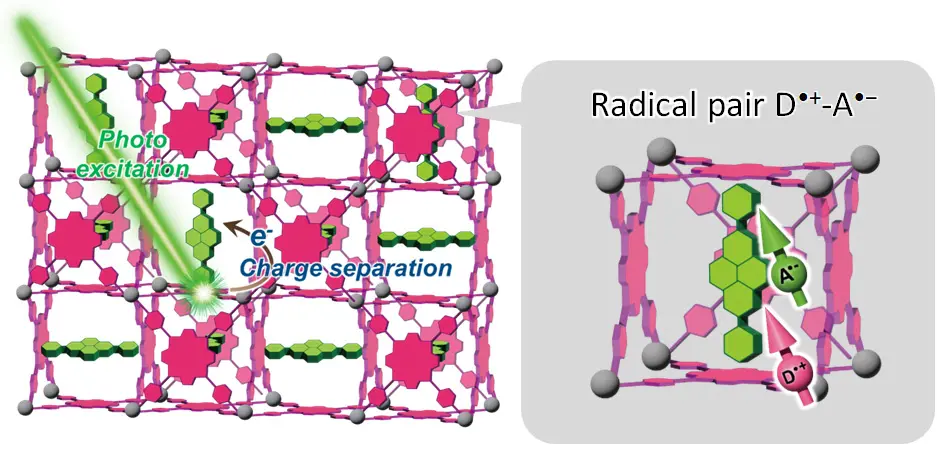
Nobuhiro Yanai of the University of Tokyo and Michael R. Wasielewski of Northwestern University co-led a team that successfully created polarized radical pairs within metal-organic frameworks, or MOFs, porous materials linking metal ions with organic molecules. This achievement establishes a foundation for future quantum chemical sensing technologies and potentially improves the sensitivity of methods like magnetic resonance imaging.
“We are interested in making a quantum nose, so to speak,” Yanai says, explaining the team’s goal to translate quantum sensing advancements into practical chemical detection. The research, published in Nature Communications, details a method for ordering radical pairs within a crystalline solid.
Polarized Radical Pairs Created Within Metal-Organic Frameworks
The research team demonstrated the response of spin properties to chemical substances within a crystalline solid, a key advancement in the pursuit of quantum-level chemical sensing. Wasielewski of Northwestern University co-led the effort, focusing on creating an ordered arrangement of radical pairs, molecules with unpaired electrons, inside metal-organic frameworks (MOFs).

These MOFs, porous materials constructed from metal ions and organic molecules, served as a scaffold for aligning the radical pairs and observing their quantum behavior. Ultrafast spectroscopy, electron paramagnetic resonance spectroscopy, and quantum chemical theory calculations were all employed to evaluate variations of the designed molecules.
Controlling the alignment of these radical pairs is important because their spin states are sensitive to external stimuli, potentially allowing for the detection of minute chemical changes. “We successfully created a pair of radicals and demonstrated the response of their spin properties to some chemical substances,” Yanai reports, outlining the immediate success of the approach.

Previous research into radical pairs had largely been limited to isolated molecules, hindering efforts to build a stable and reliable sensor. This work overcomes that limitation by embedding the pairs within the MOF structure. The international collaboration, bringing together expertise from multiple teams, was essential to the project’s success.
This development addresses a gap between advancements in quantum sensing and their application to chemical detection, a goal Yanai describes as making “chemical quantum sensing a reality.” The team’s ultimate ambition extends to creating a device capable of mimicking the human sense of smell, a “quantum nose”, with the potential to significantly improve technologies like magnetic resonance imaging (MRI). “Although quantum sensing has been a very hot topic in the past decades, leveraging it for chemical sensing has been lagging,” Yanai explains, emphasizing the importance of translating theoretical potential into practical applications. Future work will focus on exploring a wider range of spin systems within MOFs and refining their response to various chemical stimuli.
Thus far, research into radical pairs has been limited to isolated molecules in solid state.
Michael R. Wasielewski, Northwestern University



See today’s quantum computing news on Quantum Zeitgeist for the latest breakthroughs in qubits, hardware, algorithms, and industry deals.