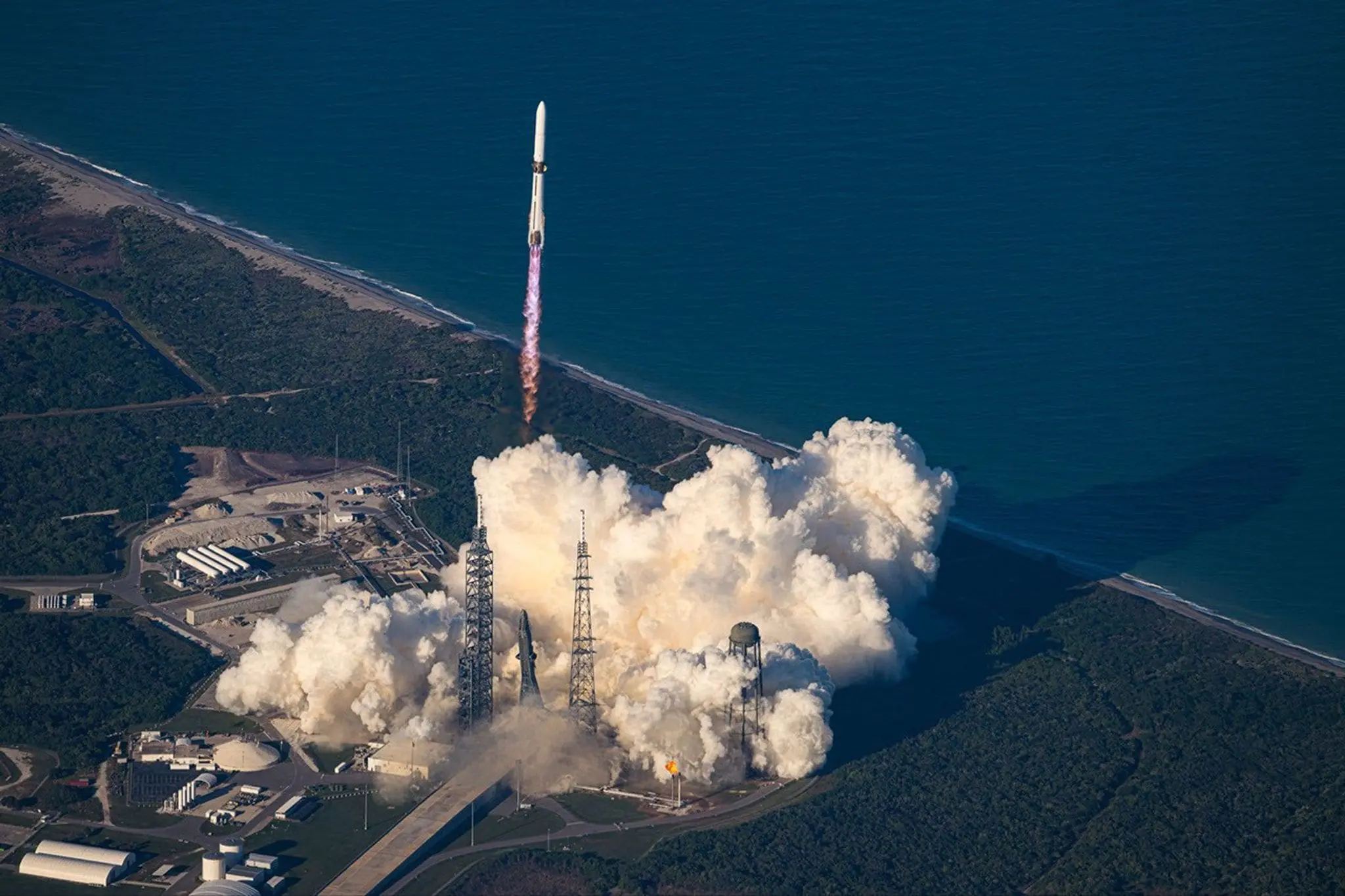
NASA’s ESCAPADE mission has activated its science instruments to investigate how the solar wind stripped away much of Mars’s atmosphere, transforming the planet from a warm, watery world to the cold, dry landscape observed. Launched November 13, 2025, the mission coordinates two spacecraft in orbit around Mars, marking the first time this has been achieved around a planet other than Earth. The twin orbiters will measure short-term changes in the planet’s magnetized environment and uncover the real-time processes driving atmospheric escape, building upon previous single-spacecraft studies. “The ESCAPADE duo will not only investigate the Sun’s role in transforming Mars into an uninhabitable planet, but also will help inform the development of space weather protocols for solar events directed at Mars during future human missions to the Red Planet,” said Joe Westlake, heliophysics division director at NASA Headquarters.
ESCAPADE Mission: First Dual-Orbiter Study of Mars
Mars has changed significantly over time, and NASA’s ESCAPADE mission, launched November 13, 2025, is now actively investigating the dramatic atmospheric loss that transformed the once-habitable planet into the cold, dry world observed. Unlike previous Martian explorations, ESCAPADE employs a coordinated pair of spacecraft to study the interaction between the solar wind and the Red Planet’s environment, activating its science instruments as of February 25th. This dual-orbiter approach allows for a novel perspective, measuring short-term changes within Mars’ magnetized environment, known as the magnetosphere, and pinpointing the processes driving atmospheric escape. The mission builds upon earlier investigations of the Martian atmosphere, but with a crucial advancement; Michele Cash, ESCAPADE program scientist at NASA Headquarters, explained that having two spacecraft will help scientists understand cause and effect, how the solar wind interacts with the magnetic field when it reaches Mars.
ESCAPADE’s twin orbiters will initially follow each other in the same path around Mars, enabling scientists to observe variations in key regions on timescales as short as two minutes, a level of temporal resolution previously unattainable. After six months, the spacecraft will diverge into different orbits, one closer to Mars and one farther away, to simultaneously study the solar wind and the planet’s magnetosphere, allowing for real-time analysis of the planet’s response to solar activity. Rob Lillis, the mission’s principal investigator at the University of California, Berkeley, said that prior spacecraft could either be in the upstream solar wind or close to the planet measuring its magnetosphere, but ESCAPADE allows scientists to be in two places at once and simultaneously measure the cause and the effect. Understanding these processes is not merely an academic exercise; it is critical for protecting future human explorers.
Earth’s robust magnetic field shields us from the Sun’s energetic particles, but Mars’ weakened field offers little protection, leaving a thin atmosphere and the surface vulnerable to radiation. Cash stated that before sending humans to Mars, scientists need to understand the environment these astronauts will encounter. ESCAPADE will investigate the Martian ionosphere, a region of the upper atmosphere vital for future radio and navigation signals. Lillis added that if scientists ever want GPS on Mars or long-distance communications, they need to understand the ionosphere. Lillis describes the mission as providing a stereo perspective, two different vantage points simultaneously.
Solar Wind Stripping and Mars’ Atmospheric Evolution
The stark contrast between present-day Mars and its warmer, wetter past is increasingly understood through atmospheric stripping caused by the solar wind. Billions of years of relentless bombardment by these energetic particles have gradually eroded the Martian atmosphere, transforming a potentially habitable world into the cold, arid planet observed. NASA’s ESCAPADE mission, activated on February 25th, directly addresses this evolutionary process by investigating precisely how the solar wind interacts with the Martian environment and continues to drive atmospheric escape. Unlike previous investigations, ESCAPADE employs a unique dual-spacecraft approach, expected to reveal dynamic processes previously obscured by single-point observations. This capability represents a significant leap forward, enabling measurements impossible with prior single-spacecraft missions. Mars’ weakened magnetic field, now a patchwork of localized magnetism, offers minimal protection against the solar wind’s erosive force.
The thin atmosphere further exacerbates the problem, allowing energetic particles to easily reach the surface and pose a risk to potential explorers. Beyond radiation shielding, ESCAPADE’s data will also inform the development of reliable communication and navigation systems, specifically addressing the characteristics of the Martian ionosphere.
It gives us what you might call a stereo perspective – two different vantage points simultaneously.
Rob Lillis, the mission’s principal investigator at the University of California, Berkeley
New Glenn Launch & Lagrange Point 2 Trajectory
Blue Origin’s New Glenn rocket propelled NASA’s ESCAPADE mission on an unconventional trajectory toward Mars, departing Earth on November 13, 2025, from Launch Complex 36 at Cape Canaveral Space Force Station in Florida. Unlike typical interplanetary missions timed to coincide with close Earth-Mars alignment, ESCAPADE pioneered a launch strategy allowing for departure at almost any point in the planets’ orbits. This was achieved by initially looping the twin spacecraft around Lagrange point 2, a gravitationally stable location approximately one million miles from Earth. This innovative approach extends the mission timeline but offers unique scientific opportunities during the interplanetary cruise.
The decision to “loiter” at Lagrange point 2 wasn’t merely a scheduling convenience; it allows ESCAPADE to become the first spacecraft to explore a previously unvisited region of Earth’s distant magnetotail. No one has ever measured Earth’s tail this far away. The magnetotail, stretched by the solar wind, presents a dynamic environment, and studying it at such a distance provides crucial insights into how Earth interacts with space weather. This preliminary phase of the mission will gather data on Earth’s magnetic environment before the spacecraft even begin their primary investigation of Mars. Following approximately six months at Lagrange point 2, the ESCAPADE spacecraft will utilize Earth’s gravity in November 2026 for a final slingshot maneuver toward Mars, anticipating a September 2027 arrival. This extended journey, lasting roughly ten months, isn’t simply transit time; the spacecraft will continue collecting data on the solar wind and interplanetary magnetic field.
Having two spacecraft is going to help us understand cause and effect – how the solar wind, when it comes to Mars, interacts with the magnetic field.
Michele Cash, ESCAPADE program scientist at NASA Headquarters
Hybrid Magnetosphere & Radiation Risks for Future Explorers
The diminished magnetic field surrounding Mars presents a significant radiation hazard for prospective human missions, a challenge NASA’s ESCAPADE mission is uniquely positioned to address. Unlike Earth’s robust shielding, the Red Planet possesses a “hybrid” magnetosphere, a patchwork of weak, localized magnetism combined with a field induced by the solar wind’s interaction with the Martian atmosphere. This configuration offers minimal protection against the constant bombardment of energetic particles from the Sun, posing a direct threat to astronaut health and equipment functionality. Billions of years of solar wind stripping have already dramatically altered Mars, and continued exposure could jeopardize long-duration surface operations. This is because the loss of the atmosphere has left the surface exposed to harmful radiation.
Earth’s robust magnetic field shields us from the Sun’s energetic particles, but Mars’ weakened field offers little protection, leaving a thin atmosphere and the surface vulnerable to radiation. Cash stated that before sending humans to Mars, scientists need to understand the environment these astronauts will encounter. ESCAPADE will investigate the Martian ionosphere, a region of the upper atmosphere vital for future radio and navigation signals. Lillis added that if scientists ever want GPS on Mars or long-distance communications, they need to understand the ionosphere.
The ESCAPADE duo will not only investigate the Sun’s role in transforming Mars into an uninhabitable planet, but also will help inform the development of space weather protocols for solar events directed at Mars during future human missions,” said Joe Westlake, heliophysics division director at NASA Headquarters.



See today’s quantum computing news on Quantum Zeitgeist for the latest breakthroughs in qubits, hardware, algorithms, and industry deals.