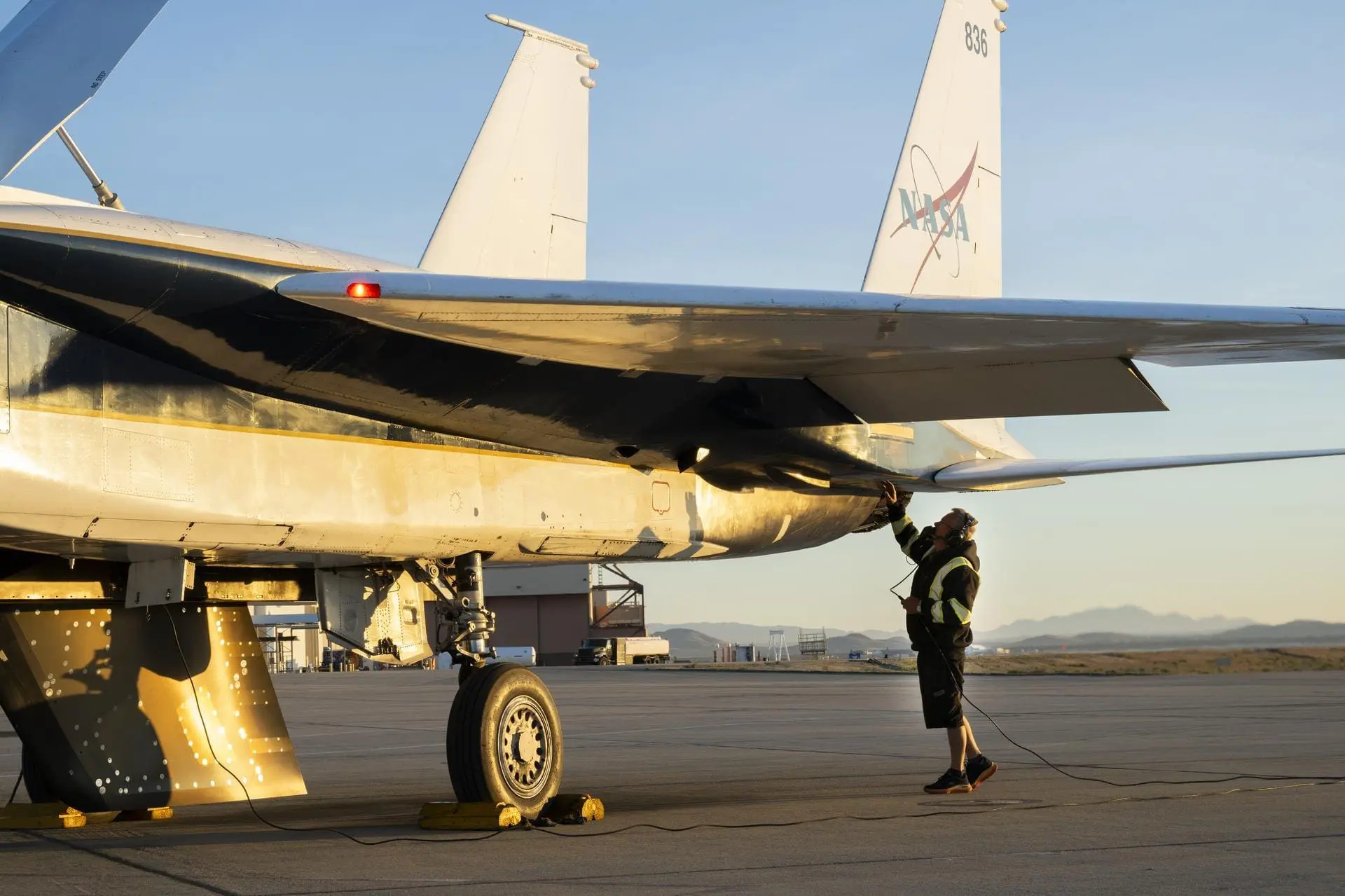
NASA is broadening its high-speed research capabilities this year with the addition of two F-15 aircraft to the fleet at Armstrong Flight Research Center in Edwards, California. Alongside existing platforms like the ER-2s and the X-59, these new additions reflect a wider scope of missions for the agency’s airborne research. The integration of the F-15s is already underway; NASA crew chief Walt Kondracki was pictured inspecting one of the aircraft on March 17th, demonstrating the immediate work of the ground crews responsible for maintaining operational readiness. “That’s the beauty of our Armstrong maintenance teams. They adapt to any type of change,” said Jose “Manny” Rodriguez, NASA Armstrong Gulfstream G-IV crew chief, as the center also added a Pilatus PC-12, signaling potential expansion into new mission types beyond high-speed and high-altitude research.
Aircraft Fleet Diversity at Armstrong Flight Research Center
This expansion isn’t simply about adding aircraft; it reflects a deliberate strategy to support a wider spectrum of aeronautical and scientific investigations, demanding adaptability from maintenance personnel. The diverse fleet necessitates a highly skilled maintenance workforce capable of transitioning between vastly different aircraft systems and mission requirements. Maintaining this operational tempo requires constant vigilance, from routine checks of ejection seats and fuel levels to more substantial repairs of brakes, wheels, wiring, and hardware, all of which experience wear with each flight. Each aircraft is overseen by a dedicated crew chief responsible for its airworthiness; Rodriguez clarifies, “The crew chief is responsible for the integrity of that aircraft, and at the end of the day, his signature and the pilot’s together constitute confirmation that the aircraft is safe for flight.” This layered approach to safety and maintenance ensures NASA can continue to pursue ambitious aeronautics and science advancements.
Maintenance Team Roles and Adaptability
NASA’s expanding fleet at the Armstrong Flight Research Center demands a workforce capable of maintaining diverse aircraft types, ranging from the established ER-2s to newly integrated platforms like the F-15s and Pilatus PC-12. The addition of two F-15s this year, alongside the PC-12, signifies a broadening of NASA’s research scope beyond solely high-speed and high-altitude missions, requiring adaptable maintenance protocols. Currently, the center juggles multiple concurrent operations; the C-20A is deployed in Peru and Panama, the X-59 undertakes twice-daily flights with a chase plane, and the ER-2 supports the Geological Earth Mapping Experiment (GEMx) in Colorado. This operational tempo necessitates a highly structured maintenance hierarchy. The crews’ responsibilities extend beyond scheduled maintenance, encompassing constant checks of critical components like ejection seats, fuel tanks, brakes, and wiring, all subject to degradation with each flight. A final safety check, conducted jointly by the pilot and crew chief, precedes every mission, culminating in the crew chief’s signature alongside the pilot’s, certifying the aircraft’s flight readiness.
That’s the beauty of our Armstrong maintenance teams. They adapt to any type of change.
Jose “Manny” Rodriguez, NASA Armstrong Gulfstream G-IV crew chief
Ongoing Aircraft Support for Missions like GEMx
The integration of two F-15s into NASA’s Armstrong Flight Research Center fleet this year isn’t simply an increase in numbers; it reflects a deliberate expansion of the agency’s airborne research capacity, complementing existing platforms like the X-59 and high-altitude ER-2s. While the addition of a Pilatus PC-12 suggests NASA is broadening mission profiles beyond speed and altitude, current operations demonstrate the immediate demands placed on Armstrong’s maintenance personnel. This operational tempo requires a highly structured approach to aircraft upkeep, extending beyond routine checks to encompass constant component replacement and system adjustments. Mechanics are continuously inspecting ejection seats, refueling aircraft, and replacing worn parts like brakes, wheels, wiring, and hardware, all critical for maintaining flightworthiness. Each aircraft’s readiness is ultimately signed off by a dedicated crew chief, a role with significant responsibility.
It’s difficult at times to work with different airplanes from both the civilian and military sides, but it’s very rewarding to see that we have the capability and the expertise to keep these aircraft flying.




See today’s quantum computing news on Quantum Zeitgeist for the latest breakthroughs in qubits, hardware, algorithms, and industry deals.