Researchers at Nanjing University have created a new source emitting at least 62-dimensional spatially entangled photons, a significant increase over the two dimensions typically used in current quantum technologies. The work demonstrates a 1.56-fold enhancement in single-photon count rate and a 1.45-fold enhancement in coincidence count rate using beam-like Type-II spontaneous parametric down-conversion in a β-barium borate crystal. These characteristics, the researchers report, establish the source as a practical resource for high-dimensional photonic quantum technologies. The team’s measurements certify entanglement within a 121-dimensional basis and demonstrate quantum imaging in both position and momentum domains.
Type-II SPDC Source Outperforms Collinear Type-I Configurations
The detected single-photon count rate was 1.56 times greater when contrasted with a conventional collinear Type-I source operating under identical conditions. This improvement in brightness is coupled with a 1.45-fold increase in the coincidence count rate, signifying a more efficient generation of entangled photon pairs for quantum applications. The researchers fixed pump power at 120 milliwatts and used a SPAD camera recording one million frames with 0.5 millisecond exposure times to evaluate the brightness of both sources.
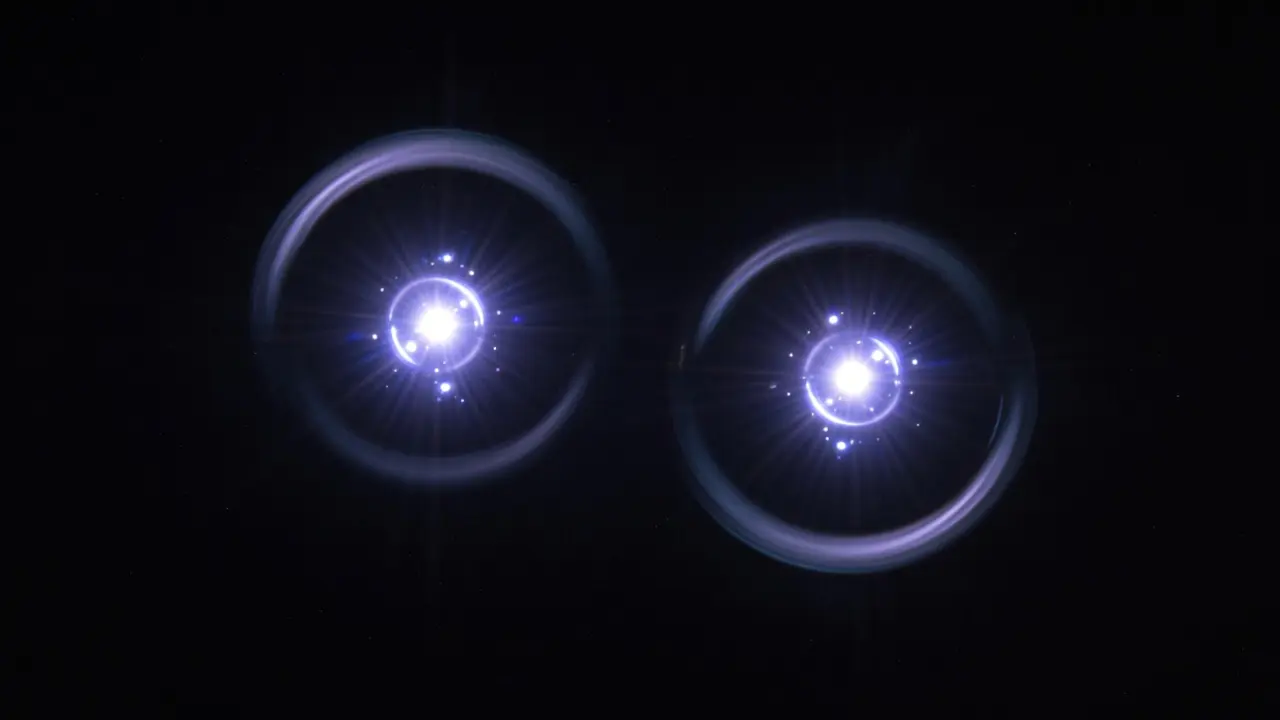
A key advantage of this Type-II configuration lies in the orthogonal polarization of the generated photon pairs, enabling deterministic separation of the signal and idler photons. This separation simplifies downstream processing and reduces potential errors in quantum information protocols. The far-field distribution from the beam-like Type-II SPDC exhibits two distinct emission spots, corresponding to the signal and idler photons, a characteristic not observed in the collinear Type-I setup.
Correcting for a 50% separation probability, the photon-pair count rate of the beam-like Type-II source was approximately 1.45 times greater than that of the conventional Type-I source. The researchers performed two proof-of-principle experiments, measuring spatial correlations in mutually unbiased position and momentum bases to achieve this certification.
The analysis yielded a value of Fmin = 0.5052, exceeding the threshold of B61 = 61/121 = 0.5041, confirming the 62-dimensional spatial entanglement. The team reconstructed position correlation images by projecting measured joint probability distributions onto sum and difference coordinates, revealing strong correlations in both position and momentum domains.
The reported count rates represent detected values measured by the SPAD camera, rather than intrinsic photon-generation rates, and are subject to limitations imposed by the camera’s quantum efficiency and the overall optical system’s efficiency. “Here, we have demonstrated a bright source of high-dimensional spatially entangled photon pairs using a BBO crystal operated under beam-like Type-II phase-matching conditions,” the researchers state in their publication.
The combination of enhanced brightness and high-dimensional entanglement positions this source as a promising component for future quantum technologies, offering increased data capacity and improved performance in quantum communication and computation. The source’s characteristics establish it as a valuable tool for exploring and advancing the frontiers of quantum information science.
Beam-Like Phase Matching in β-Barium Borate Crystal
Beam-like Type-II phase matching in a β-barium borate crystal offers a distinct advantage in generating entangled photons by producing two separated beams, each with orthogonal polarization, facilitating efficient collection and isolation of the signal and idler photons. This configuration contrasts with conventional collinear Type-I sources.
The experimental setup involved a 2-millimeter-long BBO crystal pumped by a 390-nanometer continuous-wave laser operating under beam-like Type-II phase-matching conditions, with cut angles of 42.62 degrees and 30 degrees. This configuration generated noncollinear signal and idler photon pairs through spontaneous parametric down-conversion, a process where a single photon splits into two entangled photons with lower energy.
A bandpass filter, centered at 780 nanometers with an 8-nanometer bandwidth, selected frequency-degenerate photon pairs, while dichroic mirrors rejected residual pump light. The data revealed a 1.45-fold enhancement in coincidence biphoton count rate, indicating a stronger correlation between the entangled photon pairs generated by the beam-like configuration. “Combining these properties with high-dimensional spatial entanglement is therefore desirable for applications requiring high photon brightness, such as quantum imaging and high-dimensional quantum-state characterization,” the researchers write.
The team exploited these correlations to perform correlation imaging in both the position and momentum domains, demonstrating the versatility of the source. The ability to generate and manipulate photons in multiple dimensions is a key requirement for advanced quantum technologies, enabling increased data capacity and enhanced security for quantum communication protocols.
62-Dimensional Spatial Entanglement Certification via Correlation Measurements
Certification of at least 62-dimensional spatial entanglement has been achieved using a new source of entangled photons, exceeding the capabilities of many existing quantum systems and opening avenues for dramatically increased data capacity. The work demonstrates a method for certifying entanglement dimensionality, a necessary validation for building complex quantum networks. The team’s approach relies on a beam-like Type-II spontaneous parametric down-conversion (SPDC) process within a barium borate crystal, a technique that allows for the generation of entangled photon pairs with tailored spatial properties.
Discretizing both transverse position and momentum spaces into 121 modes, an 11×11 grid of “macropixels”, created a Hilbert space enabling the certification process. A deliberate gap was introduced between adjacent macropixels to minimize crosstalk and maximize the number of accessible spatial modes, optimizing the certifiable entanglement dimensionality. This careful design addresses a common challenge in high-dimensional entanglement: maintaining signal fidelity as dimensionality increases.
Experimental measurements of correlation matrices in both position and momentum bases were then used to determine a lower bound on the fidelity between the generated state and a maximally entangled target state. The fidelity, a measure of how closely the experimental state matches the ideal entangled state, must exceed a certain threshold to certify a specific level of entanglement.
Biphoton Wavefunction Characterization with Gaussian Approximations
Approximating the biphoton wavefunction with Gaussian functions allows for precise characterization of spatial correlations important for quantum technologies, as demonstrated by detailed analysis of the generated photon pairs’ momentum and position distributions. The research team reconstructed joint probability distributions (JPDs) in both domains to quantify these correlations, using the double-Gaussian approximation to predict expected profiles. Projected distributions exhibited Gaussian shapes, enabling extraction of experimental correlation widths through fitting procedures, and validating the theoretical model.
This agreement confirms the fidelity of the source and the accuracy of the applied approximations. These results demonstrate a strong correlation between the theoretical framework and the observed experimental data, solidifying the understanding of the biphoton state’s spatial properties.
The ability to modulate the biphoton wavefunction with an object placed in the signal arm further enhances the source’s utility, as described by the equation Ψ_T(r_ +,r_-) = A T(( + + r_-)/2) exp((| + |^2)/(4σ_(r + )^2)) exp(-(||^2)/(4σ_(r-)^2)). Under the condition σ_(r + )/σ_(r-)≫ 1, the minus-coordinate envelope narrows significantly, effectively functioning as a position correlation filter. This characteristic is particularly valuable for quantum imaging applications, where precise spatial resolution is paramount.
This separation provides a practical advantage for subsequent spatial correlation and quantum imaging measurements, streamlining the process and improving signal clarity. The team’s approach to characterizing these correlations, by reconstructing JPDs and fitting Gaussian functions, provides a robust method for assessing the quality of high-dimensional entangled states. The analysis confirms that the source’s characteristics align with the theoretical predictions based on Gaussian approximations, supporting its potential as a practical resource for advanced quantum technologies.
Quantum Imaging Demonstrated in Position and Momentum Domains
Exploiting the generated entangled photon pairs, the team demonstrated quantum imaging capabilities in both position and momentum domains, a feat enabled by the source’s unique characteristics. Specifically, the placement of an object in the signal arm of the imaging setup modulated the biphoton state, allowing for object reconstruction through the analysis of spatial correlations. The deterministic separation of the orthogonally polarized photon pairs, a consequence of the Type-II SPDC process, offers a practical benefit for subsequent measurements.
This separation simplifies the process of isolating and analyzing the entangled photons, improving the signal-to-noise ratio and enhancing the precision of quantum imaging and correlation measurements. The team highlights that this configuration, combining enhanced brightness, strong spatial correlations and high-dimensional entanglement, is relatively simple to implement, suggesting potential for scalability and integration into more complex quantum systems. The ability to achieve both high brightness and high-dimensional entanglement simultaneously represents an advance in the field of quantum photonics.
While previous sources often prioritized one characteristic over the other, this new approach demonstrates a pathway towards creating practical, high-performance resources for a range of quantum technologies. The researchers suggest that this source could be particularly valuable for applications demanding increased data capacity, such as advanced quantum communication protocols and high-resolution quantum imaging systems. The demonstrated beam-like Type-II SPDC source, they conclude, is a versatile platform for future exploration of these frontiers.
👉 More information
🗞 A bright source of high-dimensional spatially entangled photon pairs based on beam-like Type-II SPDC
✍️ Ming Zhang, Zhiming Qing, Zhi-Cheng Ren, Jianping Ding, Xi-Lin Wang and Hui-Tian Wang (National Laboratory of Solid State Microstructures and School of Physics, Nanjing University, Nanjing, China)
🧠 ArXiv: https://arxiv.org/html/2611.33852v1

See today’s quantum computing news on Quantum Zeitgeist for the latest breakthroughs in qubits, hardware, algorithms, and industry deals.