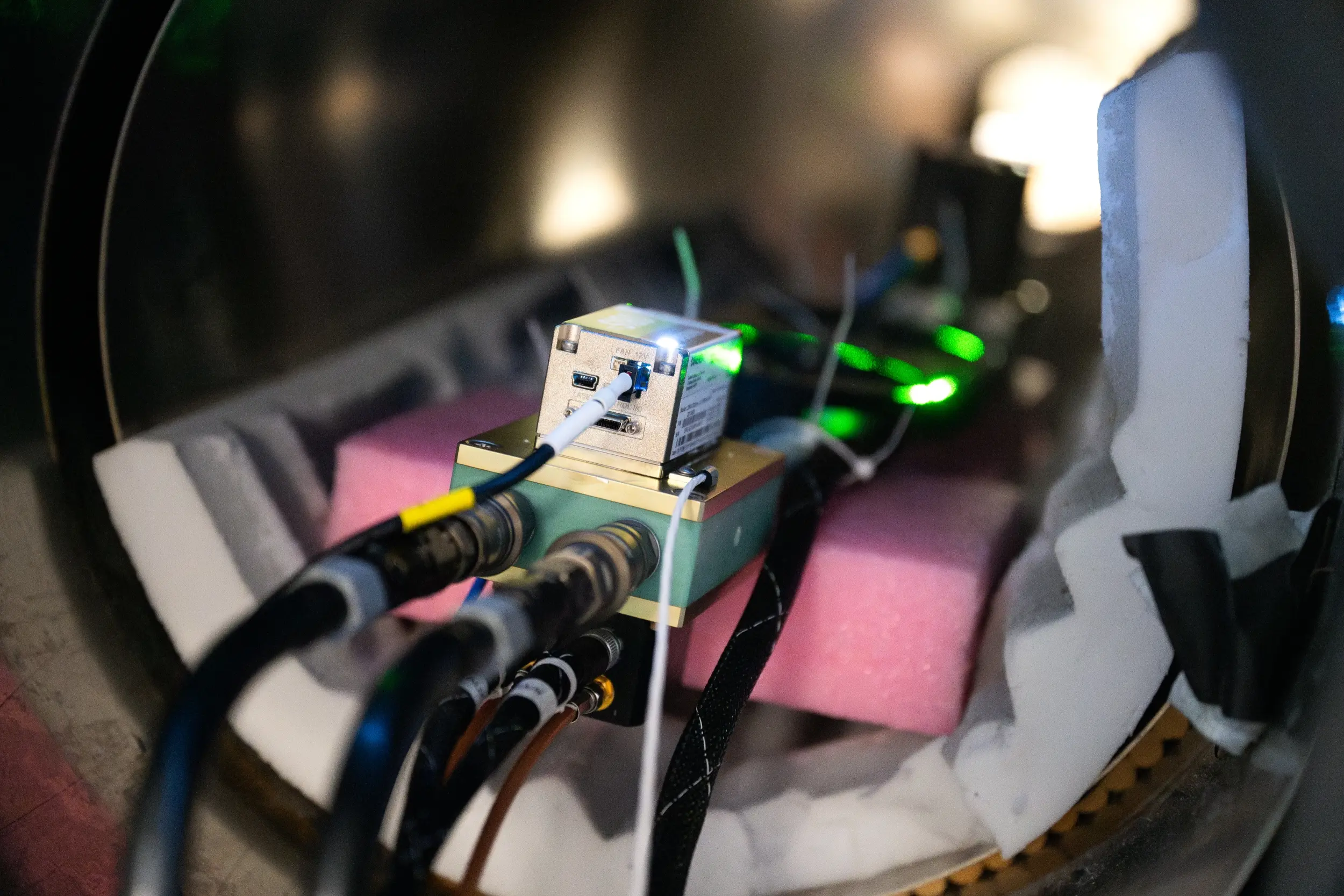
Following two incidents of GPS disruption at Dallas and Denver airports in 2022, each lasting more than 24 hours and creating dangerous risks for pilots, Lincoln Laboratory is collaborating with Frequency Electronics Inc. (FEI) to move its novel vector magnetic navigation (MagNav) system toward field trials. The system uses a quantum diamond sensor to measure the direction and magnitude of Earth’s magnetic field, offering a potential navigation solution in GPS-denied environments across air, undersea and space. “GPS is our workhorse for knowing where we are, and it’s becoming increasingly susceptible to interference,” says Linh Pham, MagNav sensor project lead at Lincoln Laboratory’s Advanced Quantum Technologies Group.
Diamond Sensor Enables Vector Magnetic Navigation
Lincoln Laboratory’s new magnetic sensor measures both the magnitude and direction of Earth’s magnetic field, a capability absent in current scalar MagNav systems and important for reliable navigation in magnetically uniform areas. This distinction is vital because a hiker lost in a visually identical forest needs directional cues to choose a path, similar to how the sensor functions in areas with minimal magnetic variation. Frequency Electronics Inc. (FEI) is collaborating to integrate the quantum diamond sensor onto an aerial platform.
The Laboratory’s expertise extends beyond sensor design to encompass comprehensive analysis and testing throughout the project’s lifespan, as Pham stated, “Lincoln Laboratory has the ability not only to design and build this type of sensor but also to embed analysis and testing of its real-world function throughout the lifetime of the project.” This integrated approach allows for continuous refinement and validation of the sensor’s performance under operational conditions, which is essential for ensuring reliability. The team is now focused on improving the sensor’s manufacturability, performance and size, weight, and power requirements to facilitate wider adoption. “We are currently charting a path to sensor manufacturability, performance improvements, and reduced size, weight, and power—all with the shared goal of significant operational improvements,” researchers noted.
Their long-term goal is to create a chip-scale version of the technology, enabling mass production and scalability to tens of thousands of units. This miniaturization and cost-effectiveness is intended to broaden the sensor’s applicability beyond specialized applications, potentially integrating it into a wider range of devices and systems.
2022-2026 Flight Tests Validate Sensor Performance
Following initial helicopter tests in 2022, Lincoln Laboratory’s vector magnetic navigation system underwent further validation through flight tests in 2025 and 2026, demonstrating consistent performance in GPS-denied environments. These later trials confirmed the sensor’s functionality even in areas with minimal magnetic variation, conditions where scalar magnetic sensors typically fail to provide reliable data. The system also achieved a twofold improvement in accuracy compared to existing scalar platforms operating under standard conditions, a key advancement for applications requiring precise positioning.
The transition of this technology development to industry began in 2023 with sponsored research funding from the Air Force Research Laboratory, and accelerated in 2025 through the Defense Innovation Unit’s Transition of Quantum Sensing program. (FEI) to prepare the sensor for broader military and industrial use, a collaboration focused on refining the system for real-world deployment.
Leidos, Inc. is concurrently developing algorithms designed to fully use the sensor’s enhanced capabilities, expanding the potential applications of the MagNav system. FEI’s involvement extends beyond simple integration; the company is actively working to address key engineering challenges.
The U.S. Army Combat Capabilities Development Command Army Research Laboratory is also collaborating to tailor the sensor for specific Army applications, highlighting the technology’s versatility and potential for widespread adoption. The team anticipates that this integrated approach will allow for new navigation options in environments where GPS signals are unavailable or unreliable, offering a resilient alternative for critical applications.




See today’s quantum computing news on Quantum Zeitgeist for the latest breakthroughs in qubits, hardware, algorithms, and industry deals.