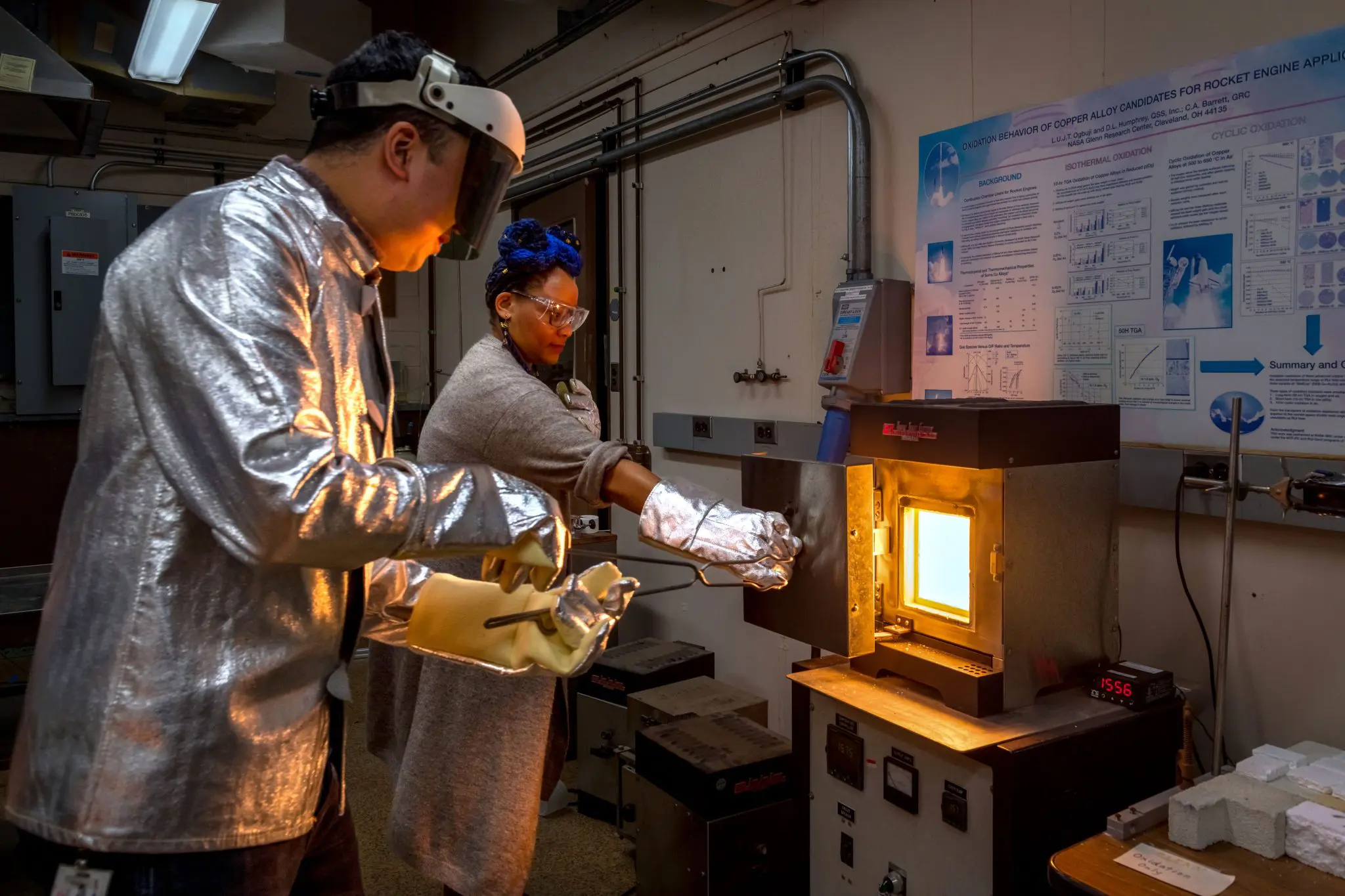
A previously undocumented material has emerged from research at NASA’s Glenn Research Center in Cleveland, potentially offering a solution to the challenges of utilizing lunar resources. Dr. Kevin Yu, now a technologist at NASA’s Jet Propulsion Laboratory in Southern California, and Dr. Jamesa Stokes discovered the substance while investigating interactions between simulated Moon dust and scandium oxide as part of a Space Technology Graduate Research Opportunities fellowship. The resulting compound, formed after high-temperature treatment, didn’t match any of the over 1 million entries in their X-ray analysis database. “It’s very corrosive, and it will very quickly eat through a lot of commonly used refractory, or heat-resistant, materials,” Yu explained, highlighting the need for a durable substance capable of withstanding the extreme conditions required to melt and process materials found on the Moon.
Simulated Lunar Dust Interaction Reveals Novel Material Formation
A previously unknown compound emerged from recent NASA research, defying existing material science databases. Researchers Dr. Kevin Yu and Dr. Jamesa Stokes, a materials research engineer at NASA Glenn, teamed up to study how a variety of substances interacted with liquefied Moon dust. Approximately six months into the investigation, the team observed the unexpected formation of a novel material after combining simulated lunar dust with scandium oxide and subjecting the mixture to extreme temperatures. The material initially presents as a distinctive pink powder, and this color change indicates the reaction is complete. Testing revealed the substance’s remarkable resilience to molten lunar dirt and its ability to withstand temperatures exceeding 2,900 degrees Fahrenheit, six times hotter than a typical kitchen oven.
While scandium oxide itself can be costly, it is less expensive than precious metals like platinum that would normally be used in these types of high-temperature processes, with implications for both lunar resource extraction technologies and terrestrial applications like jet engine coatings. Stokes emphasized the critical role of materials research, stating, “You can have the best idea in the world for a structure or a vehicle, but if you don’t have the materials that have the right properties to make your vision come true, it’s not going to succeed.”
The pursuit of in-situ resource utilization on the Moon demands materials capable of withstanding extreme conditions, and recent research at NASA’s Glenn Research Center has yielded a substance unlike any previously documented. Researchers Dr. Kevin Yu investigated interactions between simulated lunar dust and various compounds, unexpectedly creating a novel material during high-temperature treatment. This wasn’t simply a new alloy; exhaustive X-ray analysis failed to match the compound to any of the over one million substances in their database.
It has a built-in color indicator, so by the time you’re done with it, it turns to a light beige or tan color, and that’s how you know the reaction has proceeded the way you wanted it to.
The team, collaborating with materials research engineer Dr. Jamesa Stokes, encountered a substance unlike any previously documented after combining scandium oxide with the lunar simulant and subjecting it to intense heat. Rigorous analysis revealed the resulting compound was absent from a database exceeding one million known materials. Beyond its heat resistance, the material offers advantages in weight and insulation compared to current coatings, potentially improving the efficiency of future lunar infrastructure and even jet engine components.
It’s very corrosive, and it will very quickly eat through a lot of commonly used refractory, or heat-resistant, materials.
Potential Applications for Lunar Resource Extraction and Jet Engines
The discovery of a novel material at NASA’s Glenn Research Center promises advancements in both lunar resource extraction and terrestrial jet engine technology. This finding is particularly significant given the challenges of processing lunar regolith, which Dr. Kevin Yu described as corrosive and rapidly degrading many conventional heat-resistant materials. The new material’s resilience to extreme temperatures, withstanding up to 2,900 degrees Fahrenheit, and resistance to molten Moon dust corrosion position it as a potential component in future lunar infrastructure. NASA is actively exploring strategies, and this material could form the basis of pipes or basins designed to contain molten regolith during metal and oxygen extraction. Beyond the Moon, the material’s properties also offer benefits for jet engine coatings, proving lighter, less dense, and a superior insulator compared to current options.
You can have the best idea in the world for a structure or a vehicle, but if you don’t have the materials that have the right properties to make your vision come true, it’s not going to succeed no matter how well you design it.




See today’s quantum computing news on Quantum Zeitgeist for the latest breakthroughs in qubits, hardware, algorithms, and industry deals.