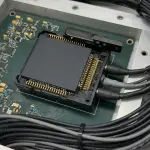
HRL Laboratories, an IBM company, is developing a fundamentally different approach to quantum computing by pursuing spin qubits. Unlike IBM’s more established superconducting transmon qubits, spin qubits encode information using the spin state of individual electrons, a property that can point up or down, representing the zeros and ones of computation. These qubits require trapping individual electrons in structures called quantum dots, using layers of silicon and silicon-germanium. Achieving superposition and entanglement with spin qubits is key to realizing the potential of quantum computing and solving problems beyond the capabilities of current technology.
HRL Laboratories Develops Exchange-Only Spin Qubit Architecture
HRL Laboratories recently demonstrated a complete quantum system incorporating 54 quantum dots, capable of hosting up to 18 qubits, and implemented a simple quantum-error-detecting code on the platform. This achievement centers on an exchange-only spin qubit architecture, a distinct approach to quantum information processing pursued alongside IBM’s superconducting transmon qubits. Unlike the microwave control used in some spin qubit designs, this architecture relies on baseband voltage pulses, mirroring techniques used in conventional electronics, though requiring many of them.
The team’s design uses three quantum dots and three electrons to represent a single qubit, a configuration that simplifies control mechanisms. The core principle of this architecture involves manipulating qubits through electron-electron exchange interactions, eliminating the need for microwave pulses altogether. Neighboring qubits are entangled by briefly overlapping their quantum wavefunctions using voltage pulses applied to the gates, a process that facilitates communication between quantum bits.
This method contrasts with the Loss-DiVincenzo spin qubit, which traps a single electron in a quantum dot and controls its state with microwave signals. Both architectures, however, use semiconductor fabrication technology, potentially allowing advancements in one to benefit the other. “Additionally, given the similarities of their underlying hardware platform, IBM Quantum Network is excited for the potential to explore hybrid systems employing both flavors of qubit architecture,” the company stated.
While IBM anticipates superconducting qubits will initially enable fault tolerance, beginning with IBM Quantum Starling and continuing with IBM Quantum Blue Jay, the development of spin qubits represents a parallel investment in alternative hardware. The exchange-only approach offers a different set of trade-offs in terms of scalability and control, and could ultimately complement superconducting systems. The team’s work demonstrates a functional system, not just theoretical designs, and provides a platform for further exploration of spin-based quantum computation.
Spin Qubit Advantages: Scaling and Voltage-Based Control
Spin qubits offer a distinct path toward larger quantum processors due to their compatibility with established semiconductor manufacturing techniques. This allows for potentially faster scaling to the high qubit counts needed for complex computations, a key advantage over some other qubit modalities. HRL Laboratories, an IBM company, is actively developing this technology, using existing infrastructure to accelerate progress. The team’s focus on spin qubits complements IBM’s ongoing work with superconducting transmon qubits, creating a dual-track approach to quantum hardware development.
A significant benefit of spin qubits lies in their control mechanisms; unlike some designs relying on microwave pulses that require room-temperature hardware and extensive cabling, these qubits are manipulated using voltage-based control. This architecture minimizes the number of connections needed from room temperature to the cryogenic environment where qubits operate.
Reducing these connections simplifies system design and promises faster growth in qubit numbers, as fewer external components need to be integrated and cooled. “This greatly reduced the number of necessary connections from room temperature, enabling future systems to grow larger more quickly,” the team reports. Spin qubits also demonstrate high gate fidelities, a measure of how accurately quantum operations can be performed, and are inherently faster than technologies like ion traps or neutral atoms.
While current spin qubit systems have fewer qubits than their superconducting counterparts, researchers are actively addressing scaling challenges. IBM Quantum Network is focused on improving qubit uniformity and fabrication yield at Anderson, streamlining the manufacturing process. Further efforts are directed at reducing power consumption and consolidating wiring as the systems increase in complexity, with ongoing research dedicated to overcoming these hurdles.
IBM Quantum Network Pursues Spin and Superconducting Qubit Tandem Research
Spin qubits use semiconductor fabrication techniques already established for superconducting processors, potentially accelerating development across both architectures. This shared foundation allows for cross-platform benefits, as advances in manufacturing processes for one qubit type could directly improve the other, a strategy IBM Quantum Network is actively pursuing. The team is currently focused on refining qubit uniformity and increasing fabrication yield at its Anderson facility, critical steps toward building larger, more reliable quantum systems.
Beyond fabrication, IBM Quantum Network is addressing practical challenges in scaling spin qubit systems. Reducing power consumption of the control electronics and consolidating wiring are key priorities, as these factors directly impact the complexity and cost of building larger quantum processors. These efforts aim to minimize the connections required between room temperature electronics and the cryogenic environment where qubits operate, a design constraint that currently limits the scalability of many quantum computing approaches.
While acknowledging the current maturity of superconducting qubits, IBM Quantum Network anticipates a future where both technologies coexist and complement each other. This strategic approach allows IBM Quantum Network to pursue multiple avenues for achieving scalable, fault-tolerant quantum computing, hedging its bets on the most promising technologies. The team’s work on spin qubits, however, continues, driven by their high gate fidelities and potential for integration with existing semiconductor infrastructure.




See today’s quantum computing news on Quantum Zeitgeist for the latest breakthroughs in qubits, hardware, algorithms, and industry deals.