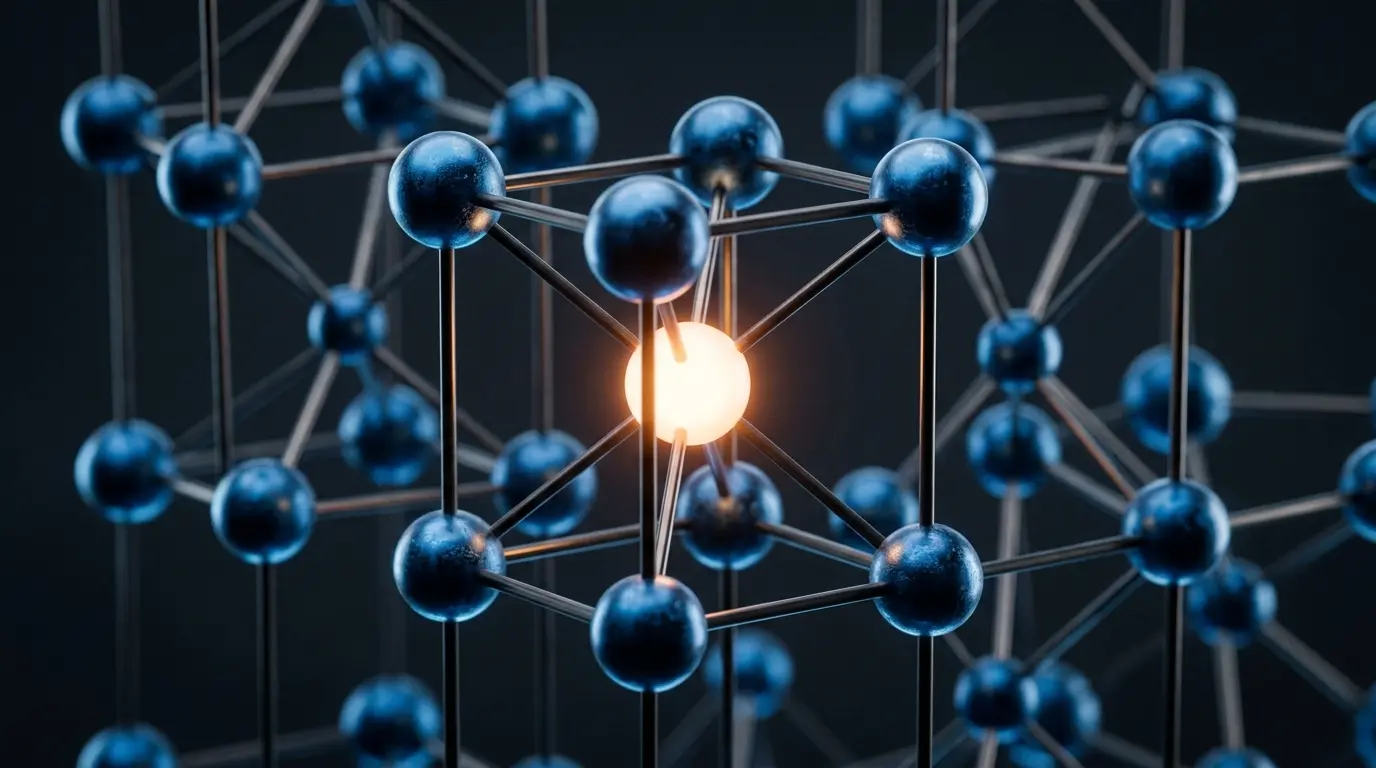
Billions of atoms embedded in a crystal flashed in a regular rhythm, like a metronome, in early 2024, a phenomenon unexpectedly observed by researchers in Andrei Faraon’s lab at Caltech while pursuing unrelated research. The team discovered that ytterbium ions were emitting both microwaves and infrared light in perfect synchronization, a combination never before seen.
“The atoms were flashing in two very different kinds of light at once—microwaves and infrared light—in perfect step with each other,” says Faraon, Caltech’s William L. Valentine Professor of Applied Physics and Electrical Engineering. By coupling this synchronized flashing to a superconducting circuit, the researchers created a new type of laser, a superradiant frequency comb, that could offer greater stability than existing single-color lasers and potentially link quantum devices.
Ytterbium Superradiance Creates Simultaneous Microwave and Infrared Emission
The unexpected discovery of coordinated ytterbium ion emissions occurred while researchers were pursuing unrelated experiments in Andrei Faraon’s laboratory in early 2024. This synchronized behavior, driven by superradiance, revealed a previously unobserved emission of both microwave and infrared light from the same ytterbium ions. Faraon explains, “That had not been observed before.” This simultaneous emission is now harnessed in a newly created device, a superradiant frequency comb, developed through collaboration between Faraon’s team and researchers led by Joonhee Choi.
Unlike conventional lasers that emit a single color of light, frequency combs act like a ruler for light across a range of frequencies, or colors; the spacing between neighboring colors is exactly the same, like the teeth of a comb. The team’s work, detailed in a paper published in Nature, demonstrates the comb’s ability to simultaneously generate microwave and optical light, potentially bridging the gap between quantum devices.
Lead author Tian Xie, who completed the work as a graduate student at and is now a postdoctoral researcher at, spearheaded the investigation into the cause of the synchronized flashing. The research team’s findings could lead to advancements in areas reliant on accurate time and distance measurements, including atomic clocks and ultrafast science. The ability to link quantum devices through simultaneous microwave and optical light generation represents a step toward more integrated quantum systems. Faraon’s team has figured out what causes this synchronized flashing.
Remarkably, the atoms were flashing in two very different kinds of light at once-microwaves and infrared light-in perfect step with each other. That had not been observed before.
Andrei Faraon, William L. Valentine Professor of Applied Physics and Electrical Engineering and the Fletcher Jones Foundation Director of the Kavli Nanoscience Institute at Caltech
Source: https://iqim.caltech.edu/2026/11/19/atoms-in-sync-superradiance-offers-a-new-kind-of-frequency-comb/


See today’s quantum computing news on Quantum Zeitgeist for the latest breakthroughs in qubits, hardware, algorithms, and industry deals.