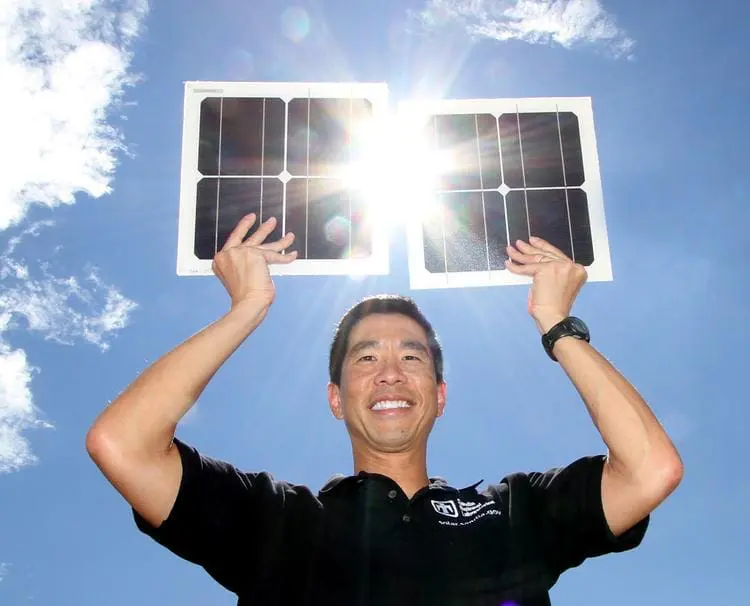
Tens of thousands of customers annually now rely on a tool born from a safety concern surrounding the rapid expansion of solar energy following the 2010 Department of Energy SunShot Initiative. Sandia National Laboratories scientist Cliff Ho created the Solar Glare Hazard Analysis tool, now known as SolarForge, to address blinding glare from large solar installations near airports, endangering pilots, air traffic controllers, motorists and communities. The web-based software allows users to map sites and identify hazardous glare, suggesting alternative configurations if needed. This year, SolarForge is among three projects developed at Sandia, along with the trajectory software TAOS and work building a quantum ecosystem, recognized with Federal Laboratory Consortium awards for Excellence in Technology Transfer. The FLC recognizes these projects as examples of successful transitions of research into practical applications.
SolarForge Mitigates Glare Hazards for Global Solar Installations
Recognizing this growing risk, Sandia National Laboratories scientist Cliff Ho spearheaded the development of a solution now utilized globally and recently honored with a Federal Laboratory Consortium (FLC) award for Excellence in Technology Transfer. The tool, initially known as the Solar Glare Hazard Analysis Tool and now branded as SolarForge, addresses a critical need for proactive glare mitigation in the rapidly expanding solar energy sector. SolarForge’s functionality centers on a web-based interface allowing users to map proposed solar array locations and predict potential glare hazards throughout the year. If problematic glare is identified, the software calculates alternative configurations designed to minimize risk. Beyond safety, the tool also estimates annual energy production, enabling developers to optimize layouts for both efficiency and glare reduction. This capability proved vital as concerns mounted regarding installations near airports, prompting urgent action from the Federal Aviation Administration, DOE, Air Force, and Department of Transportation.
Ho, alongside Sandia graduate-student intern Cianan Sims, initially made the tool freely available online, guiding over 6,000 users across 60 countries. The transition to commercialization occurred around 2016, with Sims founding Sims Industries LLC and collaborating with Ho to further refine and license the technology. Bob Westervelt, a Sandia licensing executive, facilitated the process, ultimately resulting in the renamed ForgeSolar being adopted in 140 countries. Currently, an average of 20,000 solar glare analyses are performed annually using the software, including at ten of the world’s busiest airports.
The FLC acknowledged this widespread impact, stating the technology “is a prime example of a national laboratory harnessing its creativity and resources to address a significant global need.” The tool’s evolution from a research project to an internationally recognized safety standard underscores the importance of translating laboratory innovation into practical, real-world solutions and demonstrates how focused research can address unforeseen consequences of technological advancement.
The tool can also predict annual energy production when evaluating design layouts and locations to maximize energy production while mitigating glare impacts.
TAOS Software Optimizes Trajectory Analysis for Aerospace Applications
Sandia National Laboratories’ technological advancements are increasingly impacting the aerospace industry; the trajectory and optimization software known as TAOS exemplifies this trend. Developed in 2014 for planning research rocket launches, TAOS, short for Trajectory Analysis and Optimization Software, has become a critical asset for both governmental organizations and the burgeoning commercial space market. Unlike existing software often tailored to specific problems, TAOS uniquely combined multiple trajectory solving capabilities into a single, comprehensive analysis and optimization package, supporting safety analysis throughout the entire lifecycle, from conceptual design through postflight analysis. The software’s intuitive design has proven remarkably durable, leading to its licensing by the Federal Aviation Administration and subsequent approval by NASA as an acceptable safety analysis tool. Since then, TAOS has modeled a diverse range of aerospace vehicles, including hypersonic re-entry vehicles, satellites, subsonic cruise missiles, unmanned aerial vehicles, and even sensor darts.
Expanding its reach into the commercial space sector presented significant hurdles, primarily due to its classification under International Traffic in Arms Regulations. Successfully navigating these restrictions required extensive collaboration between Sandia, the Department of Energy legal teams, and creative strategies for distribution, ultimately resulting in licenses granted to six major rocket companies and over 200 users operating under government contracts. Currently, TAOS is utilized by the companies responsible for 84% of commercial rocket launches originating in the United States in 2023. The Federal Laboratory Consortium recognized this achievement with an Excellence in Technology Transfer Award, acknowledging Sandia’s collaborative efforts in bringing a specialized, lab-developed technology to market.
The software’s sustained success isn’t attributable to a single individual, but rather decades of contributions from numerous engineers and administrators; aeronautical engineers Michael Sparapany, Michael Grant, Jon Christensen, and Nathaniel Grady, alongside David Wick, Amanda Malherbe, Sandra Pino, Elisabeta Cosarca Cordova, and Victoria Martinez, all played vital roles. Sparapany said, “TAOS is where it is today due to the hard work of several individuals, but it wouldn’t be what it is today without the foresight of its original author Dave Salguero,” emphasizing the foundational architecture that continues to underpin the software’s functionality and widespread adoption.
The fact that TAOS has stood the test of time and is one of the preferred tools nationwide is a testament to Dave’s original architecture.
Elevate Quantum Drives New Mexico’s Quantum Ecosystem Growth
Elevate Quantum, a 127 million grant-funded program, is rapidly reshaping New Mexico’s technological landscape by fostering public-private partnerships with over 140 members and accelerating the commercialization of quantum technologies. This initiative, alongside the Quantum Frontiers Project, a memorandum of agreement between the state of New Mexico and the Defense Advanced Research Projects Agency, demonstrates a concerted effort to establish a robust quantum industry within the state. Central New Mexico Community College, in partnership with Sandia National Laboratories, is spearheading the Quantum Learning Lab and Technician Bootcamp, led by Central New Mexico Community College and Sandia, and funded through the federal “Elevate Quantum” Tech Hub, to address the critical need for a skilled quantum workforce. This program complements a pilot initiative offering 100,000 grants to quantum companies committing to establish a presence in New Mexico, further incentivizing investment and job creation.
Sandia quantum physicist Megan Ivory and business development lead Jake Douglass, founders of QCaMP, a program introducing quantum concepts to high school students, have been instrumental in cultivating this momentum. Douglass said, “A major part of making New Mexico the place to be for quantum is by building new and innovative public-private partnerships,” highlighting the collaborative spirit driving the state’s quantum ambitions. The partnership with the Defense Advanced Research Projects Agency is fueling research, engineering, and testing capabilities.
This influx of funding and collaborative energy is not merely about technological advancement; it’s about leveraging New Mexico’s historical strength in technology development. Douglass explained, “New Mexico has a strong history of being a crucial player in world-changing technology development.” He continued, “The field of quantum science is at an inflection point and New Mexico is the place to be to realize the impact of these emerging technologies.” Ivory echoed this sentiment, emphasizing the state’s potential to become a central hub for quantum science and technology.
A major part of making New Mexico the place to be for quantum is by building new and innovative public-private partnerships.
FLC Awards Recognize Sandia’s Technology Transfer Excellence
Sandia National Laboratories’ innovations are demonstrably impacting critical infrastructure and emerging technologies, as evidenced by recent Federal Laboratory Consortium (FLC) awards recognizing three distinct projects originating from the New Mexico-based institution. The FLC awards, presented annually, highlight successful transitions of research into practical applications, and this year Sandia secured accolades for its work in solar energy safety, aerospace trajectory analysis, and the burgeoning field of quantum technology. These recognitions underscore the laboratory’s broad influence, extending from mitigating immediate hazards to fostering long-term economic development. Installations, often situated near airports, presented a risk of blinding glare to pilots, air traffic controllers, and surrounding communities. Beyond solar safety, Sandia’s Trajectory Analysis and Optimization Software (TAOS) has become a cornerstone of flight analysis for both government and commercial space sectors, earning it an Excellence in Technology Transfer Award for its adoption by companies responsible for 84% of U.S. commercial rocket launches in 2023.
Through partnerships with academic institutions, private firms, and government agencies, Sandia is fostering quantum innovation and workforce development. This includes initiatives like the federal “Elevate Quantum” Tech Hub and the New Mexico Quantum Venture Studio, a $25 million initiative.
New Mexico has a strong history of being a crucial player in world-changing technology development. The field of quantum science is at an inflection point and New Mexico is the place to be to realize the impact of these emerging technologies,” Douglass said.

See today’s quantum computing news on Quantum Zeitgeist for the latest breakthroughs in qubits, hardware, algorithms, and industry deals.