Compal Electronics is demonstrating a 3,500-fold acceleration in molecular docking speeds by combining NVIDIA CUDA-Q quantum simulations with GPU-accelerated simulated annealing. The company showcased this innovation in a session at NVIDIA GTC titled “Accelerating Drug Discovery Through Quantum AI and Supercomputing,” indicating a move beyond infrastructure provision to active research presentation. This advance utilizes 30-qubit quantum optimization to refine binding-energy prediction, with initial applications focused on Alzheimer’s disease research. Developed in collaboration with academic partners and supported by NSTC funding, Compal’s platform offers a practical blueprint for integrating quantum and AI workflows into large-scale virtual screening pipelines. Through deep partnerships with institutions like National Yang Ming Chiao Tung University, Compal is building a comprehensive bio-medical ecosystem, from drug design to manufacturing.
CGA-QX Docking Achieves 3,500-Fold Speed-Up in Molecular Docking
A 3,500-fold acceleration in molecular docking, achieved by Compal’s CGA-QX Docking, represents a substantial leap forward in the speed of virtual drug screening and design. The core of CGA-QX Docking lies in its utilization of 30-qubit quantum optimization, specifically aimed at refining the accuracy of binding-energy predictions, which is particularly relevant to research focused on complex neurological conditions like Alzheimer’s disease. This improvement is not simply about speed; the increased precision offered by the quantum-enhanced system promises to reduce the time and cost associated with identifying promising drug candidates, potentially accelerating the delivery of new therapies to patients. Compal’s integration of Simulated Quantum Annealing with NVIDIA CUDA-Q represents a significant step toward realizing the potential of hybrid quantum-classical computing in pharmaceutical research.
NYCU Collaboration Advances Generative AI for Antibody Development
Compal Electronics is actively translating research into tangible advancements in antibody development through a collaborative effort with the College of Pharmaceutical Sciences at National Yang Ming Chiao Tung University (NYCU). This partnership has yielded a generative AI model coupled with a rigorous validation workflow designed to accelerate the creation of novel antibody drugs. The system leverages generative AI for antibody sequence design, then employs NVIDIA Boltz-2 NIM for predicting the structure of antibody-antigen complexes, a crucial step in determining efficacy. A fine-tuned ESM-2 protein language model further refines the process, utilized for high-precision specificity prediction, ensuring the generated antibodies exhibit both targeted binding and biological activity. This work is not merely theoretical; a continuous feedback loop incorporating experimental validation confirms the superior specificity and activity of the AI-designed antibodies. This collaborative approach builds on Compal’s broader strategy of combining AI with quantum technology, validated through practical testing with Kaohsiung Medical University, to optimize molecular configuration searches and predict drug-receptor interactions with increased speed.
In this session, you can see how CGA-QX Docking combines NVIDIA CUDA-Q quantum simulations with GPU-accelerated simulated annealing to achieve up to 3,500× speed-ups over traditional molecular docking methods-while 30-qubit quantum optimization improves binding-energy prediction accuracy for targets like Alzheimer’s disease.
Compal
ReAIX Platform Integrates AI, Quantum Computing for Manufacturing Scale-Up
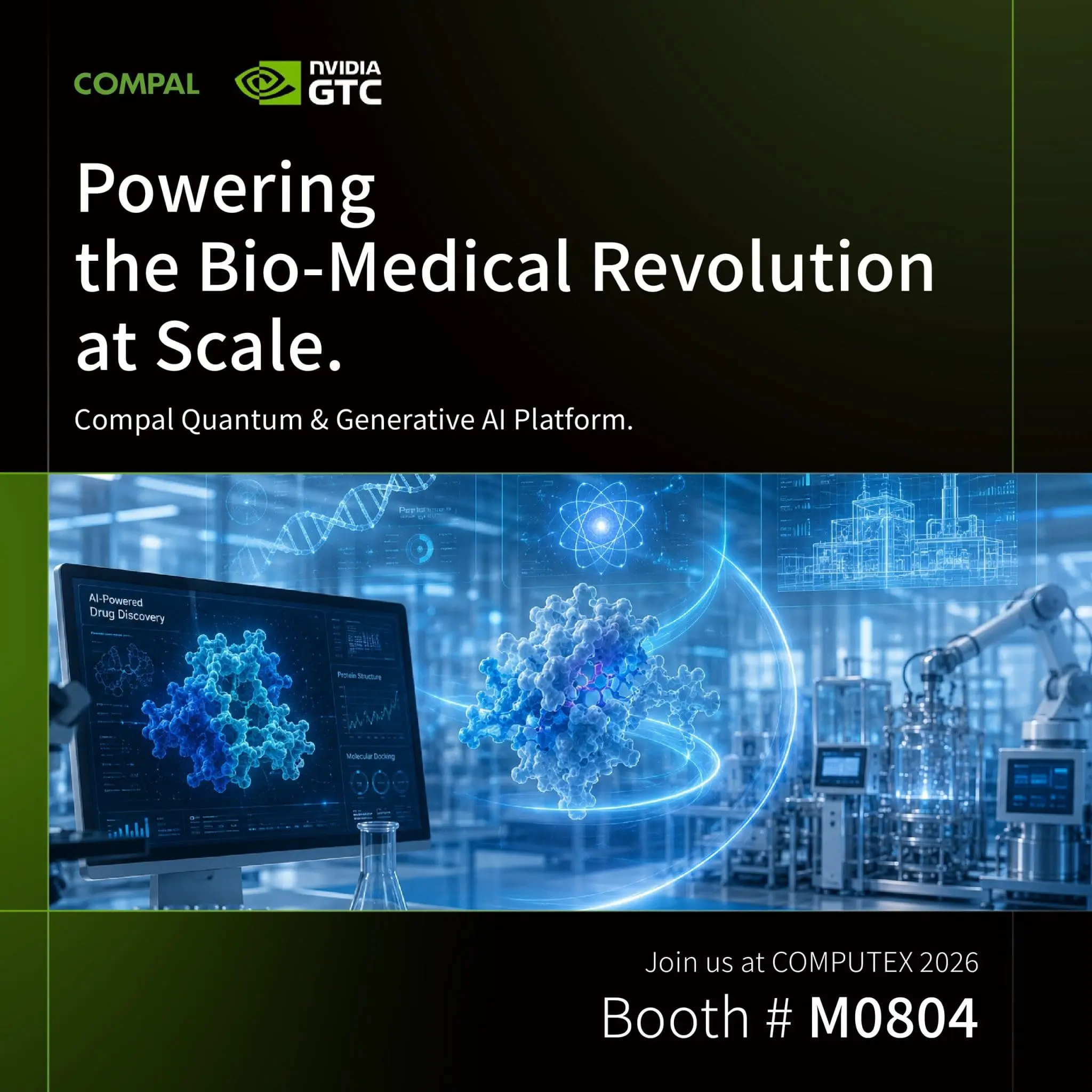
Vernus AI, a subsidiary of Compal Electronics, is actively translating theoretical advances in quantum computing and artificial intelligence into practical industrial applications with its ReAIX platform. Described as the first to integrate AI, quantum computing, and physical simulation, ReAIX focuses on bridging the gap between laboratory research and large-scale manufacturing within the pharmaceutical sector. The platform leverages tools like the NVIDIA NeMo Agent Toolkit and NVIDIA PhysicsNeMo to construct advanced agent frameworks and define precise physical environment parameters, enabling in-depth analysis and simulation of complex process variables. This capability extends to a diverse range of pharmaceutical products, encompassing small molecules, large molecules, cell therapies, and drug formulations, with the goal of optimizing and integrating processes directly into manufacturing workflows. Compal reports that ReAIX has already delivered successful projects for both domestic and international pharmaceutical companies, including Orient EuroPharma, demonstrating its potential to shorten research and development cycles while simultaneously reducing production costs. The platform’s capabilities were highlighted at COMPUTEX, where Compal showcased its broader efforts in quantum-AI hybrid computing.



See today’s quantum computing news on Quantum Zeitgeist for the latest breakthroughs in qubits, hardware, algorithms, and industry deals.