

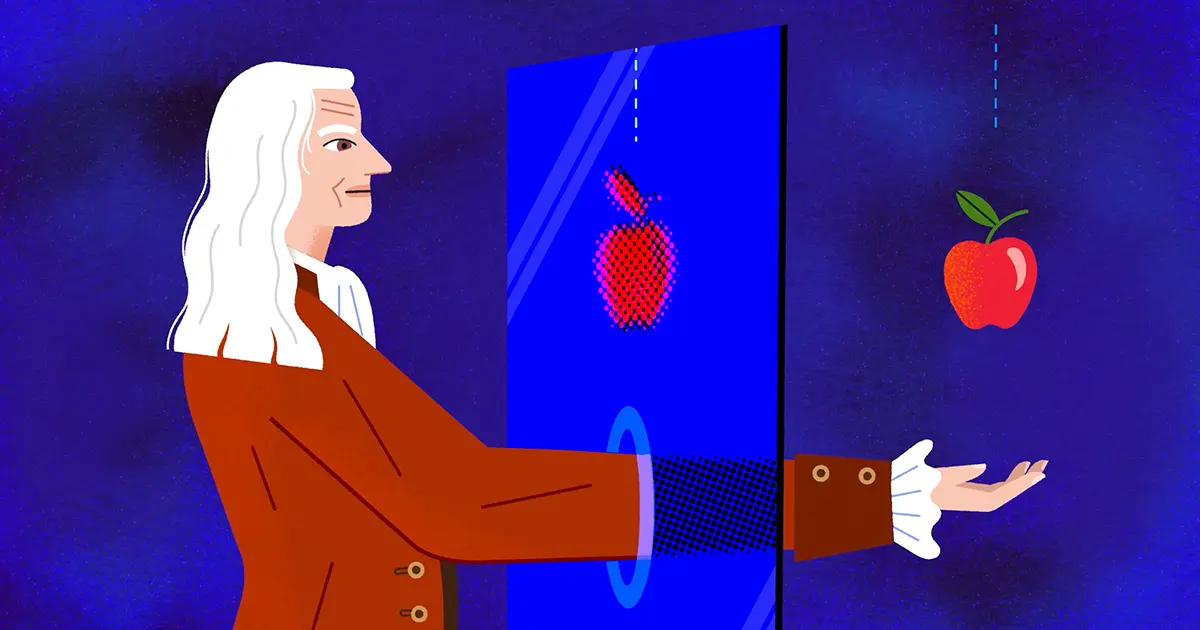
Physicists are increasingly finding that entanglement doesn’t just link quantum particles; it may actually build the very fabric of space-time. Building on John Archibald Wheeler’s observation that “space acts on matter, telling it how to move,” and “in turn, matter reacts back on space, telling it how to curve,” researchers have struggled to reconcile this relationship at the quantum level. Now, multiple teams have identified a quantum property called “magic” that appears to give space-time its bendiness, allowing matter to influence its curvature. John Preskill, a physicist at the California Institute of Technology, said that without this property, things would be too simple, and quantum space-time is not that simple. This discovery offers a potential pathway toward understanding gravity as a quantum phenomenon and resolving long-standing conflicts between general relativity and quantum physics.
Entanglement and Space-Time’s Structure
In holographic theories, physicists may have traced the pliability of space-time to its quantum roots: a measure of quantumness known as “magic.” For decades, a central challenge in theoretical physics has been reconciling general relativity, which describes gravity as the curvature of space-time, with the principles of quantum mechanics. While entanglement has been established as a key component in building the structure of space-time, explaining how matter influences that structure remained elusive until recently. The common analogy of space-time as a mattress with a bowling ball illustrates the problem; matter creates a curvature, influencing the motion of other objects. However, this breaks down at singularities like black holes, necessitating a new theoretical framework. Researchers have been exploring the holographic principle, which proposes a duality between a volume of space-time and its description on a lower-dimensional boundary, as a potential solution.
This concept, reminiscent of a holographic sticker containing a 3D scene on a 2D surface, suggests that the information defining a region of space-time can be encoded on its surface. Entanglement then emerges as the connective tissue of this space, with wormholes, theoretical tunnels connecting distant regions, demonstrably reliant on entangled particles; severing these connections dissolves the wormhole entirely. Recent work, including that of Charles Cao at Virginia Tech, has identified “magic” as the crucial ingredient enabling matter to influence space-time’s curvature. This “magic” isn’t mystical, but a quantifiable measure of quantumness, a feature of quantum mechanics that allows for more complex interactions than simple entanglement alone. These codes initially divided the entanglement of the particles into two types: one responsible for space and another responsible for matter, enabling a more nuanced interplay between space and matter.
Wheeler’s Relativity and the Quantum Challenge
For decades, models struggled to demonstrate how matter could actively curve space-time, a crucial component of gravitational interaction. Recent breakthroughs suggest a potential solution lies in a quantum property dubbed “magic,” identified by multiple teams as a critical element in establishing the pliability of space-time. This isn’t merely a mathematical convenience; researchers, including Charles Cao at Virginia Tech, now believe “magic” represents a measurable quantumness that directly influences the geometry of the universe. This holographic approach reimagines gravity not as a force within space-time, but as an emergent phenomenon arising from the entanglement of quantum particles on its boundary. Consider a wormhole, a theoretical tunnel connecting distant points in space; holographically, it manifests as two sets of entangled particles. Severing the entanglement progressively weakens the connection, ultimately dissolving the wormhole entirely.
Daniel Harlow, now at the Massachusetts Institute of Technology, identified the mathematical framework for translating between these 2D and 3D perspectives, utilizing quantum error-correcting codes, techniques initially developed to protect fragile quantum information in computers. Early iterations of these codes divided the entanglement of the particles into two types: one responsible for space and another responsible for matter. Bartek Czech, a physicist at Tsinghua University, noted that they knew how to build a space-time, but this space-time was inert. Cao’s work, building on Harlow’s foundation and incorporating more complex error-correcting codes, introduced the element of “magic”, allowing space to respond dynamically to the presence of matter. This breakthrough suggests that the curvature of space-time isn’t simply a consequence of mass-energy, but a manifestation of the underlying quantum properties of the very fabric of reality, finally bridging the gap in Wheeler’s elegant description.
When you design codes for quantum computing, you’re doing the same kind of thing that [holography] already did for you.
Bartek Czech, a physicist at Tsinghua University in China
The Holographic Principle and Dimensionality
Researchers at Virginia Tech, led by Charles Cao, are currently refining holographic theories by identifying a quantum property dubbed “magic” as a crucial component in replicating gravitational interactions within a quantum framework. Early holographic models struggled to replicate the dynamic interplay between space and matter; the resulting space-time divided the entanglement of the particles into two types: one responsible for space and another responsible for matter. This division enabled a more nuanced interplay between space and matter. Cao’s team discovered that incorporating “magic,” a measure of quantumness related to concepts like the T gate used in quantum computing, introduces the necessary pliability. This “magic” allows for the interaction between space and matter, effectively enabling matter to “curve” space-time in a manner consistent with general relativity.
This is pretty cool, because in quantum gravity, we don’t expect the background is fixed.
“Magic” as Quantumness and Space’s Bendiness
The search for a quantum theory of gravity has yielded a surprising connection: the fundamental pliability of space-time may stem from a quantum property playfully termed “magic.” This isn’t stage illusion, but a measurable characteristic of quantum systems that appears crucial in bridging the gap between Einstein’s general relativity and the perplexing world of quantum mechanics, potentially offering a pathway to understanding gravity at its most fundamental level. Researchers have increasingly focused on the holographic principle, proposing that the universe’s three-dimensional reality can be entirely described by information encoded on a two-dimensional surface, much like a hologram. This principle, however, required identifying what gives the three-dimensional fabric of space its shape, and entanglement was initially believed to be the answer. Entanglement, linking quantum particles regardless of distance, was found to build the structure of space, allowing matter to move, but failed to explain how matter could curve that space.
Charles Cao of Virginia Tech and colleagues have now pinpointed “magic” as the missing ingredient, a measure of quantumness that allows for this crucial interaction. These codes, when applied to holographic models, revealed that a more sophisticated approach was needed to allow space and matter to influence each other. They divided the entanglement of the particles into two types: one responsible for space and another responsible for matter.
We knew how to build a space-time,” Czech said, but “this space-time was inert.
Quantum Error Correction in Holographic Models
The quest to reconcile general relativity with quantum mechanics has led physicists to increasingly intricate models of space-time, yet replicating the fundamental interaction between matter and the geometry it creates has remained a significant hurdle. Early holographic models successfully used entanglement to construct space, satisfying Wheeler’s first assertion that space dictates how matter moves, but failed to account for the reciprocal relationship. The problem stemmed from the type of quantum codes initially employed, which divided the entanglement of the particles into two types: one responsible for space and another responsible for matter. Cao’s breakthrough involved exploring more sophisticated codes, eventually realizing that incorporating a specific quantum operation, a “T gate” which rotates a qubit, could introduce the necessary flexibility. Cao terms this “magic,” a measure of quantumness that allows space-time to respond to the presence of matter.
The significance of this “magic” lies in its ability to bridge the gap between the quantum realm and the curvature of space-time. The ability to encode a holographic location, a region of space and its contents, across multiple entangled sets of quantum particles, facilitated by these codes, is a crucial step toward understanding how gravity emerges from the quantum world.
Space acts on matter, telling it how to move. In turn, matter reacts back on space, telling it how to curve.
John Archibald Wheeler
Source: https://www.quantamagazine.org/entanglement-builds-space-time-now-magic-gives-it-gravity-20260603/

See today’s quantum computing news on Quantum Zeitgeist for the latest breakthroughs in qubits, hardware, algorithms, and industry deals.