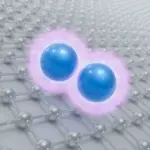
Researchers at the University of Copenhagen have radiatively coupled two quantum dots separated by 13 µm, a distance equivalent to 26 wavelengths, using a photonic crystal waveguide. This coupling allows for control of light emission direction, effectively creating an “artificial molecule” from the quantum dots and the waveguide itself. The work demonstrates that the emission direction can be switched by manipulating the driving phase of the emitters, and reveals directional photon statistics including correlated photon pairs. This approach represents key steps for scaling up as a multi-emitter waveguide QED platform.
Waveguide-Engineered Quantum Dots Enable 13µm Coupling
The waveguide’s structure allows for independent electrical tuning of the quantum dots, a critical feature for precise control of their interaction. The device itself is fabricated from a GaAs heterostructure forming a suspended membrane with a bidirectional photonic crystal waveguide patterned into it. Light enters and exits the structure through grating coupling ports positioned at each end of the waveguide, facilitating the manipulation of photons emitted by the embedded InGaAs quantum dots.
These quantum dots, acting as single-photon emitters, are brought into resonance by adjusting their dc Stark shifts with locally applied electric fields, a technique essential for establishing the necessary quantum link. This precise tuning is a key element in achieving the observed directional emission. The ability to control the emission direction stems from a dispersive dipole-dipole interaction, which shifts the energy of the collective states of the quantum dot pair.
This interaction effectively transforms the two dots and the waveguide into what the researchers describe as offering a novel approach to chiral quantum optics. By manipulating the relative phase of the driving fields, the team demonstrated the ability to switch the direction of single-photon emission in a pulsed collective-excitation regime, showing a level of control previously unrealized in optical systems. The observed coupling isn’t simply a matter of signal transmission. It’s a fundamental interaction that alters the quantum states of the emitters.
The researchers observed time-resolved emission dynamics confirming waveguide-mediated coupling between the quantum dots, revealing the dispersive component of this interaction. This dispersive element allows for the manipulation of the energy levels and, consequently, the emission characteristics of the system. The team observed directional photon statistics under continuous driving, detecting single photons at one output port and photon pairs at the other.
With pulsed excitation, both emitters were fully inverted, and correlated photon pairs were observed in time-resolved intensity correlation measurements. “In essence, the emitters form a waveguide-engineered molecule, which offers an alternative realization of chiral quantum optics,” the researchers state in their publication. This engineered molecule represents a new paradigm for controlling light-matter interactions at the quantum level, potentially clearing the way for more complex and scalable quantum technologies.
Bidirectional Photonic Crystal Waveguide Controls Emission Direction
A 13µm separation, roughly ten times the length of the photonic crystal lattice used in its construction, did not prevent radiative coupling between quantum dots in a recent experiment, demonstrating a surprising scale for maintaining quantum connection within a waveguide structure. The device, fabricated from a GaAs heterostructure, functions as a p-i-n diode, enabling electrical control over the quantum dots’ emission frequencies via the dc Stark effect.
A shallow trench etched into the p-doped layer allows for localized adjustment of the electric fields applied to emitters positioned in the left and right halves of the waveguide, providing independent tuning capabilities. The team’s design moves beyond previous attempts at directional emission, which lacked the capacity for selective driving to control the light’s path.
The observed directionality arises from a specific phase relationship between the emitted photons, dictated by the spatial separation of the quantum dots and the properties of the photonic crystal waveguide. Calculations reveal a phase lag, φ, accumulating between the emitters, determined by the waveguide’s band edge and the number of unit cells separating the dots. Numerical simulations corroborated these findings, accurately predicting the observed directional emission patterns.
This control is achieved through precise electrical tuning, altering the energy levels and influencing the interference of the emitted photons. The researchers characterized this directionality by measuring the relative intensities of light emitted to the left and right, observing a clear correlation between the driving phase and the emission direction. This level of control opens possibilities for building more complex hybrid quantum networks, where information can be routed and processed using light.
Dispersive Dipole-Dipole Interaction Forms Artificial Molecule
The successful radiative coupling of quantum dots separated by 13 µm relies on a dispersive dipole-dipole interaction that fundamentally alters the collective behavior of the emitters. This interaction, stemming from their shared connection to a guided mode within a photonic crystal waveguide, shifts the energy of the combined system, effectively creating an “artificial molecule” where the individual quantum dots behave as linked components. The observed asymmetry in transmission dips, a signature of this dispersive coupling, demonstrates a deviation from simple energy level behavior and confirms the formation of this novel collective state.
This coupling isn’t merely a theoretical construct. It manifests in a measurable directional dependence of emitted light. This allows for a predictable and controllable influence on the path of emitted photons, a key step toward more complex quantum systems.
This control arises because the dispersive component of the coupling, proportional to sinφ, establishes a specific regime of collective emission where the system’s behavior is sensitive to external adjustments. The ability to tailor both the direction and the statistical properties of emitted photons represents an advancement in the field of quantum optics. The team suggests that incorporating on-chip phase shifters could further enhance directionality, while a secondary coupling mechanism might allow for cancellation of energy-level shifts without sacrificing interference, the source of directional emission.
Directional Photon Statistics Reveal Emission Control
This distance, equivalent to 26 effective wavelengths, exceeds typical coupling ranges and suggests a pathway toward more scalable architectures by reducing the density requirements for quantum emitters. Researchers observed that this coupling enables not only the transfer of energy but also precise control over the direction of emitted photons, a capability important for building complex hybrid quantum networks. Beyond directional control, detailed analysis of the emitted light revealed specific statistical properties, with single photons consistently detected at one waveguide output port while photon pairs emerged from the other.
This distinct photon distribution arises from a cascaded decay process, where the initial emission dictates the subsequent photon’s path, and is further governed by the overlap of collective energy states. “The full emission from |ee⟩ can be considered as a two-step process,” the study notes, detailing how the initial photon emission determines the subsequent decay pathway and ultimately the direction of the second photon.
The researchers explain that the emission of photon pairs can also be understood as one quantum emitter stimulating the emission from the other, further highlighting the strong interaction between the dots. Together, these results show that waveguide-coupled quantum emitters constitute a versatile platform for routing optical photons and generating correlated states of light.
Correlated Photon Pairs Demonstrate Collective Excitation
This achievement bypasses limitations imposed by closer proximities typically required for strong coupling, potentially easing fabrication demands for future quantum networks. The ability to maintain interaction across this relatively large gap stems from the waveguide’s ability to mediate the coupling, effectively acting as a conduit for quantum information exchange between the spatially separated emitters.
The team demonstrated this control by switching emission direction from left to right, a feat achieved through collective excitation of the emitters. Analysis of these correlations reveals a diagonally elongated feature in the correlation map, indicating that two photons arrive together, a feature absent in uncorrelated measurements.
This correlation is a consequence of a cascaded decay process, where one quantum emitter stimulates emission from the other. The team’s analysis of the underlying probability distributions confirms this cascaded process. This capability is essential for building complex hybrid quantum networks, where the reliable transfer of quantum information between distant nodes is paramount.
👉 More information
🗞 Directional and Correlated Optical Emission from a Waveguide-Engineered Molecule with Local Control
✍️ Clara Henke et al.
🧠 DOI: http://link.aps.org/doi/10.1103/v1r7-lr89

See today’s quantum computing news on Quantum Zeitgeist for the latest breakthroughs in qubits, hardware, algorithms, and industry deals.