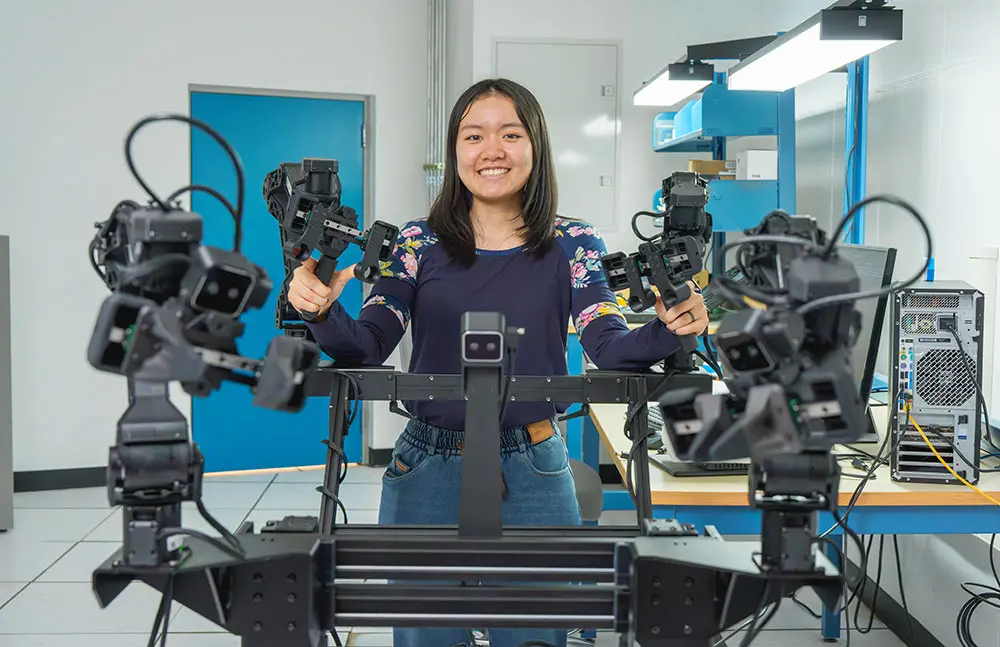
Jasmin Lin, a recent intern at Brookhaven National Laboratory, integrated virtual reality (VR) with a plant digital twin during a January to May Science Undergraduate Laboratory Internships (SULI) term, shifting her research toward artificial intelligence and robotics. Lin’s initial project connected VR interaction with a 3D mockup of a mother board, allowing users to access original images used to generate that exact gaussian at the point of intersection; “This was my first experience using AI within the AI department,” she said, noting an improvement in AI reliability after working with it for a year. Working under the mentorship of Wei Xu, Lin’s focus expanded to training humanoid robots in simulation, contributing to the Department of Energy’s Genesis Mission to accelerate AI innovation within Brookhaven’s Computing and Data Sciences Directorate. Her work, presented at the New York Scientific Data Summit last year, demonstrates the growing intersection of computational biology, embodied AI, and advanced robotics.
VR Integration with Plant Digital Twins for Computational Biology
The convergence of virtual reality (VR) and plant digital twins is expanding the possibilities within computational biology, offering researchers new methods for data visualization and manipulation. Jasmin Lin’s work at Brookhaven National Laboratory exemplifies this trend, demonstrating how immersive technologies can bridge the gap between in-silico modeling and real-world botanical observation. This allowed her to visually explore a plant’s structure in a virtual space and trace the origins of individual visual elements back to their source images. A digital twin, as she defines it, is a “dynamic, real-time digital model of a physical system that continuously updates alongside the real counterpart.” By pointing and clicking within the VR environment, Lin could access the original images used to generate that exact gaussian at the point of intersection, providing a powerful tool for validation and analysis.
This initial project, mentored by Wei Xu, marked Lin’s first experience applying artificial intelligence within Brookhaven’s Artificial Intelligence group. The work contributes to the DOE’s Genesis Mission to accelerate AI innovation and discovery. Integrating VR with plant digital twins is not merely about visualization; it’s about creating a more intuitive and efficient workflow for computational biologists. Traditional methods often involve sifting through large datasets and complex models on a 2D screen, while VR offers a more natural and immersive way to interact with this information. Lin’s experience highlights a broader shift toward embodied AI, where artificial intelligence systems learn through interaction with a physical environment. The ability to seamlessly move between virtual and real-world representations of plants promises to accelerate research in areas like plant physiology, genetics, and environmental adaptation, offering new avenues for understanding and improving plant life.
SKRL Library Applied to Humanoid Robot Locomotion
The pursuit of adaptable humanoid robots demands more than just advanced mechanics; it requires sophisticated software capable of translating abstract goals into coordinated movement. Researchers currently rely heavily on reinforcement learning, a trial-and-error process where robots learn through repeated attempts and feedback, but developing these learning algorithms remains computationally intensive and often requires extensive, specialized coding. Jasmin Lin’s recent work at Brookhaven National Laboratory demonstrates a shift towards streamlining this process through the application of the SKRL reinforcement learning library, potentially offering a faster route to robust robot locomotion. Lin utilized SKRL to investigate how humanoid robots can learn to walk and maintain balance in simulated environments, building upon a foundation established during her SULI term running from January to May and continued through the Supplemental Undergraduate Research Program (SURP).
The SKRL library, with its modular design, allowed Lin to experiment with different reinforcement learning policies and quickly assess their effectiveness, accelerating the development cycle. The implications extend beyond simply improving robot walking ability. A key goal is to reduce downtime at NSLS-II by training a robot to enter the accelerator tunnel. “If maintenance or repairs require workers to go into the accelerator tunnel, the facility must turn off the X-ray beam,” explained Lin, “But if we can train a robot to go into the accelerator tunnel, that would prevent the need to turn off the beam and reduce down time.” Successfully implementing such a system requires robots capable of navigating complex environments and performing precise actions, a capability directly enhanced by advancements in locomotion control facilitated by tools like SKRL. Lin’s work suggests that by leveraging pre-built AI components, researchers can focus on refining robot behavior for specific tasks, rather than reinventing the underlying learning algorithms, ultimately accelerating the deployment of intelligent robotic systems.
Vision-Language-Action Policies for NSLS-II Maintenance
Jasmin Lin, pursuing a master’s degree in bioinformatics at Brandeis University, is applying advancements in artificial intelligence to a practical challenge at Brookhaven National Laboratory: minimizing downtime at the National Synchrotron Light Source II (NSLS-II). Lin’s work, stemming from her internships within the lab’s Artificial Intelligence group in the Computing and Data Sciences Directorate, focuses on integrating vision-language-action policies with physical robots, a project that contributes to the Genesis Mission to accelerate AI innovation and discovery. This approach aims to circumvent the current necessity of shutting down the X-ray beam whenever human access is required for maintenance. She is now deploying AI models that enable robots to “see, understand instructions, and act” in a coordinated manner.
The initial phase involved training a robot to autonomously pick up a 3D mockup of a mother board and place it into a box, a seemingly simple task that represents a significant step towards more complex automated interventions. Currently, Lin is integrating virtual reality for teleoperation of the robot within a simulated environment, refining the system before deployment in the real world. This layered approach, simulation followed by physical implementation, is crucial for ensuring safety and reliability within the NSLS-II facility.
The potential impact extends beyond simply reducing downtime. “A lot of the work that we do in general as people is very manual,” she noted, drawing a parallel to the traditionally labor-intensive data analysis in her biology background. “Now with AI being more reliable with fewer hallucinations and irrelevant responses, we can speed that up and be so much less time-consuming.” The team at the Scientific Embodied Agents Lab (SEAL) anticipates expanding the scope of these tests, potentially addressing a wider range of maintenance tasks within the NSLS-II infrastructure. The challenges of robotics troubleshooting, Lin observed, are multifaceted, encompassing hardware, software, and the AI model itself, but the reward of seeing the robot successfully perform a task is profoundly satisfying.
It’s definitely a big twist from my current study, which is bioinformatics. I still love biology, but I also really love coding. Artificial intelligence is very adaptive, and I use it to understand the research I’m doing.
From Bioinformatics to Embodied AI: Research Motivation & Impact
Jasmin Lin’s trajectory from biological studies to the forefront of embodied artificial intelligence demonstrates the increasingly porous boundaries between disciplines, and highlights the potential for AI to accelerate discovery across scientific fields. Initially focused on pursuing a master’s degree in bioinformatics at Brandeis University following a biology undergraduate degree, Lin’s internships at Brookhaven National Laboratory’s Computing and Data Sciences Directorate catalyzed a shift towards robotics and AI, ultimately contributing to the DOE’s Genesis Mission to accelerate AI innovation and discovery. This mission aims to accelerate AI innovation, and Lin’s work exemplifies how hands-on research experiences can rapidly expand an individual’s skillset and research focus. Lin’s first SULI term ran from January to May with Wei Xu. Her experience underscored the evolving capabilities of AI, observing that it has become more reliable with fewer hallucinations and irrelevant responses after working with AI for a year.
The evolution of Lin’s work continued with a SURP internship focused on embodied AI, specifically applying robotics to assist user facilities around Brookhaven Lab, such as the National Synchrotron Light Source II (NSLS-II). The team is exploring how robots can train a robot to go into the accelerator tunnel, potentially eliminating downtime caused by the need to shut off the X-ray beam.
She is currently connecting vision-language-action policies with a physical robot, successfully training it to autonomously manipulate a 3D mockup of a mother board, and integrating VR for remote operation in simulation. Lin’s enthusiasm for the field is clear: “I love that there’s a lot we can explore because it’s relatively new, especially with a shift and focus on embodied AI right now.” She envisions a future where AI streamlines traditionally manual processes, accelerating research and reducing time-consuming tasks, and ultimately contributing to “something that will eventually be used in the future.”
Troubleshooting robotics is really difficult because whenever there’s an issue, you can’t really pinpoint where it starts from. There’s hardware in the robot, there’s software in the robot, and there’s also software on the computer connection and deployment of the AI model that we’re using.
See today’s quantum computing news on Quantum Zeitgeist for the latest breakthroughs in qubits, hardware, algorithms, and industry deals.