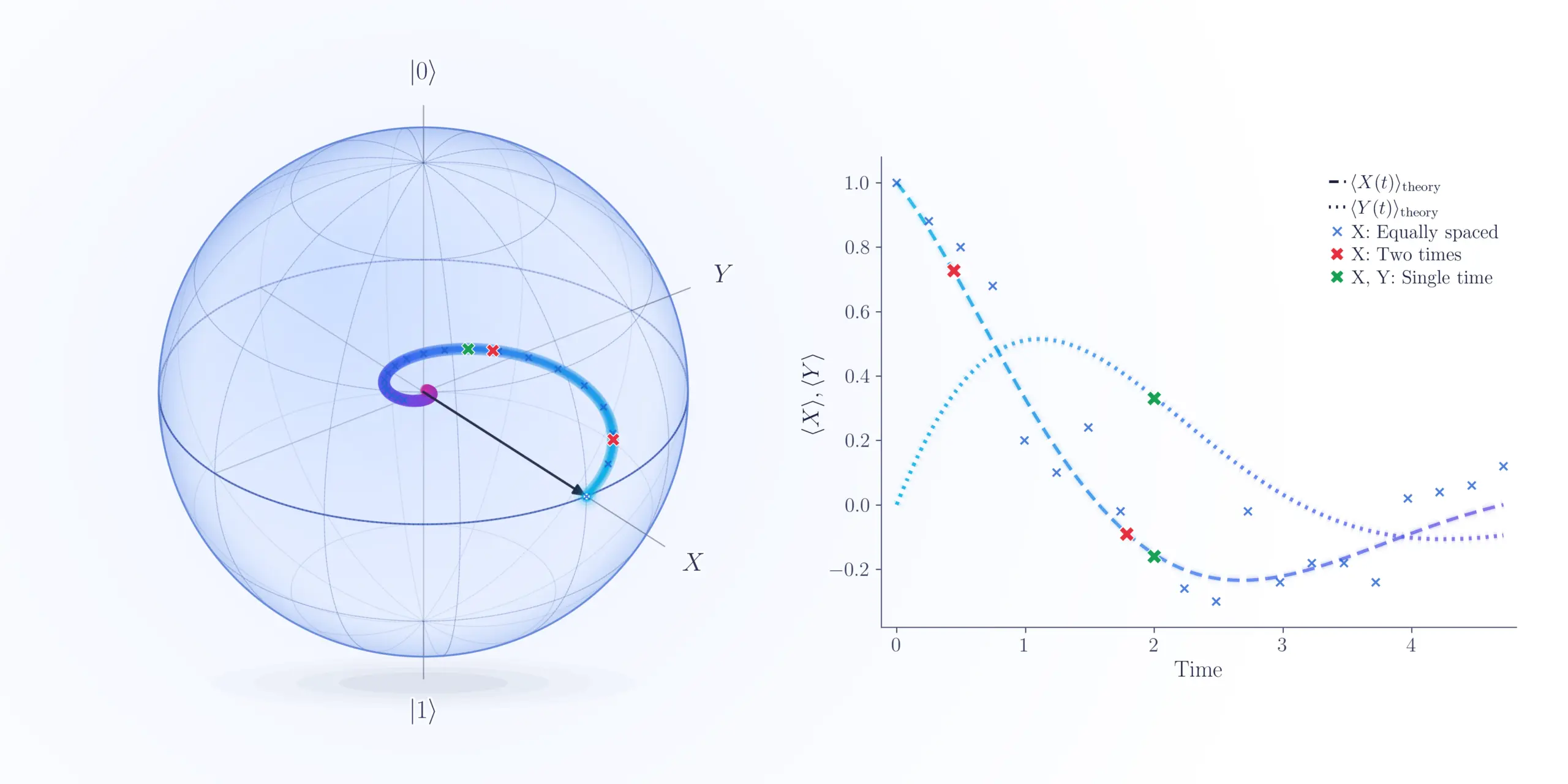
David Shnaiderov and colleagues at Bar-Ilan University demonstrated a calibration method that reduces the time needed to prepare quantum processors for computation. The work reports a 50% reduction in calibration time while maintaining estimation accuracy, which is important for scaling up quantum computing hardware. Researchers achieved this by optimizing Ramsey interference experiments and discovering that measuring two quadratures simultaneously yields higher precision than traditional methods of measuring a single quadrature over multiple times. This approach was experimentally validated using both a single NV center and superconducting transmon qubits, suggesting broad applicability across different qubit technologies.
Ramsey Experiments Optimize Qubit Detuning Calibration
Calibration routines for quantum processors benefit from a newly detailed method that prioritizes efficiency without sacrificing accuracy. The work demonstrates that measuring two quadratures of a qubit simultaneously provides greater precision and robustness than traditional methods relying on sequential single-quadrature measurements, even when the total measurement count remains constant. The optimization centers on Ramsey interference experiments, a standard technique for determining qubit detuning, the difference between a qubit’s actual frequency and the frequency of the control signal applied to it.
By applying Fisher information and the Cramér-Rao bound, the researchers derived strategies for estimating both detuning and crosstalk parameters, the unwanted interactions between qubits that complicate calibration. This approach yields the highest precision and robustness in both cases of isolated and coupled qubits.
This approach allows for a more complete characterization of the qubit’s state with fewer measurements, directly addressing a key bottleneck in scaling quantum processors. The method enables accurate parameter extraction with significantly fewer measurements, resulting in up to a 50% reduction in calibration time while maintaining estimation accuracy. This is particularly important as quantum processors increase in size, as the calibration process scales rapidly with the number of qubits.
Experimental validation confirmed the theoretical predictions, using both a single nitrogen-vacancy (NV) center in diamond and superconducting transmon qubits. This versatility demonstrates the broad applicability of the calibration method, suggesting it is not limited to a specific qubit technology. “To maintain reliable operation, quantum computers must therefore be calibrated frequently,” the researchers write, highlighting the ongoing need for improved calibration techniques. By reducing the resources required for calibration, this approach offers a practical way to make quantum computers more efficient, helping future quantum processors spend less time being calibrated and more time performing computations.
Fisher Information and the Cramér-Rao Bound Guide Calibration Strategies
The application of Fisher information and the Cramér-Rao bound allowed for a refined approach to calibration protocols, specifically comparing single and simultaneous quadrature measurements. This improvement stems from a more efficient extraction of information about qubit parameters, directly impacting the speed and reliability of quantum computations. The work demonstrates a practical reduction in calibration demands, achieving approximately 50% fewer measurements needed to maintain equivalent accuracy, and even greater improvements in crosstalk assessments.
This efficiency gain is not merely about saving time. It addresses a critical bottleneck in scaling quantum processors, as calibration overhead increases significantly with qubit count. By minimizing the resources dedicated to calibration, the method frees up valuable processor time for actual computations, accelerating the path toward more complex quantum algorithms. The researchers’ findings highlight that the choice of measurement strategy profoundly influences calibration performance, and that optimizing this choice is essential for practical quantum computing.
Experimental validation across distinct qubit technologies, diamond-based systems and superconducting qubits, highlights the versatility of this calibration method. This broad applicability suggests the underlying principles are not specific to a particular hardware platform, but rather represent a fundamental optimization applicable to diverse quantum systems. The theoretical foundation also draws upon the work of Clerk et al. on quantum noise and measurement, and Mullan and Knill’s work on optimizing passive quantum clocks.
These concepts enabled the researchers to pinpoint the most informative measurements for accurate qubit characterization. The researchers’ approach to calibration is rooted in the principles of statistical estimation, specifically using the Cramér-Rao bound to determine the minimum achievable variance in parameter estimation.
By maximizing Fisher information, a measure of the amount of information a measurement provides about an unknown parameter, they identified the optimal measurement strategies for qubit detuning and crosstalk. This theoretical framework provides a rigorous foundation for the observed experimental improvements, demonstrating that the observed gains are not merely empirical but are grounded in fundamental principles of quantum information theory.


See today’s quantum computing news on Quantum Zeitgeist for the latest breakthroughs in qubits, hardware, algorithms, and industry deals.