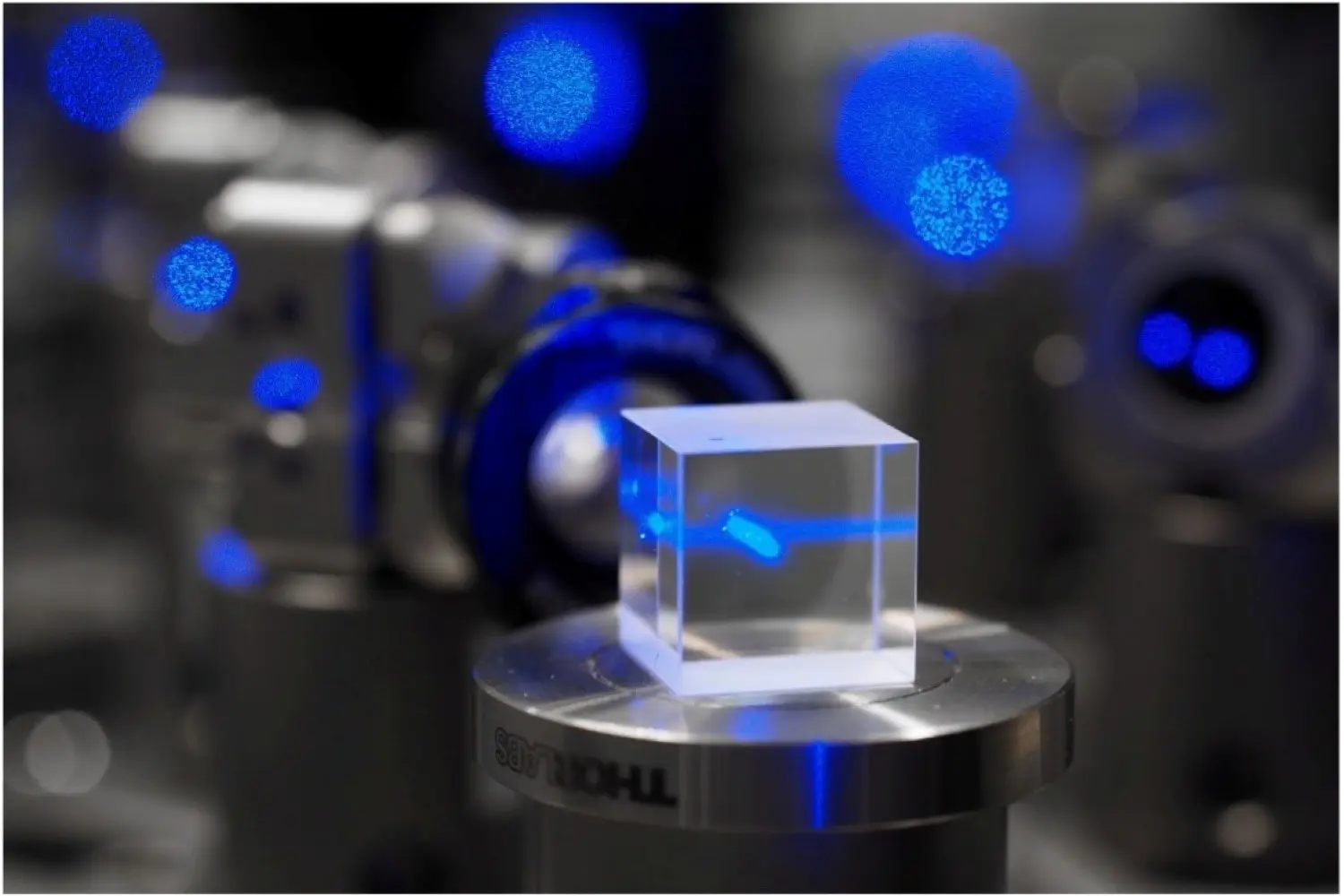
The UK’s first large-scale atom interferometer is planned following results that mark a step towards building larger quantum sensors. Researchers have, for the first time under realistic conditions, shown that comparing two atom interferometers along a common baseline can effectively cancel experimental noise, recovering signals even when individual measurements are overwhelmed. This breakthrough, detailed in a study published in Nature, underpins the Atom Interferometer Observatory and Network (AION) collaboration, funded through UKRI’s Quantum Technologies for Fundamental Physics scheme. AION aims to expand our understanding of the universe by searching for ultralight dark matter and detecting gravitational waves in a frequency range not currently covered by existing observatories; a 10-metre baseline detector, AION-10, is planned for the Beecroft building at the University of Oxford.
Differential Atom Interferometry Cancels Noise in Quantum Sensing
A noise cancellation technique promises to unlock the full potential of atom interferometry for detecting elusive phenomena like dark matter and gravitational waves. Researchers have demonstrated, for the first time, that comparing two atom interferometers along a common baseline can effectively cancel experimental noise, a critical step towards building larger, more sensitive quantum sensors. The study, appearing in Nature, addresses a long-standing challenge in the field; conventional atom interferometers are susceptible to noise from the lasers used to manipulate atoms, often obscuring the faint signals researchers seek. They deliberately introduced substantial phase noise into the system, mirroring the conditions anticipated in detectors with extended baselines, and found that individual interferometers became unusable. However, by comparing the two, a discernible signal remained, operating at the fundamental limit set by quantum physics.
This differential approach allows for signal recovery even when individual measurements are overwhelmed, according to the published findings. The researchers further validated the technique by introducing an oscillating signal, simulating a gravitational wave or dark matter field, which remained clearly detectable despite the simulated noise. “This work marks an important milestone towards future large scale quantum sensors for fundamental physics,” said Professor Oliver Buchmueller, Principal Investigator of the AION collaboration at Imperial.
This work marks an important milestone towards future large scale quantum sensors for fundamental physics. It demonstrates, under realistic experimental conditions, a key technique relevant for next generation atom interferometer facilities currently under development internationally, including MAGIS at Fermilab and the proposed AICE facility at CERN.
Professor Oliver Buchmueller, Principal Investigator of the AION collaboration at Imperial
Strontium-87 Laser Cooling for AION’s Ultracold Atom Source
The pursuit of elusive dark matter and low-frequency gravitational waves driving the AION project relies heavily on manipulating atoms to unprecedented levels of cold, achieved through a sophisticated process involving strontium-87. Researchers at RAL Space are dedicated to engineering this critical component. Strontium, a solid at room temperature, begins its transformation into a usable atom source by being heated to between 400 and 500 degrees Celsius, creating a gaseous vapor primed for manipulation. This vapor then undergoes a two-stage laser cooling process, initially utilizing blue light and subsequently red light, to dramatically reduce the atoms’ velocity. This carefully controlled deceleration allows the atoms to be trapped within an ultrahigh vacuum chamber, isolating them from external disturbances. The precision required is substantial; the goal is to create a cloud of strontium-87 atoms exhibiting minimal thermal motion, enabling the delicate measurements at the heart of AION’s design.
The STFC Particle Physics department further refines this environment by meticulously modelling and implementing a magnetic guide field and shielding around the vacuum tube. This shielding is essential to protect the atoms from any external interference as they traverse the instrument, ensuring the integrity of the quantum measurements. The entire process, from initial heating to final trapping, represents a significant engineering challenge, demanding precise control over laser frequencies, vacuum levels, and magnetic fields. “Together, these contributions represent a cross-departmental approach from STFC to help realise the prototype of the interferometer based on the AION-10 work,” highlighting the collaborative effort required to build this advanced quantum sensor.
AION Prototype Validates Dark Matter & Gravitational Wave Search
Researchers from a UK collaboration have demonstrated a critical advancement in the development of AION, the Atom Interferometer Observatory and Network, successfully validating a technique for cancelling noise in large-scale quantum sensors. This approach, detailed in a recent Nature publication, addresses a significant hurdle in detecting faint signals obscured by experimental noise; the laser used to control the experiment typically generates phase noise exceeding the signals researchers seek. The Science and Technology Facilities Council (STFC) plays a multifaceted role in AION, extending beyond financial support to encompass engineering and design contributions. STFC’s Technology Department is responsible for the design and analysis of the main tower supporting the instrument, while RAL Space’s Quantum Sensors group is optimizing the ultracold strontium atom source.
Source: https://www.ukri.org/news/quantum-experiment-opens-gravitational-waves-and-dark-matter-search/


See today’s quantum computing news on Quantum Zeitgeist for the latest breakthroughs in qubits, hardware, algorithms, and industry deals.