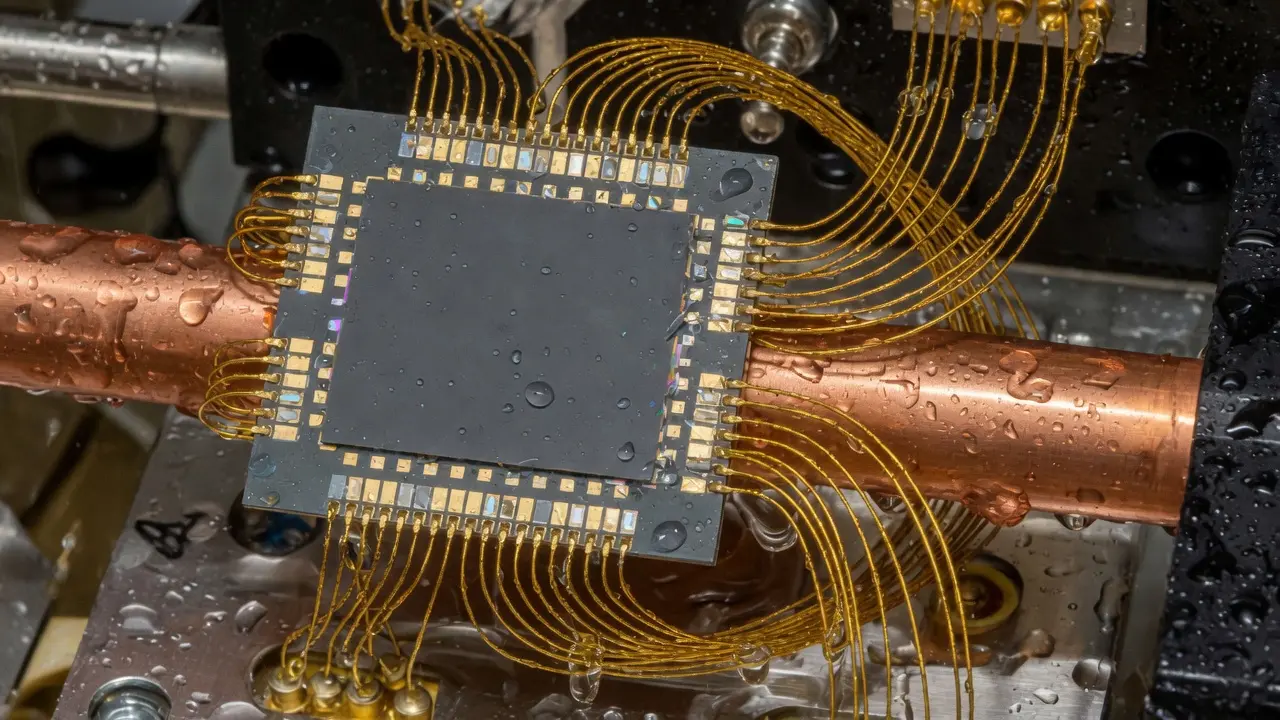
Altera Corporation, in collaboration with OQC and NVIDIA, has developed a full quantum processing unit (QPU)-to-GPU reference design using an Agilex 9 Direct RF FPGA. This design addresses the increasing density challenges in quantum computing by integrating analog-to-digital and digital-to-analog converters directly into the FPGA, eliminating external RF components. Farhad Shafai, Head of Business Solutions & Marketing at Altera, stated that the companies will showcase the system at Supercomputing 2026 in Chicago.
Agilex 9 Direct RF FPGA Enables Low-Latency QPU Control
The new reference design uses frequency multiplexing to share a single radio frequency port, reducing the need for additional RF hardware as quantum systems scale in complexity. This approach addresses the increasing density challenges inherent in building larger quantum computers by minimizing the footprint of control electronics. The integrated converters streamline signal processing and contribute to a more compact overall design.
NVQLink connects the FPGA to GPUs, which take on processing-heavy tasks such as calibration and machine learning-based readout classification, while the FPGA manages real-time qubit control and resonator readout. “Advances in AI are opening new ways to build and operate quantum computers,” said Sam Stanwyck, Director of Quantum Product, adding that “NVQLink gives quantum builders an open architecture to put those advances to work.” The reference design also includes CUDA functions that drive the FPGA logic for QPU system functions, which improves the connection between the two processing platforms. The system’s architecture runs real-time qubit control, resonator readout and spectroscopy within the FPGA itself, with synchronized scheduling across all functions.
This real-time processing capability is critical for achieving the low latency required for precise quantum control, OQC says. “Precise control and fast feedback are essential to unlocking the capabilities of our quantum processors,” explained Simon Phillips, CPO at OQC.
“Altera’s FPGA technology provides a programmable, low-latency connection to our QPU, bringing control and readout together while allowing us to refine calibration and feedback as our systems evolve.” The integration simplifies development and provides a scalable path for supporting an increasing number of qubits. Developers can also use a built-in emulation path within the reference design to test algorithms and validate the controller before deploying it with physical qubit hardware.
This feature accelerates the development process and allows for earlier identification and resolution of potential issues. “This demonstration shows how Altera’s Direct RF technology can anchor the control layer of quantum systems, and it gives developers a clear path to build on.” The full system reference design will be demonstrated at Supercomputing 2026 (SC26) in Chicago, and the Agilex 9 Direct RF quantum system controller reference design with NVQLink is expected to be released in January 2027.
Our work with OQC and NVIDIA uses FPGAs to demonstrate a full system reference design in a real-world setting, from the quantum processor through the FPGA to the GPU.
Farhad Shafai, Head of Business Solutions & Marketing at Altera


See today’s quantum computing news on Quantum Zeitgeist for the latest breakthroughs in qubits, hardware, algorithms, and industry deals.