Researchers led by Nicholas J. Sorensen and Paul E. Barclay have, for the first time, demonstrated singlet-absorption magnetometry using spin-dense diamond nanocavities, overcoming limitations of conventional absorption-based sensors. By probing cavity modes at 1042 nm, the wavelength of light corresponding to the NV singlet transition, the team observed spin-dependent cavity transmission and enhanced magnetic field sensing. The work establishes cavity-enhanced singlet absorption as a scalable readout mechanism for integrated diamond quantum sensors and delivers a practical framework for engineering nanophotonic diamond quantum magnetometers.
Diamond NV Centers for High-Resolution Quantum Sensing
A magnetic field sensitivity of 253 (9) nT was achieved using a novel diamond nanocavity, representing the first demonstration of a nanophotonic singlet-absorption magnetometer. Researchers, led by Paul E. This approach addresses a key challenge in scaling diamond quantum sensors for practical applications, where efficient spin readout is often difficult to integrate.
This cavity-enhanced sensing not only improves sensitivity but also allows for miniaturization and increased robustness of the quantum magnetometer. The work demonstrates a drift-limited minimum measurable field of 12.8 (4) nT, a significant step towards high-resolution magnetic field mapping at the nanoscale. The researchers also developed and experimentally validated a model that accurately predicts the spin-dependent cavity response, providing a framework for optimizing operating conditions.
While increasing input power typically improves sensitivity in these systems, the study revealed a critical limitation. High infrared intensities within the nanoscale cavities can induce ionization from the ^3E state, potentially degrading performance. “Optimizing sensitivity therefore requires careful engineering of the optical environment to simultaneously maximize C and while minimizing charge state conversion (CSC),” the researchers note in their report.
This finding highlights the need for precise control over the optical environment to balance sensitivity gains with potential charge state instability. The sensing volume, or the volume of diamond contributing to absorption, directly impacts sensitivity, scaling with the inverse square root of that volume.
Singlet-Absorption Magnetometry: An Alternative Readout Modality
The advantage stems from the intrinsic properties of the readout mechanisms, not simply improved light gathering, and is further bolstered by the feasibility of efficient light collection in singlet-absorption schemes. The team’s model accurately predicts measured cavity transmission and ODMR response, revealing a complex interplay between optical and microwave power, cavity enhancement and cavity stability when optimizing sensor performance. This model goes beyond simply demonstrating improved sensitivity. It identifies the practical limitations of different optically detected magnetic resonance modalities, offering a framework for engineering future nanophotonic diamond quantum magnetometers.
Fibre delivery systems eliminate the need for complex free-space optics and enable operation at lower laser power levels, simplifying sensor integration and reducing energy consumption. This approach allows for the realization of chip-based sensors that miniaturize previous demonstrations of optically detected magnetic resonance, which relied on single-pass and cavity-enhanced singlet-absorption in larger diamond samples.
Cavity-Enhanced Interaction for Improved Spin Contrast
Spin-dense diamond nanocavities enabled, for the first time, singlet-absorption magnetometry, a technique overcoming limitations imposed by short optical interaction lengths in conventional absorption-based sensors. This model incorporates spin dynamics, singlet absorption and infrared-induced charge-state conversion, allowing for a detailed understanding of the sensor’s performance characteristics. Beyond increasing the effective interaction length, cavity integration offers additional benefits, including suppression of probe interaction with NVs outside the sensing volume and reduced laser power requirements. “We collect roughly 1000 times more light than traditional triplet-PL-based measurements,” highlighting the significant improvement in readout efficiency achieved through this method.
Modeling Spin-Dependent Cavity Transmission Response
A master-equation model accurately predicts the spin-dependent response within diamond nanocavities, detailing optimal operating conditions for nanoscale singlet-absorption magnetometers. This predictive capability provides a roadmap for future optimization of these sensors, addressing a key challenge in efficient integration of quantum sensing technology. The model combines spin dynamics, singlet absorption and the complex interplay of light within the cavity structure, allowing for precise control and maximized sensitivity.
Changes in absorption directly modify the cavity loss rate, impacting both the resonance linewidth and the resulting transmission of light through the diamond sample, a principle central to the sensor’s operation. Specifically, the model accounts for multiple loss mechanisms including surface scattering, radiation loss, non-NV absorption, external coupling to a waveguide and absorption by the nitrogen-vacancy (NV) centres themselves.
This comprehensive approach allows researchers to predict how spin-dependent alterations in absorption affect the cavity linewidth and, consequently, the observed transmission signal at varying laser detunings. The quality factor of the cavity, measured at 7.6 (2) × , and resonant frequency of 288.04 THz (1040.8 nm wavelength) are key parameters incorporated into the model.
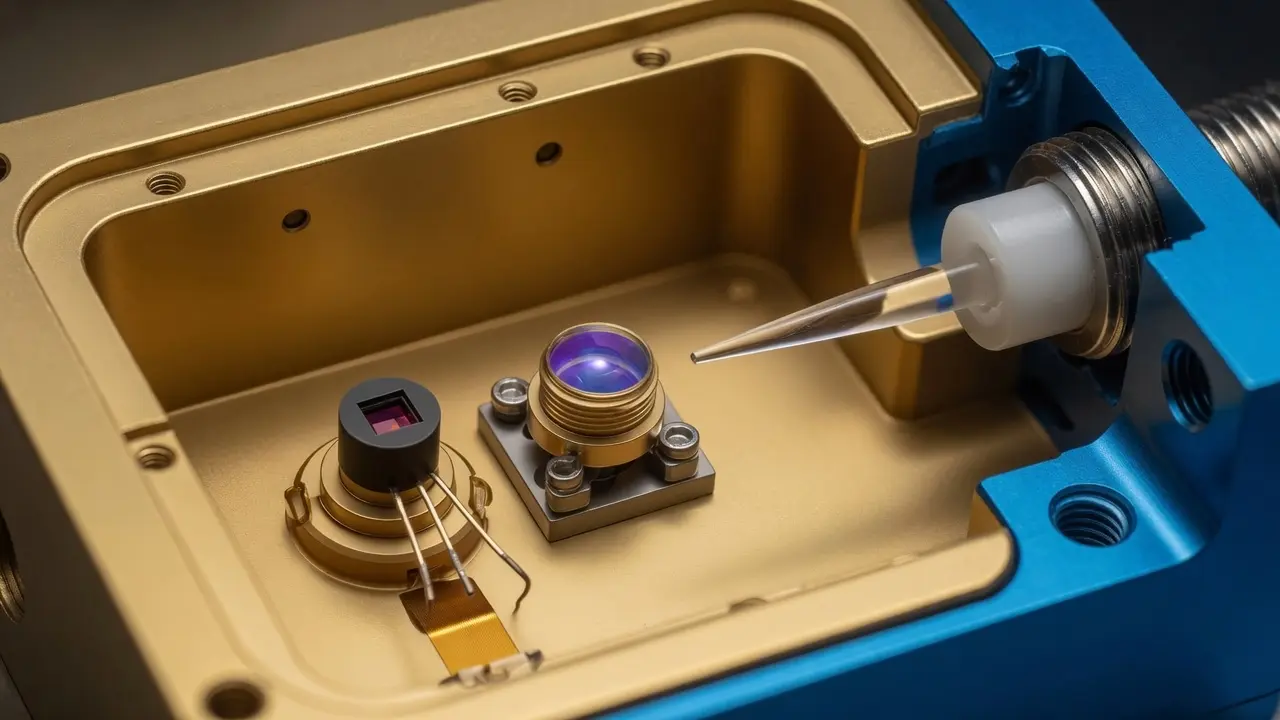
Optical spectroscopy of the cavity, performed while manipulating the spin state of embedded NVs, forms the basis of the readout process. Infrared laser light is coupled into the cavity via a fibre-taper. The resulting transmission spectrum is recorded, with the probe laser chosen for its proximity to the singlet zero-phonon line.
The NV ensemble is optically pumped using a 532 nm laser, and a microwave field modulates the spin state, influencing the singlet population and modulating the level of cavity absorption. “We use the Allan deviation of the time signal to determine the stability of the sensor, and, as demonstrated by the dependence, the sensor is dominated by white noise at short time scales,” the researchers report.
Despite achieving a maximum spin-dependent transmission contrast of 3.6 × for a single NV orientation, the model accurately captures experimental data across a two-dimensional parameter space. Vertical and horizontal line cuts comparing measured and predicted transmission changes and ODMR spectra demonstrate excellent agreement with the model’s predictions, validating its ability to simulate the sensor’s behaviour. The full cavity model integrates an NV absorption model with coupled-mode theory to predict the spin-dependent transmission of a non-ideal cavity.
Sensitivity Gains with Singlet-Absorption ODMR
The demonstrated minimum measurable magnetic field reached 12.8 (4) nT, a result enabled by the use of diamond nanocavities to enhance singlet-absorption ODMR, and represents the first demonstration of a nanophotonic magnetometer using this approach. The work details how singlet absorption is transduced into an ODMR signal, allowing for prediction of magnetic sensitivity in both single-pass and cavity geometries, and establishes a framework for optimizing future designs.
The researchers also characterized long-term stability using the Allan deviation of the magnetic time trace, identifying an inflection point at approximately 30 seconds that indicates drift-limited performance. This drift is primarily attributed to fluctuations in laser power and cavity temperature, suggesting that active stabilization of these parameters could further improve the sensor’s performance.
Nanocavity Integration for Scalable Diamond Quantum Sensors
Cavity integration addresses a fundamental limitation of compact absorption-based sensors, where short optical interaction lengths previously restricted sensitivity, and allows for a predicted improvement in sensitivity when the cavity reaches absorption-limited operation. The experimental setup employed monolithic wavelength-scale diamond microdisk cavities to realize singlet-absorption magnetometry, a departure from earlier demonstrations that relied on single-pass or cavity-enhanced techniques using macroscopic diamond samples. This specific wavelength selection is critical, as it directly excites the singlet transition, enabling the observation of the spin-dependent optical response within the nanocavity.
👉 More information
🗞 Infrared-absorption magnetometry in a diamond nanocavity: demonstration and limits at the nanoscale
✍️ Nicholas J. Sorensen et al.
🧠 ArXiv: https://arxiv.org/abs/2611.33481



See today’s quantum computing news on Quantum Zeitgeist for the latest breakthroughs in qubits, hardware, algorithms, and industry deals.