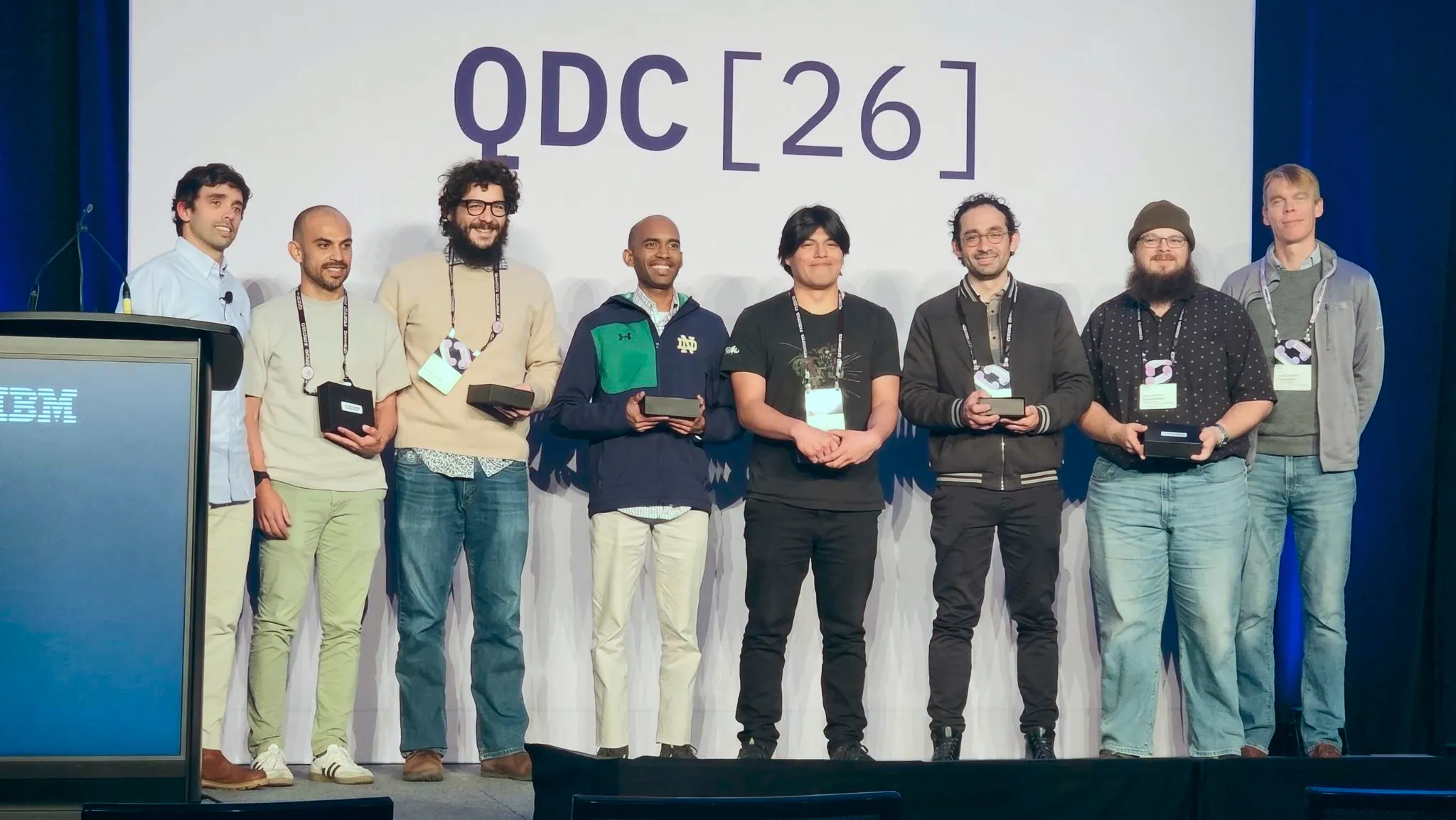
Team Qumbia secured first place in Track B of the IBM Quantum Developer Conference 2026 (QDC 2026) developer challenge, marking a third consecutive win for Daniel Sierra-Sosa and Alejandro Montañez-Barrera. The team tackled four utility-scale problems, including estimating a demanding 56-qubit Operator Loschmidt Echo, by using Q-CTRL’s Fire Opal Performance Management function within the Qiskit toolkit.
Team Qumbia’s Three-Year QDC Win with Fire Opal
The team’s success hinged on their ability to rapidly iterate on algorithm design, a feat enabled by automating noise suppression with Fire Opal. Scaling these quantum dynamics simulations presents a significant hurdle, as hardware noise and gate errors often obscure the underlying physics before a meaningful result can be obtained. Team Qumbia bypassed extensive manual profiling and hand-tuning of error mitigation pipelines by integrating Fire Opal into their workflow.
The tool, accessible as an IBM Quantum Function within Qiskit, automates hardware-aware compilation and deterministic error suppression without requiring configuration. This automation freed up valuable time for the team to focus on the physics and algorithms driving their solution. “Under a tight challenge clock, you can’t afford to fight hardware noise by hand,” said Daniel Sierra-Sosa, Assistant Professor at The Catholic University of America. The team’s approach highlights a shift toward infrastructure-level error suppression as essential for practical quantum computing.
The challenge also included tasks focused on preparing thermal states of frustrated quantum spin systems, solving constrained quantum approximate multi-objective optimization problems, and realizing error suppression in partially fault-tolerant quantum simulations using the Iceberg code, IBM says. Each task demanded increasingly complex circuits on IBM’s quantum computers, pushing the boundaries of what’s achievable with current hardware, according to the company. By offloading noise suppression to Fire Opal, Team Qumbia could execute the 56-qubit OLE benchmark with high fidelity on the first attempt, accelerating their iterative design process.
Q-CTRL’s technology has also seen broader adoption within the IBM Quantum ecosystem, with the company reporting that its clients and partners have run over 34 billion circuits on IBM Nighthawk r2. This speedup highlights the potential of automated error suppression to unlock more efficient quantum simulations. Researchers in materials science, chemistry, and condensed matter physics can now access Dynamics Simulator, Q-CTRL’s latest addition to IBM Quantum Functions.
This tool further streamlines the simulation process by automating circuit design, hardware mapping and error suppression, allowing users to focus solely on defining the underlying physics of their problem. IBM Quantum Premium and Flex Plan users can access Fire Opal’s automated error suppression through Q-CTRL’s Performance Management, Dynamics Simulator, and Optimization Solver in the IBM Quantum Functions catalog. The team’s consistent success at QDC, coupled with the growing adoption of Q-CTRL’s tools, suggests that deterministic error suppression is becoming a critical component of the quantum computing landscape., the company says.
Source: https://q-ctrl.com/blog/how-team-qumbia-won-the-developer-challenge-at-ibm-qdc-2026-with-fire-opal




See today’s quantum computing news on Quantum Zeitgeist for the latest breakthroughs in qubits, hardware, algorithms, and industry deals.