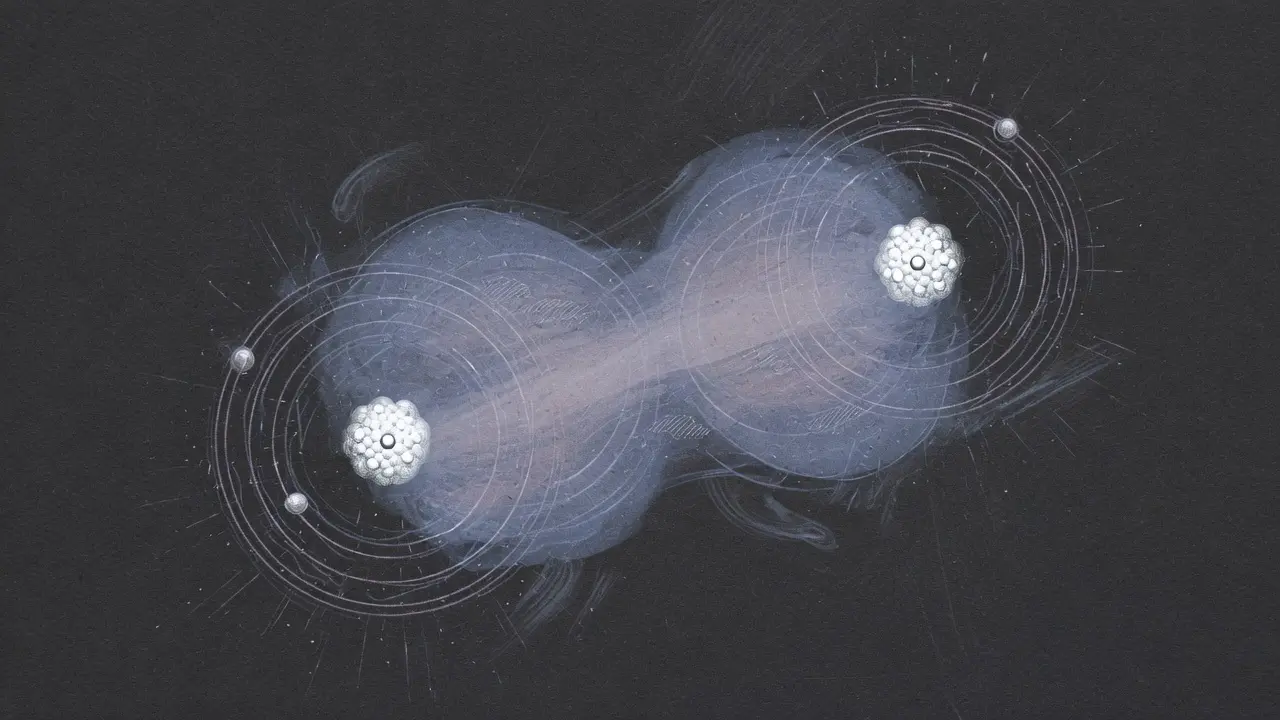
Netta Engelhardt and Ivri Nagar of the Massachusetts Institute of Technology have proven a singularity theorem for evaporating black holes without relying on previously standard assumptions about spacetime. Their work establishes that standard models of these shrinking objects are meaning light-like particles’ trajectories break down as the spacetime itself collapses.
This confirms a singularity forms at the end of evaporation, offering new insight into the breakdown of physics at the heart of black holes. The researchers replaced traditional energy condition requirements with the Generalized Second Law, which dictates that “the generalized entropy increases monotonically in time.”
Generalized Second Law Defines Singularity in Evaporating Black Holes
The new theorem definitively establishes that evaporating black holes are meaning light paths within these shrinking objects terminate at a singularity where spacetime breaks down, a confirmation of the inevitable formation of such a point at the end of evaporation. This finding addresses a gap in existing literature; to the researchers’ knowledge, no previous result guaranteed incomplete geodesics in standard models of evaporating black holes.
Specifically, they bypassed the need for global hyperbolicity and the null energy/curvature condition. This law, expressed mathematically as ρₐ for any sufficiently well-behaved codimension-one achronal set a, replaces traditional energy condition requirements, representing a fundamental shift in how physicists prove the inevitability of singularities. The researchers combined methods developed by Andrea Wall and Wojciech Minguzzi, focusing on matter and causality respectively, to create a quantum singularity theorem specifically designed for evaporating black holes.
This combination allowed for a proof tailored to the dynamic environment of a shrinking black hole, a significant departure from previous static analyses. To prove the theorem, three conditions had to be met: stable causality, past reflectivity and spatial openness, alongside the Generalized Second Law acting along generators reaching the causal horizon.
This emphasis on the causal horizon, rather than demanding global properties of spacetime, is critical to the theorem’s relevance to the constantly changing conditions surrounding an evaporating black hole. The work provides a new tool for investigating the ultimate fate of black holes and the limits of classical gravity, offering a path to understanding the strong quantum gravity regime.
Minguzzi’s Theorem & Generator Analysis Resolve Spacetime Focusing
The new theorem sidesteps a longstanding challenge in singularity proofs, demonstrating the focusing of light-like paths without assuming a complete understanding of spacetime’s overall structure. Previous theorems relied on generator locality within the null energy condition to guarantee this focusing, a requirement now bypassed through the application of Minguzzi’s theorem. This allows for analysis of scenarios, such as those found in evaporating black holes, where global hyperbolicity, a condition ensuring spacetime predictability, does not hold.
Wall’s work focuses on appropriate treatment of matter, while Minguzzi’s concentrates on causal structure. Their integration allows for a quantum singularity theorem applicable to evaporation. The Generalized Second Law, central to the proof, specifically applies to these generators, as it must hold along them to validate the theorem.
The theorem operates within a spacetime described as “stably causal” with a future asymptotic boundary, a mathematical framework enabling rigorous analysis of causal relationships and light propagation. The team’s work, while not directly resolving the information paradox, offers a promising avenue for exploring the strong quantum gravity regime by understanding how singularity physics manifests in the final stages of evaporation, and “pushes it forward in time.”
Stable Causality and Reflectivity Bypass Global Hyperbolicity
The new theorem’s applicability extends beyond static black holes to those actively evaporating, a feat achieved by abandoning the long-held requirement of global hyperbolicity. This approach sidesteps limitations inherent in previous proofs, which relied on assumptions about the overall structure of spacetime, and focuses instead on local properties near the causal horizon. The theorem’s structure allows for the construction of a future inextendible causal curve that violates expected behavior, definitively confirming a singularity. The authors explain that this process “pushes it forward in time,” revealing the incompleteness of spacetime.
This is particularly relevant to evaporating black holes, where the dynamic environment and changing topology present challenges to traditional singularity theorems, and where gradients weighted by the inverse of the gravitational constant can compete with area gradients. The ability to incorporate these competing gradients, previously difficult to address, is a key innovation of the new proof.
Quantum Trapped Surfaces Establish Initial Data for Proof
The new theorem from Engelhardt and Nagar at the Massachusetts Institute of Technology hinges on the existence of a “robustly quantum trapped surface” within an open timeslice, a specific geometric configuration not previously required for proving singularity formation. This surface, defined by its ability to trap quantum fields, is an important initial data point for the singularity proof, moving beyond reliance on classical curvature conditions.
The researchers demonstrated that establishing this surface, alongside stable causality and past reflectivity, is sufficient to guarantee singularity formation even as the black hole evaporates. The team’s analysis reveals that a deformation of a surface will lead to a contradiction if it is not entropy normal at a point on the edge, ultimately confirming the singularity.
The significance of this work extends beyond simply confirming singularity formation. “While the presence of curvature singularities is not central to the information paradox, understanding the final state of an evaporating black hole and how it encodes singularity physics offers a promising path toward exploring,” the researchers state. The proof relies on demonstrating that a stably entropy-anomalous region, combined with a proper future-directed outward null deformation, leads to a contradiction if entropy normality is not maintained at a specific edge point, a subtle interplay of entropy and hypersurface topology.

See today’s quantum computing news on Quantum Zeitgeist for the latest breakthroughs in qubits, hardware, algorithms, and industry deals.