
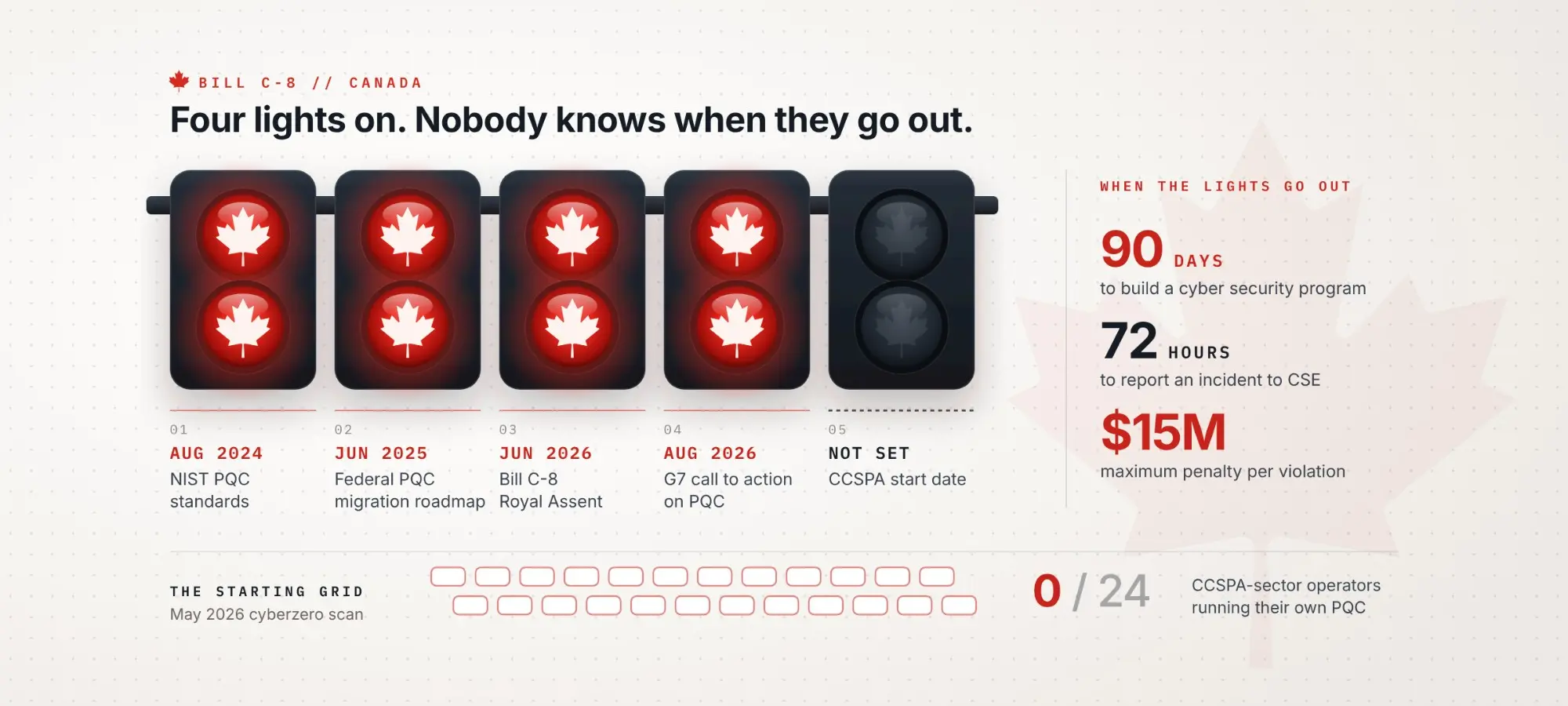
A single violation of Canada’s new Critical Cyber Systems Protection Act could cost organizations up to $15 million, yet the legislation remains technically paused as of November 16, 2026. Bill C-8, which received Royal Assent on June 15, 2026, established a 90-day deadline to establish a cybersecurity program once triggered by an order from the Governor in Council. Despite post-quantum standards being published on August 13, 2024, the Canadian government has not activated enforcement, leaving many firms operating under a potentially false sense of security and treating preparedness as a priority.
Bill C-8: CCSPA’s 90-Day Program Mandate for Critical Infrastructure
The Canadian Critical Cyber Systems Protection Act, enshrined in law June 15, 2026, currently lacks a formal activation date, despite establishing a 90-day window for critical infrastructure operators to establish cybersecurity programs. Cyberzero, an Ottawa-based cybersecurity firm, is tracking these steps weekly and will update its Canada quantum deadlines page when the start date is published. Section 9 of Bill C-8 requires a cybersecurity program that identifies and manages risk across systems and supply chains, a task complicated by the need to first locate existing cryptographic elements.
The impending deadline is particularly challenging given the timeframe is measured from the date of an order “fixed by order of the Governor in Council,” a process that introduces uncertainty. Cyberzero notes that 90 days sounds generous, but it is not if day one starts with a search.
This emphasis on proactive planning, rather than waiting for relaxed regulations, emphasises the urgency for organizations to begin assessing their cryptographic posture immediately, even before official notification of the enforcement date. The company’s mission is to help defend Canada’s national security and critical infrastructure, and Quantanaut is its tool for doing so.
NIST FIPS 203/204/205 Standards Trigger CCSPA Compliance Deadlines
The publication of NIST Federal Information Processing Standards FIPS 203, 204, and 205 on August 13, 2024, now underpins potential compliance deadlines within Canada’s recently enacted Bill C-8, despite the Act remaining officially “not in force” as of November 16, 2026. This discrepancy between published standards and governmental activation is leading some organizations to misinterpret their immediate obligations, potentially delaying preparation work.
The firm’s analysis suggests that many Canadian critical infrastructure operators will spend the initial portion of that timeframe simply locating and cataloging the cryptographic assets within their systems and those of their vendors. Cyberzero explains that the remaining steps, issuing a coming-into-force order, setting reporting windows and designating operator classes, must occur before the 90-day countdown begins, adding further pressure to organizations already facing a complex migration to post-quantum cryptography.
Cyberzero’s Findings: Zero Post-Quantum Readiness in Key Sectors
Across four key sectors, banking, telecommunications, energy and transportation, no Canadian critical infrastructure operators have deployed post-quantum hybrid key exchange, according to an analysis by Cyberzero. While five such exchanges exist within these sectors, all originate from content delivery networks rather than the operators themselves, revealing a significant gap in proactive security measures. This lack of internal deployment extends beyond the front door, as control systems, vendor products, and internal links remain vulnerable to future quantum attacks.
The firm’s analysis further identifies two primary attack vectors amplified by the advent of quantum computing: Harvest Now, Decrypt Later (HNDL) and Trust Now, Forge Later (TNFL). HNDL attacks involve capturing encrypted traffic for decryption once quantum computers become powerful enough, while TNFL attacks focus on forging digital signatures trusted by systems.
To address this looming threat, Cyberzero proposes a five-question self-assessment for organizations, starting with determining whether they fall within the scope of Bill C-8 and identifying their most critical assets. If an organization cannot answer these questions, Cyberzero suggests that should be their immediate priority before any formal deadlines are set.
HNDL/TNFL Threats Demand Cryptographic Inventory and Risk Mitigation
The G7 Cybersecurity Working Group cautions that quantum computing’s potential to compromise authentication protocols presents a significant risk, enabling attackers to impersonate trusted entities within sectors like pipelines and payment networks. For these critical systems, Trust Now, Forge Later (TNFL) attacks pose a particularly acute danger; a forged firmware signature, unlike a data leak, constitutes a reportable incident with a 72-hour disclosure window. This accelerated timeline demands immediate attention to cryptographic vulnerabilities, extending beyond perimeter defenses to encompass control systems and internal network links.
Cyberzero’s assessment reveals a concerning trend. All currently identified post-quantum cryptographic deployments originate from content delivery networks, not the infrastructure operators themselves. This external reliance leaves deeper systems, including those governing essential functions, exposed to evolving threats. “HNDL-exposed systems” are prioritized by the Cyber Centre due to this immediate risk, highlighting the urgency of identifying and securing vulnerable assets.
Addressing these threats requires more than a simple inventory of cryptographic systems; organizations must pinpoint their “crown jewels”, the critical systems and the business services they support, and trace the cryptography protecting them. A key component is understanding key management practices, including who controls the keys, and whether those controls extend to vendor products. The firm emphasizes that if an organization cannot answer these questions, that is their first task before the start date is set.




See today’s quantum computing news on Quantum Zeitgeist for the latest breakthroughs in qubits, hardware, algorithms, and industry deals.