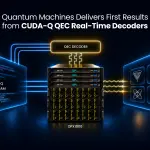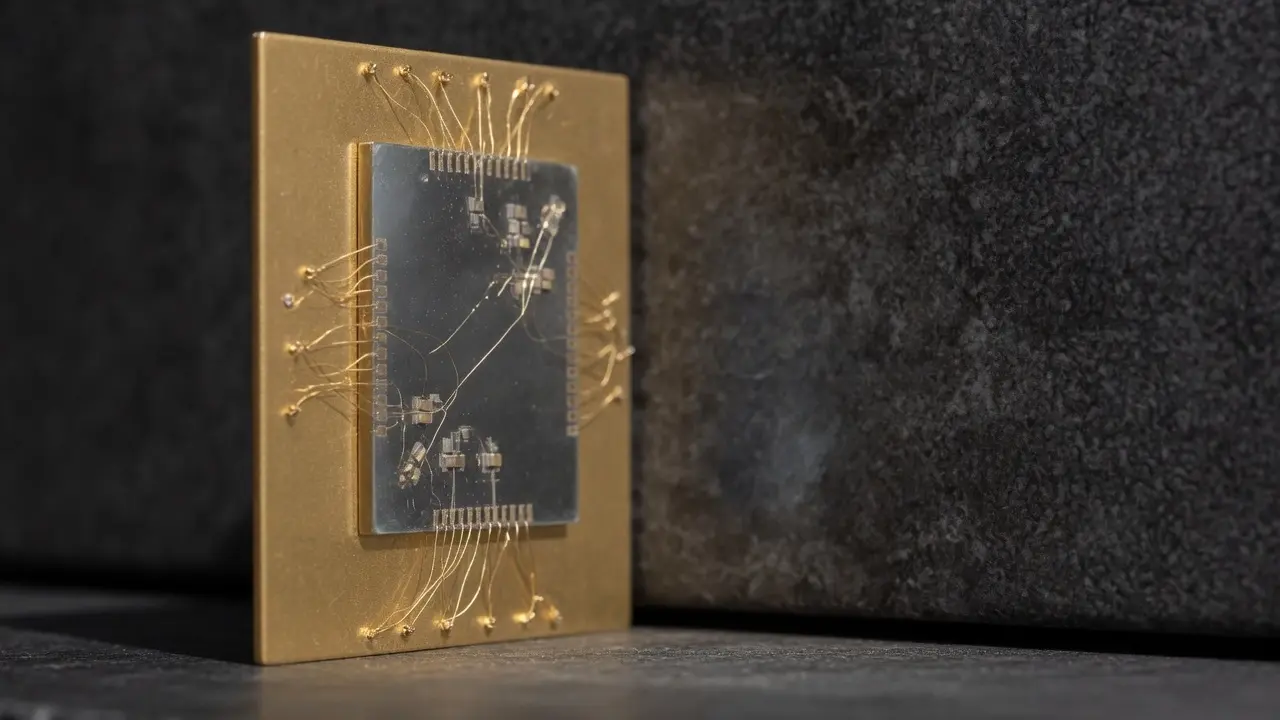
Anyon Computing has demonstrated a functional, real-time error decoding loop for superconducting quantum processors using NVIDIA’s NVQLink, a critical step toward building practical, fault-tolerant quantum computers, the company says. The system sent mid-circuit measurement results via a low-latency RDMA network to a host server, applying corrections in the subsequent round, processing that must occur within microseconds. Anyon plans to openly share its proof-of-concept control architecture with builders of quantum control systems to accelerate the development of million-qubit quantum supercomputing clusters with thousands of logical qubits, according to the company.
Real-Time Error Decoding Loop with NVIDIA NVQLink
This speed is essential; the system’s architecture is designed to operate on timescales measured in microseconds, a necessity for effective quantum error correction. Anyon Computing’s proof-of-concept control architecture integrates with existing supercomputing infrastructure through NVIDIA’s NVQLink and the CUDA-Q QEC library. Decoders from the CUDA-Q library were installed on real-time host servers and incorporated into the decoding loop, allowing for leakage handling, detecting and accounting for qubits that have lost their defined state, and compatibility with Slurm, a widely used supercomputer job scheduler.
The system treats the quantum processor as a resource, similar to GPUs, enabling efficient job allocation and controller preparation, according to NVIDIA. “Large-scale, fault-tolerant quantum computers will be built as clusters of interconnected quantum processors tightly coupled to GPU supercomputers, and their error correction will have to run in real time,” said Dr. Jie (Roger) Luo, cofounder and CEO of Anyon Computing.
This open approach is designed to provide developers with a starting point for constructing accelerated quantum computers, and supports programming with NVIDIA CUDA-Q, OpenQASM, or QIR. The team believes this collaborative approach is vital, as quantum error correction is advancing rapidly, and builders need systems that can evolve with the science, according to Stanwyck.
Large-scale, fault-tolerant quantum computers will be built as clusters of interconnected quantum processors tightly coupled to GPU supercomputers, and their error correction will have to run in real time.
Dr. Jie (Roger) Luo, cofounder and CEO of Anyon Computing
Anyon’s Control Architecture for Superconducting Quantum Processors
According to Dr. Anyon Computing intends to openly share this proof-of-concept control architecture, a move intended to accelerate development beyond its own labs. “With NVIDIA CUDA-Q and NVQLink, Anyon is demonstrating how new decoding algorithms can be deployed as software within a real-time quantum control loop,” said Sam Stanwyck, Director of Quantum Product at NVIDIA.
“Sharing that architecture openly gives more developers a starting point for building accelerated quantum supercomputers.” This collaborative strategy acknowledges the rapid pace of innovation in quantum error correction, recognizing that builders require adaptable systems capable of incorporating future advancements. The company believes that an open-source approach will encourage a broader ecosystem of developers and accelerate the realization of million-qubit quantum supercomputing clusters.
Quantum error correction is advancing rapidly, and builders need systems that can evolve with the science.
Sam Stanwyck, Director of Quantum Product at NVIDIA


See today’s quantum computing news on Quantum Zeitgeist for the latest breakthroughs in qubits, hardware, algorithms, and industry deals.